




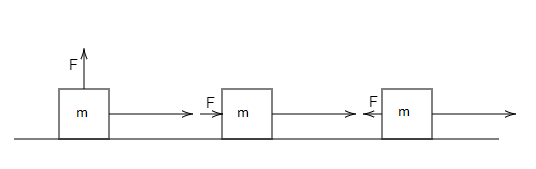
In each of the following a force, $F$ is acting on an object of mass $M$. The direction of displacement is from west to east shown by the longer arrow. Observe the diagram carefully and state whether the work done by the force is negative, positive or zero.
Answer
 Verified
579.3k+ views
Hint
The work done by the force can be determined by using the formula which shows the relation between the direction of the force and the direction of the motion of the object and the angle between the direction of motion and the force. By using this the solution can be determined.
The formula which shows the relation between the direction of the force and the direction of the motion of the object and the angle between the direction of motion and the force is given by,
$\Rightarrow W = FS\cos \theta $
Where, $W$ is the work done by the force on the object, $F$ is the force acting on the object, $S$ is the direction of the motion of the object and $\theta $ is the angle between the force and the direction of the motion of the object.
Complete step by step answer
Given that, The force is acting on the object is, $F$
The mass of the object is, $M$
The work done by the force is given by,
$\Rightarrow W = FS\cos \theta \,...................\left( 1 \right)$
1. For the first diagram,
The angle between the force and the direction of the motion of the object is, $\theta = {90^ \circ }$
By substituting the angle between the and the direction of the motion of the object in the equation (1), then
$\Rightarrow W = FS\cos {90^ \circ }$
From trigonometry, the value of the $\cos {90^ \circ } = 0$, by substituting this value in the above equation, then
$\Rightarrow W = FS \times 0$
By multiplying the terms, then
$\Rightarrow W = 0$
For the first condition, the work done by the force is zero.
2. For the second diagram,
The angle between the force and the direction of the motion of the object is, $\theta = {0^ \circ }$
By substituting the angle between the and the direction of the motion of the object in the equation (1), then
$\Rightarrow W = FS\cos {0^ \circ }$
From trigonometry, the value of the $\cos {0^ \circ } = 1$, by substituting this value in the above equation, then
$\Rightarrow W = FS \times 1$
By multiplying the terms, then
$\Rightarrow W = FS > 0$
For the second condition, the work done by the force is positive.
3. For the third diagram,
The angle between the force and the direction of the motion of the object is, $\theta = {180^ \circ }$
By substituting the angle between the and the direction of the motion of the object in the equation (1), then
$\Rightarrow W = FS\cos {180^ \circ }$
From trigonometry, the value of the $\cos {180^ \circ } = - 1$, by substituting this value in the above equation, then
$\Rightarrow W = FS \times - 1$
By multiplying the terms, then
$\therefore W = - FS$
For the third condition, the work done by the force is negative.
Note
From the above three conditions, it is well known that the work done by the force depends on the angle of the force which acts on the object when the application of the force and the direction of motion of the object is the same for all the three conditions.
The work done by the force can be determined by using the formula which shows the relation between the direction of the force and the direction of the motion of the object and the angle between the direction of motion and the force. By using this the solution can be determined.
The formula which shows the relation between the direction of the force and the direction of the motion of the object and the angle between the direction of motion and the force is given by,
$\Rightarrow W = FS\cos \theta $
Where, $W$ is the work done by the force on the object, $F$ is the force acting on the object, $S$ is the direction of the motion of the object and $\theta $ is the angle between the force and the direction of the motion of the object.
Complete step by step answer
Given that, The force is acting on the object is, $F$
The mass of the object is, $M$
The work done by the force is given by,
$\Rightarrow W = FS\cos \theta \,...................\left( 1 \right)$
1. For the first diagram,
The angle between the force and the direction of the motion of the object is, $\theta = {90^ \circ }$
By substituting the angle between the and the direction of the motion of the object in the equation (1), then
$\Rightarrow W = FS\cos {90^ \circ }$
From trigonometry, the value of the $\cos {90^ \circ } = 0$, by substituting this value in the above equation, then
$\Rightarrow W = FS \times 0$
By multiplying the terms, then
$\Rightarrow W = 0$
For the first condition, the work done by the force is zero.
2. For the second diagram,
The angle between the force and the direction of the motion of the object is, $\theta = {0^ \circ }$
By substituting the angle between the and the direction of the motion of the object in the equation (1), then
$\Rightarrow W = FS\cos {0^ \circ }$
From trigonometry, the value of the $\cos {0^ \circ } = 1$, by substituting this value in the above equation, then
$\Rightarrow W = FS \times 1$
By multiplying the terms, then
$\Rightarrow W = FS > 0$
For the second condition, the work done by the force is positive.
3. For the third diagram,
The angle between the force and the direction of the motion of the object is, $\theta = {180^ \circ }$
By substituting the angle between the and the direction of the motion of the object in the equation (1), then
$\Rightarrow W = FS\cos {180^ \circ }$
From trigonometry, the value of the $\cos {180^ \circ } = - 1$, by substituting this value in the above equation, then
$\Rightarrow W = FS \times - 1$
By multiplying the terms, then
$\therefore W = - FS$
For the third condition, the work done by the force is negative.
Note
From the above three conditions, it is well known that the work done by the force depends on the angle of the force which acts on the object when the application of the force and the direction of motion of the object is the same for all the three conditions.
Recently Updated Pages
Master Class 11 Computer Science: Engaging Questions & Answers for Success

Master Class 11 Business Studies: Engaging Questions & Answers for Success
Master Class 11 Economics: Engaging Questions & Answers for Success
Master Class 11 English: Engaging Questions & Answers for Success
Master Class 11 Maths: Engaging Questions & Answers for Success
Master Class 11 Biology: Engaging Questions & Answers for Success
Trending doubts
One Metric ton is equal to kg A 10000 B 1000 C 100 class 11 physics CBSE
There are 720 permutations of the digits 1 2 3 4 5 class 11 maths CBSE
Discuss the various forms of bacteria class 11 biology CBSE
Draw a diagram of a plant cell and label at least eight class 11 biology CBSE
State the laws of reflection of light
Explain zero factorial class 11 maths CBSE