




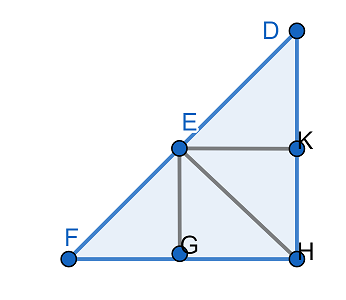
In $ \Delta DFH $ , point E is the midpoint of hypotenuse DF, segment HE is perpendicular to the diagonal DF, segment EG is perpendicular to segment FH, segment EK is perpendicular to segment DH. Show that $ E{{G}^{2}}=FG\times EK $
Answer
 Verified
566.7k+ views
Hint:
As given in the figure $ \angle K=\angle G=\angle H=90{}^\circ $, it means EGHK is a square. We will take $ \Delta DEH\And \Delta EFH $ and prove that these triangles are congruent. To prove $ E{{G}^{2}}=FG\times EK $ we use the property of square and congruency property of triangle.
Complete step by step answer:
We have been given a triangle $ \Delta DFH $.
We have to prove that $ E{{G}^{2}}=FG\times EK $
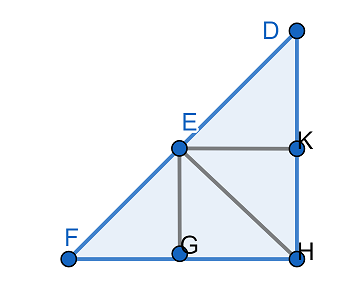
In the above figure, segment HE is perpendicular to the diagonal DF, segment EG is perpendicular to segment FH, segment EK is perpendicular to segment DH.
So, we have from figure $ \angle K=\angle G=\angle H=\angle DEH=90{}^\circ $
From the above figure, we know that EGHK is a square.
Now, let us take two triangles $ \Delta DEH\And \Delta EFH $.
In $ \Delta DEH\And \Delta EFH $ we have
$ \Rightarrow EF=ED $ (As given in the question point E is the midpoint of hypotenuse DF)
$ \Rightarrow EH=EH $ (common side)
$ \Rightarrow \angle FEH=\angle DEH=90{}^\circ $ (given in the figure)
So, we get $ \Delta DEH\cong \Delta EFH $ (By SAS congruency)
So, we know that corresponding parts of congruent triangles are equal.
So, we get
$ \Rightarrow FH=DH $
Also, we have $ \angle EFG=\angle FEG=45{}^\circ $ .
Now, in $ \Delta EFG $ , we have
$ \tan 45{}^\circ =\dfrac{EG}{FG} $ $ \left( \tan \theta =\dfrac{\text{Perpendicular}}{\text{Base}} \right) $
We know that $ \tan 45{}^\circ =1 $ , so we get
$ \begin{align}
& \Rightarrow 1=\dfrac{EG}{FG} \\
& \Rightarrow EG=FG.........(i) \\
\end{align} $
Now, as we have EGHK a square, so we know that all sides of a square are equal in length.
So, we get $ EG=EK......(ii) $
From equation (i) and (ii) we get
$ \begin{align}
& \Rightarrow EG\times EG=FG\times EK \\
& \Rightarrow E{{G}^{2}}=FG\times EK \\
\end{align} $
Hence proved.
Note:
If two sides and the angle included between the side of one triangle are equivalent to the corresponding two sides and angle between the sides of another triangle, then these two triangles are said to be congruent by the SAS rule. Also, to solve this type of question first understand the diagram and collect the information given.
As given in the figure $ \angle K=\angle G=\angle H=90{}^\circ $, it means EGHK is a square. We will take $ \Delta DEH\And \Delta EFH $ and prove that these triangles are congruent. To prove $ E{{G}^{2}}=FG\times EK $ we use the property of square and congruency property of triangle.
Complete step by step answer:
We have been given a triangle $ \Delta DFH $.
We have to prove that $ E{{G}^{2}}=FG\times EK $
In the above figure, segment HE is perpendicular to the diagonal DF, segment EG is perpendicular to segment FH, segment EK is perpendicular to segment DH.
So, we have from figure $ \angle K=\angle G=\angle H=\angle DEH=90{}^\circ $
From the above figure, we know that EGHK is a square.
Now, let us take two triangles $ \Delta DEH\And \Delta EFH $.
In $ \Delta DEH\And \Delta EFH $ we have
$ \Rightarrow EF=ED $ (As given in the question point E is the midpoint of hypotenuse DF)
$ \Rightarrow EH=EH $ (common side)
$ \Rightarrow \angle FEH=\angle DEH=90{}^\circ $ (given in the figure)
So, we get $ \Delta DEH\cong \Delta EFH $ (By SAS congruency)
So, we know that corresponding parts of congruent triangles are equal.
So, we get
$ \Rightarrow FH=DH $
Also, we have $ \angle EFG=\angle FEG=45{}^\circ $ .
Now, in $ \Delta EFG $ , we have
$ \tan 45{}^\circ =\dfrac{EG}{FG} $ $ \left( \tan \theta =\dfrac{\text{Perpendicular}}{\text{Base}} \right) $
We know that $ \tan 45{}^\circ =1 $ , so we get
$ \begin{align}
& \Rightarrow 1=\dfrac{EG}{FG} \\
& \Rightarrow EG=FG.........(i) \\
\end{align} $
Now, as we have EGHK a square, so we know that all sides of a square are equal in length.
So, we get $ EG=EK......(ii) $
From equation (i) and (ii) we get
$ \begin{align}
& \Rightarrow EG\times EG=FG\times EK \\
& \Rightarrow E{{G}^{2}}=FG\times EK \\
\end{align} $
Hence proved.
Note:
If two sides and the angle included between the side of one triangle are equivalent to the corresponding two sides and angle between the sides of another triangle, then these two triangles are said to be congruent by the SAS rule. Also, to solve this type of question first understand the diagram and collect the information given.
Recently Updated Pages
Master Class 10 Computer Science: Engaging Questions & Answers for Success

Master Class 10 General Knowledge: Engaging Questions & Answers for Success
Master Class 10 English: Engaging Questions & Answers for Success
Master Class 10 Social Science: Engaging Questions & Answers for Success
Master Class 10 Maths: Engaging Questions & Answers for Success
Master Class 10 Science: Engaging Questions & Answers for Success
Trending doubts
What is the median of the first 10 natural numbers class 10 maths CBSE
Which women's tennis player has 24 Grand Slam singles titles?
Who is the Brand Ambassador of Incredible India?
Why is there a time difference of about 5 hours between class 10 social science CBSE
Write a letter to the principal requesting him to grant class 10 english CBSE
A moving boat is observed from the top of a 150 m high class 10 maths CBSE