




In $\Delta ABC,$ the internal bisector AD of $\angle A$ meets the side BC at D. If BD=2.5cm, AB=5cm and AC=4.2cm, then find DC.
Answer
 Verified
683.7k+ views
Hint: Start by drawing a neat diagram. Then apply the theorem that the internal angle bisector of a triangle divides the opposite side of the triangle in the ratio of its other two sides.
Complete step by step answer:
To start with the solution, let us first draw the diagram.
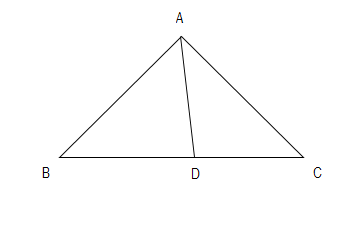
Now it is given in the question that AD is the angle bisector of $\angle BAC$. So, we can say $\angle BAD=\angle CAD$ .
Also, it is given in the question that AB=5cm, AC=4.2cm and BD=2.5cm.
Now, as we know that the angle bisector of the internal angle of the triangle divides the opposite sides in the ratio of the other two sides of the triangle. So, we can represent this mathematically as:
$\dfrac{BD}{DC}=\dfrac{AB}{AC}$
Now we will put the values given in the question. On doing so, we get
$\dfrac{2.5}{DC}=\dfrac{5}{4.2}$
On cross-multiplication, we get
$2.5\times 4.2=5\times DC$
Now we will take 5 to the other side of the equation. On doing so, our equation becomes:
$\dfrac{2.5\times 4.2}{5}=DC$
$\Rightarrow DC=2.1cm$
Therefore, we can conclude that the length of DC is 2.1cm.
Note: The key to such questions is the diagram. If you get the diagram correct, then there is a high possibility that you would reach an answer provided you have the basic knowledge of regularly used theorems, as we saw in the above question. Also, the general mistake that a student makes is getting confused between the medians and the angle bisectors leading to errors, so be careful while using the properties of medians and angle bisectors.
Complete step by step answer:
To start with the solution, let us first draw the diagram.
Now it is given in the question that AD is the angle bisector of $\angle BAC$. So, we can say $\angle BAD=\angle CAD$ .
Also, it is given in the question that AB=5cm, AC=4.2cm and BD=2.5cm.
Now, as we know that the angle bisector of the internal angle of the triangle divides the opposite sides in the ratio of the other two sides of the triangle. So, we can represent this mathematically as:
$\dfrac{BD}{DC}=\dfrac{AB}{AC}$
Now we will put the values given in the question. On doing so, we get
$\dfrac{2.5}{DC}=\dfrac{5}{4.2}$
On cross-multiplication, we get
$2.5\times 4.2=5\times DC$
Now we will take 5 to the other side of the equation. On doing so, our equation becomes:
$\dfrac{2.5\times 4.2}{5}=DC$
$\Rightarrow DC=2.1cm$
Therefore, we can conclude that the length of DC is 2.1cm.
Note: The key to such questions is the diagram. If you get the diagram correct, then there is a high possibility that you would reach an answer provided you have the basic knowledge of regularly used theorems, as we saw in the above question. Also, the general mistake that a student makes is getting confused between the medians and the angle bisectors leading to errors, so be careful while using the properties of medians and angle bisectors.

Recently Updated Pages
Find the greatest six digit number that is exactly class 8 maths CBSE

What is the time difference between India and Cana class 8 social science CBSE
Compare LPG and wood as fuels class 8 chemistry CBSE
In Indian rupees 1 trillion is equal to how many c class 8 maths CBSE
30 opposite words in English from a to z class 8 english CBSE
How many cubic feet equals to 1 unit sand class 8 maths CBSE
Trending doubts
What is BLO What is the full form of BLO class 8 social science CBSE
Citizens of India can vote at the age of A 18 years class 8 social science CBSE
Full form of STD, ISD and PCO
One cusec is equal to how many liters class 8 maths CBSE
What are the methods of reducing friction. Explain
What is the difference between rai and mustard see class 8 biology CBSE