




In $\Delta ABC$, right angled at B, $AB=5cm$ and $\angle ACB={{30}^{\circ }}$. Determine lengths of the sides BC and AC.
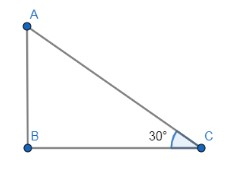
Answer
 Verified
616.8k+ views
Hint:The question has given a right angled triangle, one side and an angle. So, using trigonometric ratios we can find the other sides of the triangle. As length of AB is given so applying $\sin {{30}^{\circ }}=\dfrac{AB}{AC}$ we can get the value of AC. Now, if we can use $\tan {{30}^{\circ }}=\dfrac{AB}{BC}$ then we can find the length of BC.
Complete step-by-step answer:
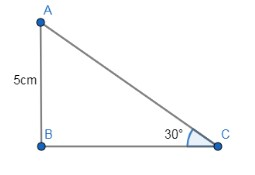
The figure below describes, a $\Delta ABC$ right angled at B and length of $AB=5cm$. It is also given that$\angle ACB={{30}^{\circ }}$.
Using trigonometric ratios,
$\sin \theta =\dfrac{P}{H}$
In the above equation, P stands for perpendicular or the side just opposite to angle θ and H stands for hypotenuse of the right $\Delta ABC$ .
And$\tan \theta =\dfrac{P}{B}$
In the above equation, P stands for perpendicular or the side just opposite to angle θ and B stands for the base (or the side other than perpendicular) of the right $\Delta ABC$ .
In right $\Delta ABC$,
It is given that:
$AB=5cm$
$\angle ACB={{30}^{\circ }}$.
$\sin {{30}^{\circ }}=\dfrac{AB}{AC}$
It can infer from the given figure that AB is the perpendicular and AC is the hypotenuse of the $\Delta ABC$.
$\begin{align}
& \sin {{30}^{\circ }}=\dfrac{5}{AC} \\
& \Rightarrow \dfrac{1}{2}=\dfrac{5}{AC} \\
& \Rightarrow AC=10 \\
\end{align}$
Hence, the length of AC is equal to 10cm.
$\tan {{30}^{\circ }}=\dfrac{AB}{BC}$
It can infer from the given figure that AB is the perpendicular and BC is the base of the $\Delta ABC$.
$\begin{align}
& \tan {{30}^{\circ }}=\dfrac{5}{BC} \\
& \Rightarrow \dfrac{1}{\sqrt{3}}=\dfrac{5}{BC} \\
& \Rightarrow BC=5\sqrt{3} \\
\end{align}$
Hence, length of BC is equal to $5\sqrt{3}$.
Hence, length of AC = 10 cm and length of $BC=5\sqrt{3}$ .
Note: You can check whether the lengths of AC and BC that you are getting is correct or not by satisfying these values in the Pythagoras theorem which is applied on $\Delta ABC$.
In $\Delta ABC$,
$\begin{align}
& A{{C}^{2}}=A{{B}^{2}}+B{{C}^{2}} \\
& {{\left( 10 \right)}^{2}}={{\left( 5 \right)}^{2}}+{{\left( 5\sqrt{3} \right)}^{2}} \\
\end{align}$
$L.H.S=100$
$R.H.S=25+75=100$
From the above calculation, L.H.S = R.H.S. Hence the lengths of the triangle are successfully satisfied Pythagoras theorem.
Complete step-by-step answer:
The figure below describes, a $\Delta ABC$ right angled at B and length of $AB=5cm$. It is also given that$\angle ACB={{30}^{\circ }}$.
Using trigonometric ratios,
$\sin \theta =\dfrac{P}{H}$
In the above equation, P stands for perpendicular or the side just opposite to angle θ and H stands for hypotenuse of the right $\Delta ABC$ .
And$\tan \theta =\dfrac{P}{B}$
In the above equation, P stands for perpendicular or the side just opposite to angle θ and B stands for the base (or the side other than perpendicular) of the right $\Delta ABC$ .
In right $\Delta ABC$,
It is given that:
$AB=5cm$
$\angle ACB={{30}^{\circ }}$.
$\sin {{30}^{\circ }}=\dfrac{AB}{AC}$
It can infer from the given figure that AB is the perpendicular and AC is the hypotenuse of the $\Delta ABC$.
$\begin{align}
& \sin {{30}^{\circ }}=\dfrac{5}{AC} \\
& \Rightarrow \dfrac{1}{2}=\dfrac{5}{AC} \\
& \Rightarrow AC=10 \\
\end{align}$
Hence, the length of AC is equal to 10cm.
$\tan {{30}^{\circ }}=\dfrac{AB}{BC}$
It can infer from the given figure that AB is the perpendicular and BC is the base of the $\Delta ABC$.
$\begin{align}
& \tan {{30}^{\circ }}=\dfrac{5}{BC} \\
& \Rightarrow \dfrac{1}{\sqrt{3}}=\dfrac{5}{BC} \\
& \Rightarrow BC=5\sqrt{3} \\
\end{align}$
Hence, length of BC is equal to $5\sqrt{3}$.
Hence, length of AC = 10 cm and length of $BC=5\sqrt{3}$ .
Note: You can check whether the lengths of AC and BC that you are getting is correct or not by satisfying these values in the Pythagoras theorem which is applied on $\Delta ABC$.
In $\Delta ABC$,
$\begin{align}
& A{{C}^{2}}=A{{B}^{2}}+B{{C}^{2}} \\
& {{\left( 10 \right)}^{2}}={{\left( 5 \right)}^{2}}+{{\left( 5\sqrt{3} \right)}^{2}} \\
\end{align}$
$L.H.S=100$
$R.H.S=25+75=100$
From the above calculation, L.H.S = R.H.S. Hence the lengths of the triangle are successfully satisfied Pythagoras theorem.
Recently Updated Pages
Basicity of sulphurous acid and sulphuric acid are

Master Class 11 Business Studies: Engaging Questions & Answers for Success
Master Class 11 Computer Science: Engaging Questions & Answers for Success
Master Class 11 Economics: Engaging Questions & Answers for Success
Master Class 11 Social Science: Engaging Questions & Answers for Success
Master Class 11 English: Engaging Questions & Answers for Success
Trending doubts
One Metric ton is equal to kg A 10000 B 1000 C 100 class 11 physics CBSE
State and prove Bernoullis theorem class 11 physics CBSE
Actinoid contraction is more than lanthanoid contraction class 11 chemistry CBSE
The transition element that has lowest enthalpy of class 11 chemistry CBSE
Can anyone list 10 advantages and disadvantages of friction
State the laws of reflection of light