




In $\Delta ABC$, if$M$is the midpoint of side BC, then$A{B^2} + A{C^2} = 2A{M^2} + 2B{M^2}$
Answer
 Verified
618.9k+ views
Hint: Since the question is given in terms of squares of sides, it would be better to approach this question by Pythagoras theorem. We need to have a right angled triangle to use Pythagoras theorem. So we will construct a perpendicular to make the question easy.
Complete step by step solution:
We have to prove
$A{B^2} + A{C^2} = 2A{M^2} + 2B{M^2}$
As explained in the hint, draw a perpendicular from A on BC
$ \Rightarrow AD \bot BC$
In$\Delta ABC$, it is also given that, $M$is the midpoint of side$BC$
$ \Rightarrow BM = MC$
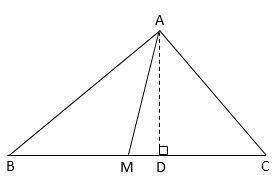
By Pythagoras theorem, in $\Delta ABC$
$A{B^2} = A{D^2} + B{D^2}$ and $A{C^2} = A{D^2} + D{C^2}$
Adding the two equations above, we get
$A{B^2} + A{C^2} = A{D^2} + B{D^2} + A{D^2} + D{C^2}$ . . . (1)
Now we will rearrange the above equation in such a way that we could substitute the terms that our proof requires.
For that, use
$BD = BM + MD$ and $DC = MC - MD$
Hence, equation (1) becomes
$A{B^2} + A{C^2} = A{D^2} + {(BM + MD)^2} + A{D^2} + {(MC - MD)^2}$
By using the formula ${(a + b)^2} = {a^2} + {b^2} + 2ab$ and ${(a - b)^2} = {a^2} + {b^2} - 2ab,$we can simplify the above equation as
$A{B^2} + A{C^2} = A{D^2} + B{M^2} + M{D^2} + 2BM \times MD + A{D^2} + M{C^2} + M{D^2} - 2MC \times MD$
Rearranging the above equation, we get
$A{B^2} + A{C^2} = A{D^2} + M{D^2} + B{M^2} + 2BM \times MD + A{D^2} + M{D^2} + M{C^2} - 2MC \times MD$
Now, in $\Delta ADM,$by Pythagoras theorem, we get
$A{D^2} + M{D^2} = A{M^2}$
\[ \Rightarrow A{B^2} + A{C^2} = A{M^2} + B{M^2} + 2BM \times MD + A{M^2} + M{C^2} - 2MC \times MD\]
Now, since, $BM = MC$, we can rearrange the above equation as
\[ \Rightarrow A{B^2} + A{C^2} = 2A{M^2} + B{M^2} + 2BM \times MD + B{M^2} - 2BM \times MD\]
Simplifying it, we get
\[A{B^2} + A{C^2} = 2A{M^2} + 2B{M^2}\]
Hence, it is proved that \[A{B^2} + A{C^2} = 2A{M^2} + 2B{M^2}\]
Additional information:
According to Pythagoras theorem, in a right angled triangle, the sum of squares of two adjacent sides is equal to the square of the hypotenuse.
Mathematically, in a right angle triangle, ABC, right angled at B.
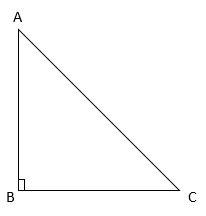
$A{B^2} + B{C^2} = A{C^2}$
Note: Simplest way to solve such a question is to use an approach that uses the information given in the question. This way, it becomes easy to reach the solution in less time. Having a foresight of using a proper construction whenever required can be very helpful in the long run.
Complete step by step solution:
We have to prove
$A{B^2} + A{C^2} = 2A{M^2} + 2B{M^2}$
As explained in the hint, draw a perpendicular from A on BC
$ \Rightarrow AD \bot BC$
In$\Delta ABC$, it is also given that, $M$is the midpoint of side$BC$
$ \Rightarrow BM = MC$
By Pythagoras theorem, in $\Delta ABC$
$A{B^2} = A{D^2} + B{D^2}$ and $A{C^2} = A{D^2} + D{C^2}$
Adding the two equations above, we get
$A{B^2} + A{C^2} = A{D^2} + B{D^2} + A{D^2} + D{C^2}$ . . . (1)
Now we will rearrange the above equation in such a way that we could substitute the terms that our proof requires.
For that, use
$BD = BM + MD$ and $DC = MC - MD$
Hence, equation (1) becomes
$A{B^2} + A{C^2} = A{D^2} + {(BM + MD)^2} + A{D^2} + {(MC - MD)^2}$
By using the formula ${(a + b)^2} = {a^2} + {b^2} + 2ab$ and ${(a - b)^2} = {a^2} + {b^2} - 2ab,$we can simplify the above equation as
$A{B^2} + A{C^2} = A{D^2} + B{M^2} + M{D^2} + 2BM \times MD + A{D^2} + M{C^2} + M{D^2} - 2MC \times MD$
Rearranging the above equation, we get
$A{B^2} + A{C^2} = A{D^2} + M{D^2} + B{M^2} + 2BM \times MD + A{D^2} + M{D^2} + M{C^2} - 2MC \times MD$
Now, in $\Delta ADM,$by Pythagoras theorem, we get
$A{D^2} + M{D^2} = A{M^2}$
\[ \Rightarrow A{B^2} + A{C^2} = A{M^2} + B{M^2} + 2BM \times MD + A{M^2} + M{C^2} - 2MC \times MD\]
Now, since, $BM = MC$, we can rearrange the above equation as
\[ \Rightarrow A{B^2} + A{C^2} = 2A{M^2} + B{M^2} + 2BM \times MD + B{M^2} - 2BM \times MD\]
Simplifying it, we get
\[A{B^2} + A{C^2} = 2A{M^2} + 2B{M^2}\]
Hence, it is proved that \[A{B^2} + A{C^2} = 2A{M^2} + 2B{M^2}\]
Additional information:
According to Pythagoras theorem, in a right angled triangle, the sum of squares of two adjacent sides is equal to the square of the hypotenuse.
Mathematically, in a right angle triangle, ABC, right angled at B.
$A{B^2} + B{C^2} = A{C^2}$
Note: Simplest way to solve such a question is to use an approach that uses the information given in the question. This way, it becomes easy to reach the solution in less time. Having a foresight of using a proper construction whenever required can be very helpful in the long run.
Recently Updated Pages
Master Class 12 Economics: Engaging Questions & Answers for Success

Master Class 12 English: Engaging Questions & Answers for Success
Master Class 12 Social Science: Engaging Questions & Answers for Success
Master Class 12 Maths: Engaging Questions & Answers for Success
Master Class 12 Physics: Engaging Questions & Answers for Success
Master Class 9 General Knowledge: Engaging Questions & Answers for Success
Trending doubts
One Metric ton is equal to kg A 10000 B 1000 C 100 class 11 physics CBSE
Difference Between Prokaryotic Cells and Eukaryotic Cells
Find the value of the expression given below sin 30circ class 11 maths CBSE
Two of the body parts which do not appear in MRI are class 11 biology CBSE
1 ton equals to A 100 kg B 1000 kg C 10 kg D 10000 class 11 physics CBSE
Draw a diagram of nephron and explain its structur class 11 biology CBSE