




In $\Delta ABC$, if the medians $AD,BE$ are perpendicular, $AC = 4,BC = 3$. Find the length of $AB$.
Answer
 Verified
558.6k+ views
Hint: In order to solve this question, draw the figure and understand the question at first.
Then assume the two medians of the variable lengths and use the property of medians for centroid.
At last use Pythagoras theorem and solve the question.
Complete step-by-step solution:
As stated in the question, the medians $AD,BE$ are perpendicular and $AC = 4,BC = 3$. We need to find the length of $AB$. We know that the sum of the angles on the line is $180^\circ $.
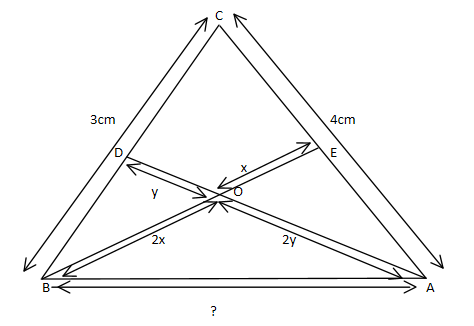
Hence they are perpendicular from all four sides i.e. angle of the intersection is $90^\circ $
Now let us assume that length of the medians $AD,BE$ be $3y,3x$
As we know that the point of intersection of the medians is known as the centroid which is $O$ and it divides the median in the ratio $2:1$
$AO:OD = 2y:y$
$BO:OE = 2x:x$
$AO = 2y,OD = y$
$BO = 2x,OE = x$
As we can see the triangles $AOB,BOD,AOE$ are the right angled triangles and hence we can use Pythagoras theorem in them.
Using Pythagoras theorem in $\Delta AOE,\Delta BOD$
$A{O^2} + O{E^2} = A{E^2}$
$B{O^2} + O{D^2} = B{D^2}$
We know that the medians bisect their respective sides which means
$\Rightarrow$$BD = \dfrac{1}{2}BC = \dfrac{3}{2}{\text{cm}}$
$\Rightarrow$$AE = \dfrac{1}{2}AC = 2{\text{cm}}$
Using these values, we get
$\Rightarrow$$4{y^2} + {x^2} = 4$$ - - - - (1)$
$\Rightarrow$${y^2} + 4{x^2} = \dfrac{9}{4}$$ - - - - - (2)$
Multiplying equation (2) by 4 and then subtracting from (1), we get
$\Rightarrow$$ - 15{x^2} = - 5$
$\Rightarrow$${x^2} = \dfrac{1}{3}$
Using this value in the (1), we get
$\Rightarrow$$4{y^2} = 4 - \dfrac{1}{3} = \dfrac{{11}}{{12}}$
Now to find $AB$, we will use Pythagoras theorem in $\Delta AOB$
$\Rightarrow$$A{O^2} + O{B^2} = A{B^2}$
$\Rightarrow$$4{x^2} + 4{y^2} = A{B^2}$
$\Rightarrow$$4\left( {\dfrac{{11}}{{12}} + \dfrac{1}{3}} \right) = A{B^2}$
$\Rightarrow$$AB = \sqrt 5 $
Hence the length of the $AB = \sqrt 5 {\text{ cm}}$
Note: Why do we assume the value of the medians as $3x,3y$ and not $x,y$? This is because we have to divide it into $2x,x{\text{ and }}2y,y$ in the next step. Choosing it as $x$ would divide it into the fractions $\dfrac{x}{3},\dfrac{{2x}}{3}{\text{ and }}\dfrac{y}{3},\dfrac{{2y}}{3}$ which would complicate the question and would be difficult to solve.
Then assume the two medians of the variable lengths and use the property of medians for centroid.
At last use Pythagoras theorem and solve the question.
Complete step-by-step solution:
As stated in the question, the medians $AD,BE$ are perpendicular and $AC = 4,BC = 3$. We need to find the length of $AB$. We know that the sum of the angles on the line is $180^\circ $.
Hence they are perpendicular from all four sides i.e. angle of the intersection is $90^\circ $
Now let us assume that length of the medians $AD,BE$ be $3y,3x$
As we know that the point of intersection of the medians is known as the centroid which is $O$ and it divides the median in the ratio $2:1$
$AO:OD = 2y:y$
$BO:OE = 2x:x$
$AO = 2y,OD = y$
$BO = 2x,OE = x$
As we can see the triangles $AOB,BOD,AOE$ are the right angled triangles and hence we can use Pythagoras theorem in them.
Using Pythagoras theorem in $\Delta AOE,\Delta BOD$
$A{O^2} + O{E^2} = A{E^2}$
$B{O^2} + O{D^2} = B{D^2}$
We know that the medians bisect their respective sides which means
$\Rightarrow$$BD = \dfrac{1}{2}BC = \dfrac{3}{2}{\text{cm}}$
$\Rightarrow$$AE = \dfrac{1}{2}AC = 2{\text{cm}}$
Using these values, we get
$\Rightarrow$$4{y^2} + {x^2} = 4$$ - - - - (1)$
$\Rightarrow$${y^2} + 4{x^2} = \dfrac{9}{4}$$ - - - - - (2)$
Multiplying equation (2) by 4 and then subtracting from (1), we get
$\Rightarrow$$ - 15{x^2} = - 5$
$\Rightarrow$${x^2} = \dfrac{1}{3}$
Using this value in the (1), we get
$\Rightarrow$$4{y^2} = 4 - \dfrac{1}{3} = \dfrac{{11}}{{12}}$
Now to find $AB$, we will use Pythagoras theorem in $\Delta AOB$
$\Rightarrow$$A{O^2} + O{B^2} = A{B^2}$
$\Rightarrow$$4{x^2} + 4{y^2} = A{B^2}$
$\Rightarrow$$4\left( {\dfrac{{11}}{{12}} + \dfrac{1}{3}} \right) = A{B^2}$
$\Rightarrow$$AB = \sqrt 5 $
Hence the length of the $AB = \sqrt 5 {\text{ cm}}$
Note: Why do we assume the value of the medians as $3x,3y$ and not $x,y$? This is because we have to divide it into $2x,x{\text{ and }}2y,y$ in the next step. Choosing it as $x$ would divide it into the fractions $\dfrac{x}{3},\dfrac{{2x}}{3}{\text{ and }}\dfrac{y}{3},\dfrac{{2y}}{3}$ which would complicate the question and would be difficult to solve.
Recently Updated Pages
Master Class 9 General Knowledge: Engaging Questions & Answers for Success

Master Class 9 Social Science: Engaging Questions & Answers for Success
Master Class 9 English: Engaging Questions & Answers for Success
Master Class 9 Maths: Engaging Questions & Answers for Success
Master Class 9 Science: Engaging Questions & Answers for Success
Class 9 Question and Answer - Your Ultimate Solutions Guide
Trending doubts
Difference Between Plant Cell and Animal Cell
Fill the blanks with the suitable prepositions 1 The class 9 english CBSE
Who is eligible for RTE class 9 social science CBSE
Which places in India experience sunrise first and class 9 social science CBSE
What is pollution? How many types of pollution? Define it
Name 10 Living and Non living things class 9 biology CBSE