




In $ \Delta ABC $ , if $ a=5 $ , $ b=4 $ and $ A=\dfrac{\pi }{2}+B $ then $ \tan C= $ ?
(a) $ \dfrac{9}{40} $
(b) 4
(c) 2.5
(d) 1.45
Answer
 Verified
563.1k+ views
Hint: We will use the fact that sum of all angles of a triangle is $ 180{}^\circ $ to find the angle $ C $ in terms of angle $ B $ . Then we will use the relations between trigonometric ratios of angle $ \dfrac{\pi }{2}-x $ to compute the value of $ \tan C $ . We will also use the double angle formula for the tangent function, which is given as $ \tan 2x=\dfrac{2\tan x}{1-{{\tan }^{2}}x} $ . We will also use the law of sines to obtain the value of $ \tan B $ .
Complete step by step answer:
The rough diagram of such a triangle would look like the following,
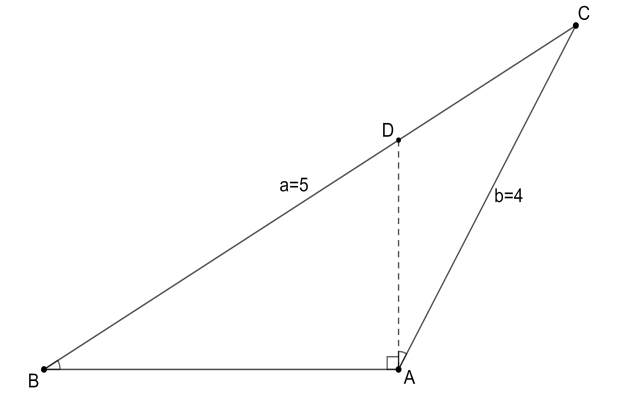
We know that the sum of all angles of a triangle is $ 180{}^\circ $ . Therefore, we have
$ A+B+C=\pi $
Substituting $ A=\dfrac{\pi }{2}+B $ in the above equation we get,
$ \begin{align}
& \dfrac{\pi }{2}+B+B+C=\pi \\
& \therefore C=\dfrac{\pi }{2}-2B \\
\end{align} $
Now, we have to find the value of $ \tan C $ . Using the value of angle $ C $ , we get
$ \tan C=\tan \left( \dfrac{\pi }{2}-2B \right) $
We have relations between trigonometric ratios of angle $ \dfrac{\pi }{2}-x $ . According to these relations, we know that $ \tan \left( \dfrac{\pi }{2}-\theta \right)=\cot \theta $ . We also know that $ \cot \theta =\dfrac{1}{\tan \theta } $ . Combining these two facts, we have $ \tan \left( \dfrac{\pi }{2}-\theta \right)=\dfrac{1}{\tan \theta } $ . So, we can write the value of $ \tan C $ as the following,
$ \tan C=\dfrac{1}{\tan 2B}....(i) $
For any triangle $ \Delta ABC $ , we have the law of sines, which is given as
$ \dfrac{a}{\sin A}=\dfrac{b}{\sin B}=\dfrac{c}{\sin C} $
where $ a,b,c $ are the lengths of sides opposite to the angles $ A,B,C $ respectively.
For the given triangle, we have $ a=5 $ , $ b=4 $ . So, using the law of sines, we get
$ \begin{align}
& \dfrac{5}{\sin A}=\dfrac{4}{\sin B} \\
& \therefore 5\sin B=4\sin A \\
\end{align} $
Substituting the value $ A=\dfrac{\pi }{2}+B $ in the above equation, we have
$ 5\sin B=4\sin \left( \dfrac{\pi }{2}+B \right) $
We know that $ \sin \left( \dfrac{\pi }{2}+\theta \right)=\cos \theta $ . Therefore, we have
$ \begin{align}
& 5\sin B=4\cos B \\
& \Rightarrow \dfrac{\sin B}{\cos B}=\dfrac{4}{5} \\
& \therefore \tan B=\dfrac{4}{5} \\
\end{align} $
Now, we will use the double angle formula for the tangent function to find the value of $ \tan 2B $ . The double angle formula is given by $ \tan 2x=\dfrac{2\tan x}{1-{{\tan }^{2}}x} $ . So, we have the following,
$ \tan 2B=\dfrac{2\tan B}{1-{{\tan }^{2}}B} $
Substituting $ \tan B=\dfrac{4}{5} $ in the above formula, we get
$ \begin{align}
& \tan 2B=\dfrac{2\times \dfrac{4}{5}}{1-{{\left( \dfrac{4}{5} \right)}^{2}}} \\
& \Rightarrow \tan 2B=\dfrac{\dfrac{8}{5}}{1-\dfrac{16}{25}} \\
& \Rightarrow \tan 2B=\dfrac{\left( \dfrac{8}{5} \right)}{\left( \dfrac{9}{25} \right)} \\
& \Rightarrow \tan 2B=\dfrac{8}{5}\times \dfrac{25}{9} \\
& \therefore \tan 2B=\dfrac{40}{9} \\
\end{align} $
Substituting this value in equation $ (i) $ , we have
$ \begin{align}
& \tan C=\dfrac{1}{\left( \dfrac{40}{9} \right)} \\
& \therefore \tan C=\dfrac{9}{40} \\
\end{align} $
Hence, the correct option is (a).
Note:
It is important to know the law of sines to solve this question. We should be familiar with the trigonometric functions and their relations amongst themselves for adding or subtracting angles like $ \dfrac{\pi }{2},\pi $, etc. The double angle formulae and the half-angle formulae are useful in calculations in such type of questions. We should do the calculations explicitly to avoid making any errors in the calculations.
Complete step by step answer:
The rough diagram of such a triangle would look like the following,
We know that the sum of all angles of a triangle is $ 180{}^\circ $ . Therefore, we have
$ A+B+C=\pi $
Substituting $ A=\dfrac{\pi }{2}+B $ in the above equation we get,
$ \begin{align}
& \dfrac{\pi }{2}+B+B+C=\pi \\
& \therefore C=\dfrac{\pi }{2}-2B \\
\end{align} $
Now, we have to find the value of $ \tan C $ . Using the value of angle $ C $ , we get
$ \tan C=\tan \left( \dfrac{\pi }{2}-2B \right) $
We have relations between trigonometric ratios of angle $ \dfrac{\pi }{2}-x $ . According to these relations, we know that $ \tan \left( \dfrac{\pi }{2}-\theta \right)=\cot \theta $ . We also know that $ \cot \theta =\dfrac{1}{\tan \theta } $ . Combining these two facts, we have $ \tan \left( \dfrac{\pi }{2}-\theta \right)=\dfrac{1}{\tan \theta } $ . So, we can write the value of $ \tan C $ as the following,
$ \tan C=\dfrac{1}{\tan 2B}....(i) $
For any triangle $ \Delta ABC $ , we have the law of sines, which is given as
$ \dfrac{a}{\sin A}=\dfrac{b}{\sin B}=\dfrac{c}{\sin C} $
where $ a,b,c $ are the lengths of sides opposite to the angles $ A,B,C $ respectively.
For the given triangle, we have $ a=5 $ , $ b=4 $ . So, using the law of sines, we get
$ \begin{align}
& \dfrac{5}{\sin A}=\dfrac{4}{\sin B} \\
& \therefore 5\sin B=4\sin A \\
\end{align} $
Substituting the value $ A=\dfrac{\pi }{2}+B $ in the above equation, we have
$ 5\sin B=4\sin \left( \dfrac{\pi }{2}+B \right) $
We know that $ \sin \left( \dfrac{\pi }{2}+\theta \right)=\cos \theta $ . Therefore, we have
$ \begin{align}
& 5\sin B=4\cos B \\
& \Rightarrow \dfrac{\sin B}{\cos B}=\dfrac{4}{5} \\
& \therefore \tan B=\dfrac{4}{5} \\
\end{align} $
Now, we will use the double angle formula for the tangent function to find the value of $ \tan 2B $ . The double angle formula is given by $ \tan 2x=\dfrac{2\tan x}{1-{{\tan }^{2}}x} $ . So, we have the following,
$ \tan 2B=\dfrac{2\tan B}{1-{{\tan }^{2}}B} $
Substituting $ \tan B=\dfrac{4}{5} $ in the above formula, we get
$ \begin{align}
& \tan 2B=\dfrac{2\times \dfrac{4}{5}}{1-{{\left( \dfrac{4}{5} \right)}^{2}}} \\
& \Rightarrow \tan 2B=\dfrac{\dfrac{8}{5}}{1-\dfrac{16}{25}} \\
& \Rightarrow \tan 2B=\dfrac{\left( \dfrac{8}{5} \right)}{\left( \dfrac{9}{25} \right)} \\
& \Rightarrow \tan 2B=\dfrac{8}{5}\times \dfrac{25}{9} \\
& \therefore \tan 2B=\dfrac{40}{9} \\
\end{align} $
Substituting this value in equation $ (i) $ , we have
$ \begin{align}
& \tan C=\dfrac{1}{\left( \dfrac{40}{9} \right)} \\
& \therefore \tan C=\dfrac{9}{40} \\
\end{align} $
Hence, the correct option is (a).
Note:
It is important to know the law of sines to solve this question. We should be familiar with the trigonometric functions and their relations amongst themselves for adding or subtracting angles like $ \dfrac{\pi }{2},\pi $, etc. The double angle formulae and the half-angle formulae are useful in calculations in such type of questions. We should do the calculations explicitly to avoid making any errors in the calculations.
Recently Updated Pages
Master Class 10 Computer Science: Engaging Questions & Answers for Success

Master Class 10 General Knowledge: Engaging Questions & Answers for Success
Master Class 10 English: Engaging Questions & Answers for Success
Master Class 10 Social Science: Engaging Questions & Answers for Success
Master Class 10 Maths: Engaging Questions & Answers for Success
Master Class 10 Science: Engaging Questions & Answers for Success
Trending doubts
What is the median of the first 10 natural numbers class 10 maths CBSE
Which women's tennis player has 24 Grand Slam singles titles?
Who is the Brand Ambassador of Incredible India?
Why is there a time difference of about 5 hours between class 10 social science CBSE
Write a letter to the principal requesting him to grant class 10 english CBSE
A moving boat is observed from the top of a 150 m high class 10 maths CBSE