




In $\Delta ABC,$ $DE$ is parallel to $BC, AD=x, BD=x+1, AE=x+3$ and $EC=x+5.$ Find $x.$
Answer
 Verified
593.1k+ views
Hint: We will use the Basic Proportionality theorem to find the value of $x.$ The theorem states that if a line is drawn parallel to one side of a triangle intersecting the other two sides of a triangle in distinct points, then the other two sides are divided in the same ratio.
Complete step by step solution:
Let us consider the given triangle $\Delta ABC.$
In this triangle, the line $DE$ is parallel to $BC.$ Also, from the given information, we can conclude that the line intersects the other two sides of the triangle in distinct points.
It is given that $AD=x, BD=x+1, AE=x+3$ and $CE=x+5.$
Given below is the triangle satisfying the given information.
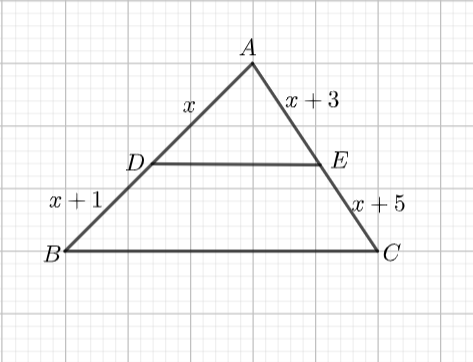
We are asked to find the value of $x.$
Now, we will use the Basic Proportionality theorem.
By the theorem, if a line is drawn parallel to one side of a triangle intersecting the other two sides of the triangle, then the other two sides are divided in the same ratio.
In this case also, as we can see, the line $DE$ is drawn in a way that it is parallel to the side $BC$ of the triangle and that it is intersecting the other two sides of the triangle.
We can conclude that the sides of the triangle are divided in the same ratio.
So, we will get $\dfrac{AD}{BD}=\dfrac{AE}{CE}.$
Now, we will get $\dfrac{x}{x+1}=\dfrac{x+3}{x+5}.$
After we transpose the terms, we will get $x\left( x+5 \right)=\left( x+1 \right)\left( x+3 \right).$
So, we will get ${{x}^{2}}+5x={{x}^{2}}+4x+3.$
From this, we will get $5x-4x=x=3.$
Hence $x=3.$
Note: The converse of the Basic Proportionality is also true. The converse theorem of Proportionality states that if a line divides any two sides of a triangle in the same ratio, then the line must be parallel to the third side of the triangle.
Complete step by step solution:
Let us consider the given triangle $\Delta ABC.$
In this triangle, the line $DE$ is parallel to $BC.$ Also, from the given information, we can conclude that the line intersects the other two sides of the triangle in distinct points.
It is given that $AD=x, BD=x+1, AE=x+3$ and $CE=x+5.$
Given below is the triangle satisfying the given information.
We are asked to find the value of $x.$
Now, we will use the Basic Proportionality theorem.
By the theorem, if a line is drawn parallel to one side of a triangle intersecting the other two sides of the triangle, then the other two sides are divided in the same ratio.
In this case also, as we can see, the line $DE$ is drawn in a way that it is parallel to the side $BC$ of the triangle and that it is intersecting the other two sides of the triangle.
We can conclude that the sides of the triangle are divided in the same ratio.
So, we will get $\dfrac{AD}{BD}=\dfrac{AE}{CE}.$
Now, we will get $\dfrac{x}{x+1}=\dfrac{x+3}{x+5}.$
After we transpose the terms, we will get $x\left( x+5 \right)=\left( x+1 \right)\left( x+3 \right).$
So, we will get ${{x}^{2}}+5x={{x}^{2}}+4x+3.$
From this, we will get $5x-4x=x=3.$
Hence $x=3.$
Note: The converse of the Basic Proportionality is also true. The converse theorem of Proportionality states that if a line divides any two sides of a triangle in the same ratio, then the line must be parallel to the third side of the triangle.
Recently Updated Pages
Class 10 Question and Answer - Your Ultimate Solutions Guide

Master Class 10 Computer Science: Engaging Questions & Answers for Success
Master Class 10 General Knowledge: Engaging Questions & Answers for Success
Master Class 12 Economics: Engaging Questions & Answers for Success
Master Class 12 Social Science: Engaging Questions & Answers for Success
Master Class 12 English: Engaging Questions & Answers for Success
Trending doubts
Explain the Treaty of Vienna of 1815 class 10 social science CBSE
The slogan Jai Hind was given by A Lal Bahadur Shastri class 10 social science CBSE
10 examples of evaporation in daily life with explanations
What is the full form of POSCO class 10 social science CBSE
Identify the feminine form of noun nephew a shenephew class 10 english CBSE
CSIR full form?