




In \[\Delta ABC\], circumradius is 3 and inradius is 1.5 units, then the value of \[a{\cot ^2}\left( A \right) + {b^2}{\cot ^3}\left( B \right) + {c^3}{\cot ^4}\left( C \right)\]is
A. \[5\sqrt 3 \]
B. \[7\sqrt 3 \]
C. \[13\sqrt 3 \]
D. None of these
Answer
 Verified
662.7k+ views
Hint: First of all, find the ratio of the circumradius and inradius of the given triangle to know whether it is an equilateral triangle or not. If it is an equilateral triangle then all the angles in the triangle are equal and thus the sides. So, use this concept to reach the solution of the given problem.
Complete step by step answer:
Given circumradius of \[\Delta ABC\] is \[R = 3\]
Inradius of \[\Delta ABC\] is \[r = 1.5\]
Now consider the ratio of circumradius and inradius i.e., \[R:r = 3:1.5 = 2:1\]
We know that if the ratio of circumradius and inradius of a triangle is \[2:1\], then the triangle is an equilateral triangle.
So, \[\Delta ABC\] is an equilateral triangle i.e., all the three angles are equal to \[{60^0}\] as shown in the below figure.
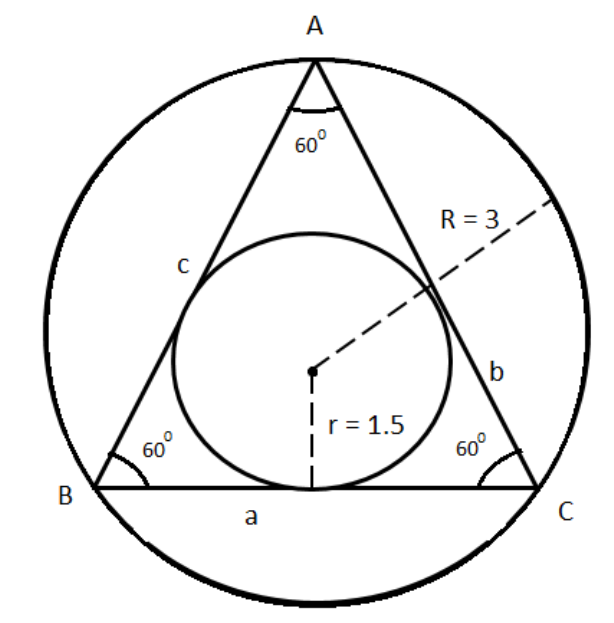
As \[\Delta ABC\] is an equilateral triangle it must satisfy that \[a = b = c = 2R\sin \dfrac{\pi }{3} = R\sqrt 3 \]
Now, consider \[a{\cot ^2}\left( A \right) + {b^2}{\cot ^3}\left( B \right) + {c^3}{\cot ^4}\left( C \right)\]
\[
\Rightarrow a{\cot ^2}\left( A \right) + {b^2}{\cot ^3}\left( B \right) + {c^3}{\cot ^4}\left( C \right) = R\sqrt 3 {\cot ^2}\left( {\dfrac{\pi }{3}} \right) + {\left( {R\sqrt 3 } \right)^2}{\cot ^3}\left( {\dfrac{\pi }{3}} \right) + {\left( {R\sqrt 3 } \right)^3}{\cot ^4}\left( {\dfrac{\pi }{3}} \right) \\
\Rightarrow a{\cot ^2}\left( A \right) + {b^2}{\cot ^3}\left( B \right) + {c^3}{\cot ^4}\left( C \right) = \sqrt 3 R{\left( {\dfrac{1}{{\sqrt 3 }}} \right)^2} + 3{R^2}{\left( {\dfrac{1}{{\sqrt 3 }}} \right)^3} + 3\sqrt 3 {R^3}{\left( {\dfrac{1}{{\sqrt 3 }}} \right)^4} \\
\Rightarrow a{\cot ^2}\left( A \right) + {b^2}{\cot ^3}\left( B \right) + {c^3}{\cot ^4}\left( C \right) = \dfrac{{\sqrt 3 R}}{3} + \dfrac{{3{R^2}}}{{3\sqrt 3 }} + \dfrac{{3\sqrt 3 {R^3}}}{9} \\
\Rightarrow a{\cot ^2}\left( A \right) + {b^2}{\cot ^3}\left( B \right) + {c^3}{\cot ^4}\left( C \right) = \dfrac{R}{{\sqrt 3 }} + \dfrac{{{R^2}}}{{\sqrt 3 }} + \dfrac{{{R^3}}}{{\sqrt 3 }} \\
\Rightarrow a{\cot ^2}\left( A \right) + {b^2}{\cot ^3}\left( B \right) + {c^3}{\cot ^4}\left( C \right) = \dfrac{3}{{\sqrt 3 }} + \dfrac{{{{\left( 3 \right)}^2}}}{{\sqrt 3 }} + \dfrac{{{{\left( 3 \right)}^3}}}{{\sqrt 3 }}{\text{ }}\left[ {\because R = 3} \right] \\
\therefore a{\cot ^2}\left( A \right) + {b^2}{\cot ^3}\left( B \right) + {c^3}{\cot ^4}\left( C \right) = \dfrac{{3 + 9 + 27}}{{\sqrt 3 }} = \dfrac{{39}}{{\sqrt 3 }} = 13\sqrt 3 \\
\]
So, the correct answer is “Option C”.
Note: If the ratio of circumradius and inradius of a triangle is equal to \[2:1\], then that triangle is an equilateral triangle in which all the sides and the angle are equal. Circumradius is defined as the radius of that circle which circumscribes the triangle and the inradius is defined as the radius of the circle which is inscribed in the triangle.
Complete step by step answer:
Given circumradius of \[\Delta ABC\] is \[R = 3\]
Inradius of \[\Delta ABC\] is \[r = 1.5\]
Now consider the ratio of circumradius and inradius i.e., \[R:r = 3:1.5 = 2:1\]
We know that if the ratio of circumradius and inradius of a triangle is \[2:1\], then the triangle is an equilateral triangle.
So, \[\Delta ABC\] is an equilateral triangle i.e., all the three angles are equal to \[{60^0}\] as shown in the below figure.
As \[\Delta ABC\] is an equilateral triangle it must satisfy that \[a = b = c = 2R\sin \dfrac{\pi }{3} = R\sqrt 3 \]
Now, consider \[a{\cot ^2}\left( A \right) + {b^2}{\cot ^3}\left( B \right) + {c^3}{\cot ^4}\left( C \right)\]
\[
\Rightarrow a{\cot ^2}\left( A \right) + {b^2}{\cot ^3}\left( B \right) + {c^3}{\cot ^4}\left( C \right) = R\sqrt 3 {\cot ^2}\left( {\dfrac{\pi }{3}} \right) + {\left( {R\sqrt 3 } \right)^2}{\cot ^3}\left( {\dfrac{\pi }{3}} \right) + {\left( {R\sqrt 3 } \right)^3}{\cot ^4}\left( {\dfrac{\pi }{3}} \right) \\
\Rightarrow a{\cot ^2}\left( A \right) + {b^2}{\cot ^3}\left( B \right) + {c^3}{\cot ^4}\left( C \right) = \sqrt 3 R{\left( {\dfrac{1}{{\sqrt 3 }}} \right)^2} + 3{R^2}{\left( {\dfrac{1}{{\sqrt 3 }}} \right)^3} + 3\sqrt 3 {R^3}{\left( {\dfrac{1}{{\sqrt 3 }}} \right)^4} \\
\Rightarrow a{\cot ^2}\left( A \right) + {b^2}{\cot ^3}\left( B \right) + {c^3}{\cot ^4}\left( C \right) = \dfrac{{\sqrt 3 R}}{3} + \dfrac{{3{R^2}}}{{3\sqrt 3 }} + \dfrac{{3\sqrt 3 {R^3}}}{9} \\
\Rightarrow a{\cot ^2}\left( A \right) + {b^2}{\cot ^3}\left( B \right) + {c^3}{\cot ^4}\left( C \right) = \dfrac{R}{{\sqrt 3 }} + \dfrac{{{R^2}}}{{\sqrt 3 }} + \dfrac{{{R^3}}}{{\sqrt 3 }} \\
\Rightarrow a{\cot ^2}\left( A \right) + {b^2}{\cot ^3}\left( B \right) + {c^3}{\cot ^4}\left( C \right) = \dfrac{3}{{\sqrt 3 }} + \dfrac{{{{\left( 3 \right)}^2}}}{{\sqrt 3 }} + \dfrac{{{{\left( 3 \right)}^3}}}{{\sqrt 3 }}{\text{ }}\left[ {\because R = 3} \right] \\
\therefore a{\cot ^2}\left( A \right) + {b^2}{\cot ^3}\left( B \right) + {c^3}{\cot ^4}\left( C \right) = \dfrac{{3 + 9 + 27}}{{\sqrt 3 }} = \dfrac{{39}}{{\sqrt 3 }} = 13\sqrt 3 \\
\]
So, the correct answer is “Option C”.
Note: If the ratio of circumradius and inradius of a triangle is equal to \[2:1\], then that triangle is an equilateral triangle in which all the sides and the angle are equal. Circumradius is defined as the radius of that circle which circumscribes the triangle and the inradius is defined as the radius of the circle which is inscribed in the triangle.
Recently Updated Pages
If x a + bt + ct2 where x is in meters and t is in class 11 physics CBSE

A car covers the first half distance between two places class 11 physics CBSE
The resultant of two vectors overrightarrow P and overrightarrow class 11 physics CBSE
Find the value of cos 135 class 11 maths CBSE
A mass M is held in place by an applied force F and class 11 physics CBSE
A solution of glucose in water is labelled as 10 dfracwv class 11 chemistry CBSE
Trending doubts
One Metric ton is equal to kg A 10000 B 1000 C 100 class 11 physics CBSE
Find the value of the expression given below sin 30circ class 11 maths CBSE
What do you mean by retardation What is its SI uni class 11 physics CBSE
Draw a diagram of nephron and explain its structur class 11 biology CBSE
10 examples of friction in our daily life
Difference between physical and chemical change class 11 chemistry CBSE