




In \[\Delta ABC\text{ AB=20cm, BC=21cm and AC=29cm}\] find the radius of the circle touching all the sides of \[\Delta ABC.\]
Answer
 Verified
619.5k+ views
Hint: We know that a circle that touches all the sides of a triangle is known as incircle and its radius is known as inradius, denoted by 'r' and the value of inradius is equal to the ratio of area of triangles to semi perimeter of the triangle. Mathematically, \[r=\dfrac{\Delta }{S}\] where \[\Delta \] is the area and S is a semi perimeter.
Complete step-by-step answer:
Also, we will use the heron's formula to calculate the area of a triangle having sides a, b and c given by,
\[\Delta =\sqrt{S\left( S-a \right)\left( S-b \right)\left( S-c \right)}\]
Where, \[S=\dfrac{a+b+c}{2}\]
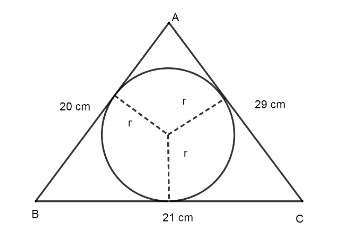
We have been given the side of a \[\Delta ABC\text{ AB=20cm, BC=21cm and AC=29cm}\] and asked to find the radius of the circle touching all the sides of \[\Delta ABC.\]
We know that a circle that touches all the side of \[\Delta ABC\] is known as incircle and in radius is known as inradius, denoted by 'r' and given by,
\[r=\dfrac{\Delta }{S}\]
Where,\[\Delta =\text{area of triangle = }\sqrt{S\left( S-a \right)\left( S-b \right)\left( S-c \right)}\]. Now known as Heron's formula.
\[S=\text{ semi-perimeter = }\dfrac{a+b+c}{2}\]
a, b and c are sides of the triangle.
We have \[\text{AB=20cm, BC=21cm and AC=29cm}\]
\[\Rightarrow S=\dfrac{20+21+29}{2}=\dfrac{70}{2}=35cm.\]
So,
\[\begin{align}
& \Delta =\sqrt{35\left( 35-20 \right)\left( 35-21 \right)\left( 35-29 \right)} \\
& \text{ = }\sqrt{35\times 15\times 14\times 6} \\
& \text{ = }\sqrt{44100} \\
& \text{ = 210 c}{{\text{m}}^{\text{2}}} \\
\end{align}\]
Now, the inradius (r) \[\Rightarrow \dfrac{\Delta }{S}\]
\[\begin{align}
& \Rightarrow \dfrac{210}{35} \\
& \Rightarrow 6cm \\
\end{align}\]
Therefore, the radius of the circle that touches all the sides of \[\Delta ABC\] is equal to 6cm.
Note: First of all be careful while calculating the value of semi perimeter i.e. S as sometimes we just add all the sides of the triangle and forget to divide it by 2 and we get the incorrect answer.Also, you can observe that the given triangle has a right angled triangle so the inradius of the triangle is \[r=\dfrac{P+B+H}{2}\] where, P, B and H have their own meaning. This concept is very important in the competitive examination view as it will save your time.
Complete step-by-step answer:
Also, we will use the heron's formula to calculate the area of a triangle having sides a, b and c given by,
\[\Delta =\sqrt{S\left( S-a \right)\left( S-b \right)\left( S-c \right)}\]
Where, \[S=\dfrac{a+b+c}{2}\]
We have been given the side of a \[\Delta ABC\text{ AB=20cm, BC=21cm and AC=29cm}\] and asked to find the radius of the circle touching all the sides of \[\Delta ABC.\]
We know that a circle that touches all the side of \[\Delta ABC\] is known as incircle and in radius is known as inradius, denoted by 'r' and given by,
\[r=\dfrac{\Delta }{S}\]
Where,\[\Delta =\text{area of triangle = }\sqrt{S\left( S-a \right)\left( S-b \right)\left( S-c \right)}\]. Now known as Heron's formula.
\[S=\text{ semi-perimeter = }\dfrac{a+b+c}{2}\]
a, b and c are sides of the triangle.
We have \[\text{AB=20cm, BC=21cm and AC=29cm}\]
\[\Rightarrow S=\dfrac{20+21+29}{2}=\dfrac{70}{2}=35cm.\]
So,
\[\begin{align}
& \Delta =\sqrt{35\left( 35-20 \right)\left( 35-21 \right)\left( 35-29 \right)} \\
& \text{ = }\sqrt{35\times 15\times 14\times 6} \\
& \text{ = }\sqrt{44100} \\
& \text{ = 210 c}{{\text{m}}^{\text{2}}} \\
\end{align}\]
Now, the inradius (r) \[\Rightarrow \dfrac{\Delta }{S}\]
\[\begin{align}
& \Rightarrow \dfrac{210}{35} \\
& \Rightarrow 6cm \\
\end{align}\]
Therefore, the radius of the circle that touches all the sides of \[\Delta ABC\] is equal to 6cm.
Note: First of all be careful while calculating the value of semi perimeter i.e. S as sometimes we just add all the sides of the triangle and forget to divide it by 2 and we get the incorrect answer.Also, you can observe that the given triangle has a right angled triangle so the inradius of the triangle is \[r=\dfrac{P+B+H}{2}\] where, P, B and H have their own meaning. This concept is very important in the competitive examination view as it will save your time.
Recently Updated Pages
Master Class 12 Business Studies: Engaging Questions & Answers for Success

Master Class 12 Biology: Engaging Questions & Answers for Success
Master Class 12 Chemistry: Engaging Questions & Answers for Success
Class 12 Question and Answer - Your Ultimate Solutions Guide
Master Class 11 Social Science: Engaging Questions & Answers for Success
Master Class 11 English: Engaging Questions & Answers for Success
Trending doubts
Find the sum of series 1 + 2 + 3 + 4 + 5 + + 100 class 9 maths CBSE
Fill the blanks with the suitable prepositions 1 The class 9 english CBSE
Difference Between Plant Cell and Animal Cell
How many hours before the closure of election must class 9 social science CBSE
What is pollution? How many types of pollution? Define it
Name 10 Living and Non living things class 9 biology CBSE