



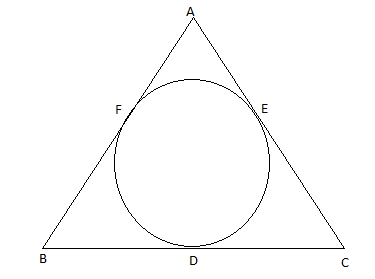
In $\Delta ABC$, a circle is inscribed .If $AB = 13cm,BC = 14cm$ and $AE = 7{\text{cm}}$. Find $AC$.
Answer
 Verified
585k+ views
Hint: We will use the fact that: tangents from the same external points are equal in length. Using the fact, we will have some equations for the sides for the triangle then using those equations and length mentioned in the questions, we will have our answer.
Complete step-by-step answer:
We see that $AB$ and $AC$ touch the circle at circle $F$ and $E$ respectively and nowhere else.
Hence we can say that $AB$ and $AC$ the tangents to the circle.
Because the tangent is a straight line or plane that touches a curve or curved surface at a point, but if extended does not cross it at that point.
Now we will use the fact that: Tangents from the same external points are in equal length.
Now tangents $AB$ and $AC$ cut at $F$ and $E$ respectively coming from the same point $A$
We are already given in the question that $AE = 7cm$
∴$AF = AE = 7cm$ (Since Tangents of the circle)
We are already given in the question that $AB = 13{\text{cm}}$
We can see in the figure clearly that\[AB = BF + AF\]
Now we have to find out $BF$ we can write it as,
$BF = AB - AF$
$ = 13 - 7$
Let us subtracting the terms
$ = 6{\text{cm}}$
Also we can see in the diagram clearly that $BC = CD + BD$
Now we have to find out $CD$, we can write it as,
$CD = BC - BD$
$ = 14 - 6$
On subtracting the terms we get,
$ = 8{\text{cm}}$
Since, we already know that the tangents of the circle
$CE = CD = 8cm$
We required the length of $AC$
$AC = AE + EC$
Substitute the value of $AE$ and $EC$ we get,
$ = 7 + 8$
On adding the terms we get,
$ = 15{\text{cm}}$
$\therefore $Hence we attained the required result.
That is $AC = 15cm$.
Note: The students might forget to write the units at the end, but without units we cannot talk about the concept of length.
Because writing just $10$ does not make any sense, but $10{\text{cm}}$ does make sense.
The student might think that ${\text{D, E and F}}$ are the midpoints but that is not necessary and you cannot put that argument without any solid reason as well.
Complete step-by-step answer:
We see that $AB$ and $AC$ touch the circle at circle $F$ and $E$ respectively and nowhere else.
Hence we can say that $AB$ and $AC$ the tangents to the circle.
Because the tangent is a straight line or plane that touches a curve or curved surface at a point, but if extended does not cross it at that point.
Now we will use the fact that: Tangents from the same external points are in equal length.
Now tangents $AB$ and $AC$ cut at $F$ and $E$ respectively coming from the same point $A$
We are already given in the question that $AE = 7cm$
∴$AF = AE = 7cm$ (Since Tangents of the circle)
We are already given in the question that $AB = 13{\text{cm}}$
We can see in the figure clearly that\[AB = BF + AF\]
Now we have to find out $BF$ we can write it as,
$BF = AB - AF$
$ = 13 - 7$
Let us subtracting the terms
$ = 6{\text{cm}}$
Also we can see in the diagram clearly that $BC = CD + BD$
Now we have to find out $CD$, we can write it as,
$CD = BC - BD$
$ = 14 - 6$
On subtracting the terms we get,
$ = 8{\text{cm}}$
Since, we already know that the tangents of the circle
$CE = CD = 8cm$
We required the length of $AC$
$AC = AE + EC$
Substitute the value of $AE$ and $EC$ we get,
$ = 7 + 8$
On adding the terms we get,
$ = 15{\text{cm}}$
$\therefore $Hence we attained the required result.
That is $AC = 15cm$.
Note: The students might forget to write the units at the end, but without units we cannot talk about the concept of length.
Because writing just $10$ does not make any sense, but $10{\text{cm}}$ does make sense.
The student might think that ${\text{D, E and F}}$ are the midpoints but that is not necessary and you cannot put that argument without any solid reason as well.

Recently Updated Pages
Master Class 8 Social Science: Engaging Questions & Answers for Success

Master Class 8 English: Engaging Questions & Answers for Success
Class 8 Question and Answer - Your Ultimate Solutions Guide
Master Class 8 Maths: Engaging Questions & Answers for Success
Master Class 8 Science: Engaging Questions & Answers for Success
Master Class 7 English: Engaging Questions & Answers for Success
Trending doubts
Difference Between Plant Cell and Animal Cell
Fill the blanks with the suitable prepositions 1 The class 9 english CBSE
Which places in India experience sunrise first and class 9 social science CBSE
Who is eligible for RTE class 9 social science CBSE
What is pollution? How many types of pollution? Define it
Name 10 Living and Non living things class 9 biology CBSE