




In ${\text{C}}{{\text{r}}_{\text{2}}}{{\text{O}}_{\text{7}}}^{{\text{2 - }}}$ every ${\text{Cr}}$ is linked to:
A) two O-atoms
B) three O-atoms
C) four O-atoms
D) five O-atoms
Answer
 Verified
600.9k+ views
Hint: Dichromate ion has a chemical formula ${\text{C}}{{\text{r}}_{\text{2}}}{{\text{O}}_{\text{7}}}^{{\text{2 - }}}$. Draw the structure of the dichromate ion and determine the number of an oxygen atom bonded with each ${\text{Cr}}$.
Complete step by step answer:
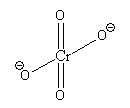
The prefix di stands for 2. So, the ion containing two chromate ions is known as dichromate ion. The structure of chromate ion (${\text{Cr}}{{\text{O}}_{\text{4}}}^{{\text{2 - }}}$) is as follows:
In chromate ion, there is one ${\text{Cr}}$ atom bonded with 4 ${\text{O}}$ atoms.
The structure of the dichromate ion ${\text{C}}{{\text{r}}_{\text{2}}}{{\text{O}}_{\text{7}}}^{{\text{2 - }}}$ is as follows:
In dichromate ion, there are 2 central ${\text{Cr}}$ atoms and 7 ${\text{O}}$ atoms.
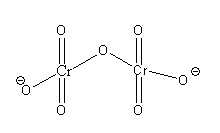
From the structure of dichromate ions, we can say that each central ${\text{Cr}}$ is bonded with 3 terminal oxygen atoms and 1 bride oxygen atom. Out of 7 oxygen atoms, 4 oxygen atoms are bonded with a double bond and 3 oxygen atoms are bonded with a single bond. Thus, each ${\text{Cr}}$ atom in dichromate ion is bonded with 4 oxygen atoms.
Hence, the correct option is (C) four O-atoms.
Additional Information: The bond angle of Cr-O-Cr is $126^\circ $. The bond length of bridge Cr-O is 179pm while the bond length of terminal Cr-O is 163 pm. The bond length of bridge Cr-O is greater than the bond length of the terminal Cr-O. This indicates all Cr-O bonds are not equal. The oxidation state of each Cr atom in dichromate ion is +6.
Note: Two tetrahedral chromate units share the oxygen atom and form dichromate ions. So, the number of oxygen atoms bonded with each ${\text{Cr}}$ atom in dichromate ion is the same as the number of oxygen atoms bonded with ${\text{Cr}}$ atom in chromate ion.
Complete step by step answer:
The prefix di stands for 2. So, the ion containing two chromate ions is known as dichromate ion. The structure of chromate ion (${\text{Cr}}{{\text{O}}_{\text{4}}}^{{\text{2 - }}}$) is as follows:
In chromate ion, there is one ${\text{Cr}}$ atom bonded with 4 ${\text{O}}$ atoms.
The structure of the dichromate ion ${\text{C}}{{\text{r}}_{\text{2}}}{{\text{O}}_{\text{7}}}^{{\text{2 - }}}$ is as follows:
In dichromate ion, there are 2 central ${\text{Cr}}$ atoms and 7 ${\text{O}}$ atoms.
From the structure of dichromate ions, we can say that each central ${\text{Cr}}$ is bonded with 3 terminal oxygen atoms and 1 bride oxygen atom. Out of 7 oxygen atoms, 4 oxygen atoms are bonded with a double bond and 3 oxygen atoms are bonded with a single bond. Thus, each ${\text{Cr}}$ atom in dichromate ion is bonded with 4 oxygen atoms.
Hence, the correct option is (C) four O-atoms.
Additional Information: The bond angle of Cr-O-Cr is $126^\circ $. The bond length of bridge Cr-O is 179pm while the bond length of terminal Cr-O is 163 pm. The bond length of bridge Cr-O is greater than the bond length of the terminal Cr-O. This indicates all Cr-O bonds are not equal. The oxidation state of each Cr atom in dichromate ion is +6.
Note: Two tetrahedral chromate units share the oxygen atom and form dichromate ions. So, the number of oxygen atoms bonded with each ${\text{Cr}}$ atom in dichromate ion is the same as the number of oxygen atoms bonded with ${\text{Cr}}$ atom in chromate ion.
Recently Updated Pages
Master Class 10 Computer Science: Engaging Questions & Answers for Success

Master Class 10 General Knowledge: Engaging Questions & Answers for Success
Master Class 10 English: Engaging Questions & Answers for Success
Master Class 10 Social Science: Engaging Questions & Answers for Success
Master Class 10 Maths: Engaging Questions & Answers for Success
Master Class 10 Science: Engaging Questions & Answers for Success
Trending doubts
Which are the Top 10 Largest Countries of the World?
Draw a labelled sketch of the human eye class 12 physics CBSE
Differentiate between homogeneous and heterogeneous class 12 chemistry CBSE
What are the major means of transport Explain each class 12 social science CBSE
Sulphuric acid is known as the king of acids State class 12 chemistry CBSE
Why should a magnesium ribbon be cleaned before burning class 12 chemistry CBSE