




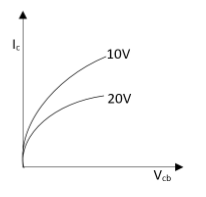
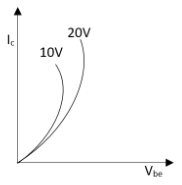
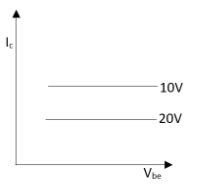
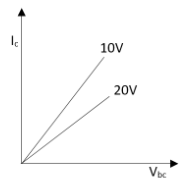
In common base transistor, the characteristic curve has been given as,
A.
B.
C.
D.
Answer
 Verified
623.4k+ views
Hint: Transistor Characteristics are basically the graphs which indicate the relationships between the current and the voltages of a transistor in a specific configuration. There are three types of characteristics. One is input characteristics. The other is output characteristics and the last one is current transfer characteristics. This will help you in answering this question.
Complete answer:
Transistor Characteristics are basically the graphs which indicate the relationships between the current and the voltages of a transistor in a specific configuration. By taking care of the configuration of transistor circuits to be identical to a two-port network, they can be checked by the help of the characteristic-curves. There are three types of characteristic curves. Input characteristics, output characteristics and current transfer characteristics. Input Characteristics define the variation in input current with the change in the values of input voltage keeping the output voltage constant. Output Characteristics is a graph representing the output current versus output voltage with a fixed input current. The current transfer Characteristics is a type of characteristic curve representing the change of output current with respect to the input current, keeping output voltage fixed. The output characteristics of CB configuration represents the change of collector current with collector base voltage, where the emitter current has been kept fixed. From the graph represented, the output resistance can be obtained as,
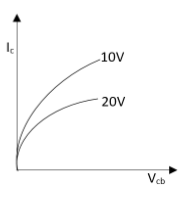
Therefore the correct answer has been mentioned as option A.
Note:
In common base Configuration, the base terminal of the transistor will be the common in between the output and the input terminals. This configuration will be giving a low input impedance, a high resistance gain, a high output impedance and high voltage gain.
Complete answer:
Transistor Characteristics are basically the graphs which indicate the relationships between the current and the voltages of a transistor in a specific configuration. By taking care of the configuration of transistor circuits to be identical to a two-port network, they can be checked by the help of the characteristic-curves. There are three types of characteristic curves. Input characteristics, output characteristics and current transfer characteristics. Input Characteristics define the variation in input current with the change in the values of input voltage keeping the output voltage constant. Output Characteristics is a graph representing the output current versus output voltage with a fixed input current. The current transfer Characteristics is a type of characteristic curve representing the change of output current with respect to the input current, keeping output voltage fixed. The output characteristics of CB configuration represents the change of collector current with collector base voltage, where the emitter current has been kept fixed. From the graph represented, the output resistance can be obtained as,
Therefore the correct answer has been mentioned as option A.
Note:
In common base Configuration, the base terminal of the transistor will be the common in between the output and the input terminals. This configuration will be giving a low input impedance, a high resistance gain, a high output impedance and high voltage gain.
Recently Updated Pages
Master Class 11 English: Engaging Questions & Answers for Success

Master Class 11 Physics: Engaging Questions & Answers for Success
Master Class 11 Computer Science: Engaging Questions & Answers for Success
Master Class 11 Chemistry: Engaging Questions & Answers for Success
Master Class 11 Social Science: Engaging Questions & Answers for Success
Master Class 11 Accountancy: Engaging Questions & Answers for Success
Trending doubts
Difference Between Prokaryotic Cells and Eukaryotic Cells
Two of the body parts which do not appear in MRI are class 11 biology CBSE
One Metric ton is equal to kg A 10000 B 1000 C 100 class 11 physics CBSE
10 examples of friction in our daily life
Draw a diagram of nephron and explain its structur class 11 biology CBSE
Draw a diagram of a plant cell and label at least eight class 11 biology CBSE