




In circular motion at a given instant centripetal acceleration is $3\dfrac{{cm}}{{{s^2}}}$ and the angle between the resultant acceleration and centripetal acceleration is ${45^ \circ }$. At that instant the magnitude of the resultant acceleration is:
A) $3\dfrac{{cm}}{{{s^2}}}$
B) $4.2\dfrac{{cm}}{{{s^2}}}$
C) $1.2\dfrac{{cm}}{{{s^2}}}$
D) $2.8\dfrac{{cm}}{{{s^2}}}$
Answer
 Verified
628.8k+ views
Hint- As, angle between the resultant acceleration and the centripetal acceleration is ${45^ \circ }$, therefore the angle between the resultant acceleration and the tangential acceleration is ${45^ \circ }$also since centripetal acceleration and tangential acceleration are perpendicular.
Formula used: \[{a_r}\cos \theta = {a_c}\]
Where, \[{a_r} = \]The resultant acceleration
\[{a_c} = \]The centripetal acceleration
θ= The angle between the resultant acceleration and the centripetal acceleration.
Complete step by step answer:
When an object is moving along a circular path, it has an acceleration along the radius towards the center of the circle or the circular path. This centralized acceleration is called centripetal acceleration.
Here given a resultant acceleration say \[{a_r}\] and a centripetal acceleration say \[{a_c} = 3\dfrac{{cm}}{{{s^2}}}\].
And, the angle between the resultant acceleration and the centripetal acceleration is given ${45^ \circ }$.
So, we may conclude that there must be an acceleration that exists towards the tangent along the radius at which the centripetal acceleration is working.
We may show the above assumption by a simple diagram,
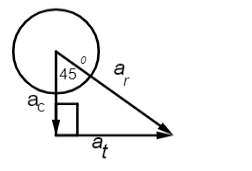
\[{a_r} = \]The resultant acceleration
\[{a_c} = \]The centripetal acceleration
\[{a_t} = \]The tangential acceleration.
Hence, the centripetal acceleration and the tangential acceleration are two components of the resultant acceleration.
So, if we divide the Resultant vector into two components at angle $\theta $ (given\[\theta = {45^0}\]) represented by the below diagram,
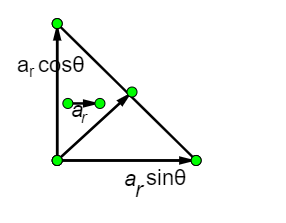
we can write, \[{a_r}\cos \theta = {a_c}\]
and, \[{a_r}\sin \theta = {a_t}\]
so, \[{a_r}\cos \theta = {a_c}\]
\[ \Rightarrow {a_r} = \dfrac{3}{{\cos {{45}^0}}}[\because {a_c} = 3,\theta = {45^0}]\]
\[ \Rightarrow {a_r} = \dfrac{3}{{\dfrac{1}{{\sqrt 2 }}}}\]
\[ \Rightarrow {a_r} = 3 \times \sqrt 2 \]
\[ \Rightarrow {a_r} = 4.24\]
Therefore the magnitude of the resultant is $4.2\dfrac{{cm}}{{{s^2}}}$.
Hence the option (B) is the right answer.
Notes: The centripetal acceleration acts towards the center of the circular path along the radius of the circle. Since the tangent and the radius of a circle is perpendicular to each other hence the tangential acceleration and centripetal acceleration are also perpendicular to each other.
The velocity of the object moving along a circular path always acts towards the tangent corresponding to the radius of the circle. Hence, the velocity is always perpendicular to the centripetal acceleration.
Formula used: \[{a_r}\cos \theta = {a_c}\]
Where, \[{a_r} = \]The resultant acceleration
\[{a_c} = \]The centripetal acceleration
θ= The angle between the resultant acceleration and the centripetal acceleration.
Complete step by step answer:
When an object is moving along a circular path, it has an acceleration along the radius towards the center of the circle or the circular path. This centralized acceleration is called centripetal acceleration.
Here given a resultant acceleration say \[{a_r}\] and a centripetal acceleration say \[{a_c} = 3\dfrac{{cm}}{{{s^2}}}\].
And, the angle between the resultant acceleration and the centripetal acceleration is given ${45^ \circ }$.
So, we may conclude that there must be an acceleration that exists towards the tangent along the radius at which the centripetal acceleration is working.
We may show the above assumption by a simple diagram,
\[{a_r} = \]The resultant acceleration
\[{a_c} = \]The centripetal acceleration
\[{a_t} = \]The tangential acceleration.
Hence, the centripetal acceleration and the tangential acceleration are two components of the resultant acceleration.
So, if we divide the Resultant vector into two components at angle $\theta $ (given\[\theta = {45^0}\]) represented by the below diagram,
we can write, \[{a_r}\cos \theta = {a_c}\]
and, \[{a_r}\sin \theta = {a_t}\]
so, \[{a_r}\cos \theta = {a_c}\]
\[ \Rightarrow {a_r} = \dfrac{3}{{\cos {{45}^0}}}[\because {a_c} = 3,\theta = {45^0}]\]
\[ \Rightarrow {a_r} = \dfrac{3}{{\dfrac{1}{{\sqrt 2 }}}}\]
\[ \Rightarrow {a_r} = 3 \times \sqrt 2 \]
\[ \Rightarrow {a_r} = 4.24\]
Therefore the magnitude of the resultant is $4.2\dfrac{{cm}}{{{s^2}}}$.
Hence the option (B) is the right answer.
Notes: The centripetal acceleration acts towards the center of the circular path along the radius of the circle. Since the tangent and the radius of a circle is perpendicular to each other hence the tangential acceleration and centripetal acceleration are also perpendicular to each other.
The velocity of the object moving along a circular path always acts towards the tangent corresponding to the radius of the circle. Hence, the velocity is always perpendicular to the centripetal acceleration.
Recently Updated Pages
Master Class 11 English: Engaging Questions & Answers for Success

Master Class 11 Social Science: Engaging Questions & Answers for Success
Master Class 11 Maths: Engaging Questions & Answers for Success
Master Class 11 Biology: Engaging Questions & Answers for Success
Master Class 11 Physics: Engaging Questions & Answers for Success
Master Class 11 Chemistry: Engaging Questions & Answers for Success
Trending doubts
One Metric ton is equal to kg A 10000 B 1000 C 100 class 11 physics CBSE
What is cell theory Who formulated it class 11 biology CBSE
Phyllotaxy is the arrangement of ALeaflets BLeaves class 11 biology CBSE
Difference Between Prokaryotic Cells and Eukaryotic Cells
The symbiotic association of fungi and algae is called class 11 biology CBSE
Cell theory was formulated by A Schleiden and Schwann class 11 biology CBSE