




In case of a projectile motion, what is the angle between the velocity and acceleration at the highest point?
A. $0^\circ $
B. $45^\circ $
C. $90^\circ $
D. $180^\circ $
Answer
 Verified
479.4k+ views
Hint: First we need to draw a rough diagram representing all the required parameters to solve the given problem. The main parameters in this problem are the velocity and the acceleration. Now with the help of a diagram and using the projectile motion concept we can find the correct option given in the above problem.
Complete step by step answer:
As per the problem we have to find the angle between the velocity and acceleration at the highest point. Now when a particle is projected an angle of $\theta $, having some initial velocity u moving along a curved path under constant acceleration acting in downward direction can be represented as given,
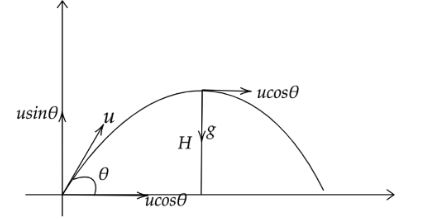
As per the diagram H is the highest point of the projectile motion and at the highest point the velocity acting is $u\cos \theta $ and the acceleration acting on the particle is the constant acceleration and it is acting in downward direction and it the acceleration due to gravity. Hence acceleration and velocity are perpendicular to each other. Now from the above figure and from the above discussion we can conclude that the angle between the velocity and acceleration at the highest point is $90^\circ $.
Therefore, the correct answer is option C.
Note: Remember here the projectile motion is defined as when a particle is through obliquely from the earth’s surface and will move in a curved path under the action of constant acceleration and that is directed towards the center of the earth. Keep in mind that here the particle is assumed to remain close to the surface of the earth.
Complete step by step answer:
As per the problem we have to find the angle between the velocity and acceleration at the highest point. Now when a particle is projected an angle of $\theta $, having some initial velocity u moving along a curved path under constant acceleration acting in downward direction can be represented as given,
As per the diagram H is the highest point of the projectile motion and at the highest point the velocity acting is $u\cos \theta $ and the acceleration acting on the particle is the constant acceleration and it is acting in downward direction and it the acceleration due to gravity. Hence acceleration and velocity are perpendicular to each other. Now from the above figure and from the above discussion we can conclude that the angle between the velocity and acceleration at the highest point is $90^\circ $.
Therefore, the correct answer is option C.
Note: Remember here the projectile motion is defined as when a particle is through obliquely from the earth’s surface and will move in a curved path under the action of constant acceleration and that is directed towards the center of the earth. Keep in mind that here the particle is assumed to remain close to the surface of the earth.
Recently Updated Pages
Master Class 11 Computer Science: Engaging Questions & Answers for Success

Master Class 11 Business Studies: Engaging Questions & Answers for Success
Master Class 11 Economics: Engaging Questions & Answers for Success
Master Class 11 English: Engaging Questions & Answers for Success
Master Class 11 Maths: Engaging Questions & Answers for Success
Master Class 11 Biology: Engaging Questions & Answers for Success
Trending doubts
One Metric ton is equal to kg A 10000 B 1000 C 100 class 11 physics CBSE
There are 720 permutations of the digits 1 2 3 4 5 class 11 maths CBSE
Discuss the various forms of bacteria class 11 biology CBSE
Draw a diagram of a plant cell and label at least eight class 11 biology CBSE
State the laws of reflection of light
Explain zero factorial class 11 maths CBSE