




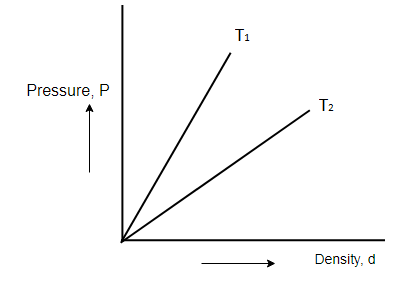
In Boyle's experiment for a given gas at different temperatures the graph drawn between pressure and density are straight lines as shown then:
A. \[{{T}_{1}}>{{T}_{2}}\]
B. \[{{T}_{2}}>{{T}_{1}}\]
C. \[{{T}_{1}}={{T}_{2}}\]
D. \[{{T}_{1}}^{3}={{T}_{2}}\]
Answer
 Verified
594.9k+ views
Hint: Pressure- density graph of a gas at different temperatures is given here. We have an ideal gas equation which relates pressure and temperature. And this equation can be converted in terms of pressure density and temperature.
Formula used:
\[PV=nRT\]
\[\text{n=}\dfrac{m}{M}\]
\[d=\dfrac{m}{V}\]
\[\text{y=mx+c}\]
Complete answer:
We have ideal gas law,
\[PV=nRT\] --------- 1
Where,
\[P=\text{Pressure of the gas}\]
\[\text{V= Volume of the gas}\]
\[\text{n= Number of moles of the gas}\]
\[\text{R=Gas constant}\]
\[\text{T= Temperature of the gas}\]
Since the graph is drawn between pressure and density, let’s convert the ideal gas equation in terms of density and pressure.
We have,
Number of moles,
\[\text{n=}\dfrac{m}{M}\]
Where, \[M-\text{Molar mass of the gas}\]
\[\text{m- mass of the gas}\]
Then,
\[PV=\dfrac{m}{M}RT\]
\[P=\dfrac{m}{M}\dfrac{RT}{V}\]
We have, density, \[d=\dfrac{m}{V}\]
\[P=\dfrac{dRT}{M}\]
\[P=dT\left( \dfrac{R}{M} \right)\] -------- 2
Here \[R\]and \[M\] are constant. Now the ideal gas equation is converted in terms of \[P,d\text{ and T}\]
We have, straight line equation \[\text{y=mx+c}\]----- 3
Comparing the equation 2 with equation 3
\[Slope=T\left( \dfrac{R}{M} \right)\]
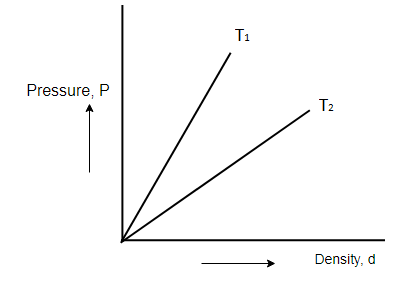
Since \[\dfrac{R}{M}\] is constant, \[T\] determines the slope of the Pressure-density graph.
i.e., as the value of \[T\] increases, slope also increases.
From the graph, slope of \[{{T}_{1}}\] is higher than slope of \[{{T}_{2}}\]
\[{{T}_{1}}\left( \dfrac{R}{M} \right)>{{T}_{2}}\left( \dfrac{R}{M} \right)\]
Hence,
\[{{T}_{1}}>{{T}_{2}}\]
So, the correct answer is “Option A”.
Note:
Ideal gas law can be used in problems in which gases are involved. Unless specified in the question, most of the ideal gas equations only work if S.I. units are used. i.e., while applying the ideal gas equation to solve the problems, convert the pressure in \[Pascal(Pa)\], Volume in \[{{m}^{3}}\] and temperature in\[Kelvin(K)\]. If we have \[N-\text{ No}\text{. of molecules of gas}\] in the question, instead of \[\text{n - no}\text{. of moles}\], we can use the ideal gas equation, \[PV=N{{k}_{B}}T\] , Where, \[{{\text{k}}_{\text{B}}}\text{(Boltzmann }\!\!'\!\!\text{ s constant) =}1.38\times {{10}^{-23}}\dfrac{J}{K}\]
Formula used:
\[PV=nRT\]
\[\text{n=}\dfrac{m}{M}\]
\[d=\dfrac{m}{V}\]
\[\text{y=mx+c}\]
Complete answer:
We have ideal gas law,
\[PV=nRT\] --------- 1
Where,
\[P=\text{Pressure of the gas}\]
\[\text{V= Volume of the gas}\]
\[\text{n= Number of moles of the gas}\]
\[\text{R=Gas constant}\]
\[\text{T= Temperature of the gas}\]
Since the graph is drawn between pressure and density, let’s convert the ideal gas equation in terms of density and pressure.
We have,
Number of moles,
\[\text{n=}\dfrac{m}{M}\]
Where, \[M-\text{Molar mass of the gas}\]
\[\text{m- mass of the gas}\]
Then,
\[PV=\dfrac{m}{M}RT\]
\[P=\dfrac{m}{M}\dfrac{RT}{V}\]
We have, density, \[d=\dfrac{m}{V}\]
\[P=\dfrac{dRT}{M}\]
\[P=dT\left( \dfrac{R}{M} \right)\] -------- 2
Here \[R\]and \[M\] are constant. Now the ideal gas equation is converted in terms of \[P,d\text{ and T}\]
We have, straight line equation \[\text{y=mx+c}\]----- 3
Comparing the equation 2 with equation 3
\[Slope=T\left( \dfrac{R}{M} \right)\]
Since \[\dfrac{R}{M}\] is constant, \[T\] determines the slope of the Pressure-density graph.
i.e., as the value of \[T\] increases, slope also increases.
From the graph, slope of \[{{T}_{1}}\] is higher than slope of \[{{T}_{2}}\]
\[{{T}_{1}}\left( \dfrac{R}{M} \right)>{{T}_{2}}\left( \dfrac{R}{M} \right)\]
Hence,
\[{{T}_{1}}>{{T}_{2}}\]
So, the correct answer is “Option A”.
Note:
Ideal gas law can be used in problems in which gases are involved. Unless specified in the question, most of the ideal gas equations only work if S.I. units are used. i.e., while applying the ideal gas equation to solve the problems, convert the pressure in \[Pascal(Pa)\], Volume in \[{{m}^{3}}\] and temperature in\[Kelvin(K)\]. If we have \[N-\text{ No}\text{. of molecules of gas}\] in the question, instead of \[\text{n - no}\text{. of moles}\], we can use the ideal gas equation, \[PV=N{{k}_{B}}T\] , Where, \[{{\text{k}}_{\text{B}}}\text{(Boltzmann }\!\!'\!\!\text{ s constant) =}1.38\times {{10}^{-23}}\dfrac{J}{K}\]
Recently Updated Pages
Master Class 11 Social Science: Engaging Questions & Answers for Success

Master Class 11 English: Engaging Questions & Answers for Success
Master Class 11 Maths: Engaging Questions & Answers for Success
Master Class 11 Chemistry: Engaging Questions & Answers for Success
Master Class 11 Biology: Engaging Questions & Answers for Success
Master Class 11 Physics: Engaging Questions & Answers for Success
Trending doubts
One Metric ton is equal to kg A 10000 B 1000 C 100 class 11 physics CBSE
Difference Between Prokaryotic Cells and Eukaryotic Cells
How many of the following diseases can be studied with class 11 biology CBSE
Draw a diagram of a plant cell and label at least eight class 11 biology CBSE
Two of the body parts which do not appear in MRI are class 11 biology CBSE
Which gas is abundant in air class 11 chemistry CBSE