




In any \[\Delta ABC,\] the least value of \[\left( {\dfrac{{{{\sin }^2}A + \sin A + 1}}{{\sin A}}} \right)\] is
A. 3
B. \[\sqrt 3 \]
C. \[9\]
D. None of these
Answer
 Verified
584.4k+ views
Hint: First of all, split the given function and cancel the common terms. Then use algebraic identities to form the function in terms of a square value. As the value of a square is always greater than zero, we can easily find the least value of the given function. So, use this concept to reach the solution of the given problem.
Complete step-by-step answer:
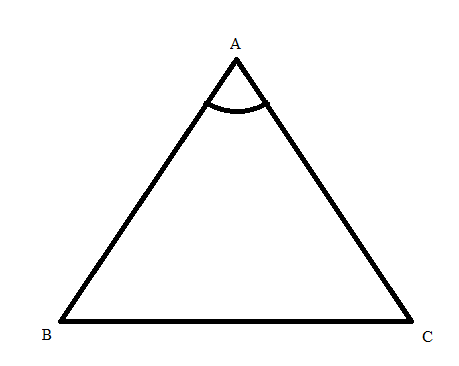
Let the given triangle \[\Delta ABC\] as shown in the below figure:
Let \[F\left( A \right) = \left( {\dfrac{{{{\sin }^2}A + \sin A + 1}}{{\sin A}}} \right)\]
Separating the fractions, we have
\[ \Rightarrow F\left( A \right) = \dfrac{{{{\sin }^2}A}}{{\sin A}} + \dfrac{{\sin A}}{{\sin A}} + \dfrac{1}{{\sin A}}\]
Cancelling the common terms, we have
\[
\Rightarrow F\left( A \right) = \sin A + 1 + \dfrac{1}{{\sin A}} \\
\Rightarrow F\left( A \right) = \sin A + \dfrac{1}{{\sin A}} + 1 \\
\]
We know that \[a + \dfrac{1}{a} = {\left( {\sqrt a - \dfrac{1}{{\sqrt a }}} \right)^2} + 2\], by using this formula we get
\[
\Rightarrow F\left( A \right) = {\left( {\sqrt {\sin A} - \dfrac{1}{{\sqrt {\sin A} }}} \right)^2} + 2 + 1 \\
\Rightarrow F\left( A \right) = {\left( {\sqrt {\sin A} - \dfrac{1}{{\sqrt {\sin A} }}} \right)^2} + 3..................................\left( 1 \right) \\
\]
We know that, the value of \[{\left( {\sqrt {\sin A} - \dfrac{1}{{\sqrt {\sin A} }}} \right)^2}\] is always greater or equal to zero i.e., \[{\left( {\sqrt {\sin A} - \dfrac{1}{{\sqrt {\sin A} }}} \right)^2} \geqslant 0\].
Adding ‘3’ on both sides in \[{\left( {\sqrt {\sin A} - \dfrac{1}{{\sqrt {\sin A} }}} \right)^2} \geqslant 0\], we have
\[
\Rightarrow {\left( {\sqrt {\sin A} - \dfrac{1}{{\sqrt {\sin A} }}} \right)^2} + 3 \geqslant 0 + 3 \\
\Rightarrow {\left( {\sqrt {\sin A} - \dfrac{1}{{\sqrt {\sin A} }}} \right)^2} + 3 \geqslant 3..................................\left( 2 \right) \\
\]
By using equations (1) and (2), we have
\[
\Rightarrow F\left( A \right) = {\left( {\sqrt {\sin A} - \dfrac{1}{{\sqrt {\sin A} }}} \right)^2} + 3 \geqslant 3 \\
\therefore F\left( A \right) = \left( {\dfrac{{{{\sin }^2}A + \sin A + 1}}{{\sin A}}} \right) \geqslant 3 \\
\]
Therefore, clearly the least value of \[\left( {\dfrac{{{{\sin }^2}A + \sin A + 1}}{{\sin A}}} \right)\] is 3.
So, the correct answer is “Option A”.
Note: In case if we are enabled to form the given function in terms of a square value, then use the second derivative test for the function to find the greatest and least value of the given function.
Complete step-by-step answer:
Let the given triangle \[\Delta ABC\] as shown in the below figure:
Let \[F\left( A \right) = \left( {\dfrac{{{{\sin }^2}A + \sin A + 1}}{{\sin A}}} \right)\]
Separating the fractions, we have
\[ \Rightarrow F\left( A \right) = \dfrac{{{{\sin }^2}A}}{{\sin A}} + \dfrac{{\sin A}}{{\sin A}} + \dfrac{1}{{\sin A}}\]
Cancelling the common terms, we have
\[
\Rightarrow F\left( A \right) = \sin A + 1 + \dfrac{1}{{\sin A}} \\
\Rightarrow F\left( A \right) = \sin A + \dfrac{1}{{\sin A}} + 1 \\
\]
We know that \[a + \dfrac{1}{a} = {\left( {\sqrt a - \dfrac{1}{{\sqrt a }}} \right)^2} + 2\], by using this formula we get
\[
\Rightarrow F\left( A \right) = {\left( {\sqrt {\sin A} - \dfrac{1}{{\sqrt {\sin A} }}} \right)^2} + 2 + 1 \\
\Rightarrow F\left( A \right) = {\left( {\sqrt {\sin A} - \dfrac{1}{{\sqrt {\sin A} }}} \right)^2} + 3..................................\left( 1 \right) \\
\]
We know that, the value of \[{\left( {\sqrt {\sin A} - \dfrac{1}{{\sqrt {\sin A} }}} \right)^2}\] is always greater or equal to zero i.e., \[{\left( {\sqrt {\sin A} - \dfrac{1}{{\sqrt {\sin A} }}} \right)^2} \geqslant 0\].
Adding ‘3’ on both sides in \[{\left( {\sqrt {\sin A} - \dfrac{1}{{\sqrt {\sin A} }}} \right)^2} \geqslant 0\], we have
\[
\Rightarrow {\left( {\sqrt {\sin A} - \dfrac{1}{{\sqrt {\sin A} }}} \right)^2} + 3 \geqslant 0 + 3 \\
\Rightarrow {\left( {\sqrt {\sin A} - \dfrac{1}{{\sqrt {\sin A} }}} \right)^2} + 3 \geqslant 3..................................\left( 2 \right) \\
\]
By using equations (1) and (2), we have
\[
\Rightarrow F\left( A \right) = {\left( {\sqrt {\sin A} - \dfrac{1}{{\sqrt {\sin A} }}} \right)^2} + 3 \geqslant 3 \\
\therefore F\left( A \right) = \left( {\dfrac{{{{\sin }^2}A + \sin A + 1}}{{\sin A}}} \right) \geqslant 3 \\
\]
Therefore, clearly the least value of \[\left( {\dfrac{{{{\sin }^2}A + \sin A + 1}}{{\sin A}}} \right)\] is 3.
So, the correct answer is “Option A”.
Note: In case if we are enabled to form the given function in terms of a square value, then use the second derivative test for the function to find the greatest and least value of the given function.
Recently Updated Pages
Master Class 11 Computer Science: Engaging Questions & Answers for Success

Master Class 11 Business Studies: Engaging Questions & Answers for Success
Master Class 11 Economics: Engaging Questions & Answers for Success
Master Class 11 English: Engaging Questions & Answers for Success
Master Class 11 Maths: Engaging Questions & Answers for Success
Master Class 11 Biology: Engaging Questions & Answers for Success
Trending doubts
One Metric ton is equal to kg A 10000 B 1000 C 100 class 11 physics CBSE
There are 720 permutations of the digits 1 2 3 4 5 class 11 maths CBSE
Discuss the various forms of bacteria class 11 biology CBSE
Draw a diagram of a plant cell and label at least eight class 11 biology CBSE
State the laws of reflection of light
Explain zero factorial class 11 maths CBSE