




In any $\Delta ABC$, prove the following:
$\dfrac{b\sec B+c\sec C}{\tan B+\tan C}=\dfrac{c\sec C+a\sec A}{\tan C+\tan A}=\dfrac{a\sec A+b\sec B}{\tan A+\tan B}$.
Answer
 Verified
610.5k+ views
Hint: We use the properties of triangles involving the values of sides, angles and the circum-radius R of $\Delta ABC$. We have to show that the three expressions of trigo are the same. We find their individual value using the properties. All of them are equal to 2R.
Complete step by step answer:
To prove the given equation, we are going to use some properties of triangles involving trigonometric ratios of the angles and the sides.
For $\Delta ABC$, the opposite sides of the angles $\angle A,\angle B,\angle C$ are $a,b,c$ respectively.
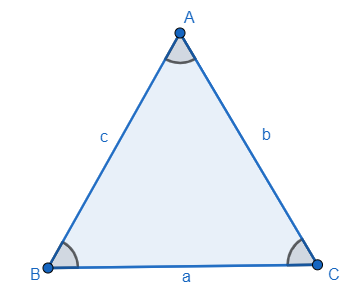
So, we have the identities $\sec A=\dfrac{2bc}{{{b}^{2}}+{{c}^{2}}-{{a}^{2}}}$. Similarly, we have $\sec B=\dfrac{2ac}{{{a}^{2}}+{{c}^{2}}-{{b}^{2}}}$ and $\sec C=\dfrac{2ab}{{{a}^{2}}+{{b}^{2}}-{{c}^{2}}}$.
We also have $\tan A=\dfrac{abc}{R\left( {{b}^{2}}+{{c}^{2}}-{{a}^{2}} \right)},\tan B=\dfrac{abc}{R\left( {{a}^{2}}+{{c}^{2}}-{{b}^{2}} \right)},\tan C=\dfrac{abc}{R\left( {{a}^{2}}+{{b}^{2}}-{{c}^{2}} \right)}$.
Here R defines the circum-radius of $\Delta ABC$.
Now we place the values in the equations.
For $\dfrac{b\sec B+c\sec C}{\tan B+\tan C}$, we get $\dfrac{b\sec B+c\sec C}{\tan B+\tan C}=\dfrac{b\left( \dfrac{2ac}{{{a}^{2}}+{{c}^{2}}-{{b}^{2}}} \right)+c\left( \dfrac{2ab}{{{a}^{2}}+{{b}^{2}}-{{c}^{2}}} \right)}{\dfrac{abc}{R\left( {{a}^{2}}+{{c}^{2}}-{{b}^{2}} \right)}+\dfrac{abc}{R\left( {{a}^{2}}+{{b}^{2}}-{{c}^{2}} \right)}}$.
We solve to get $\dfrac{b\sec B+c\sec C}{\tan B+\tan C}=\dfrac{2abc\left( \dfrac{1}{{{a}^{2}}+{{c}^{2}}-{{b}^{2}}}+\dfrac{1}{{{a}^{2}}+{{b}^{2}}-{{c}^{2}}} \right)}{\dfrac{abc}{R}\left( \dfrac{1}{{{a}^{2}}+{{c}^{2}}-{{b}^{2}}}+\dfrac{1}{{{a}^{2}}+{{b}^{2}}-{{c}^{2}}} \right)}=2R$.
For $\dfrac{c\sec C+a\sec A}{\tan C+\tan A}$, we get $\dfrac{c\sec C+a\sec A}{\tan C+\tan A}=\dfrac{c\left( \dfrac{2ab}{{{a}^{2}}+{{b}^{2}}-{{c}^{2}}} \right)+a\left( \dfrac{2bc}{{{b}^{2}}+{{c}^{2}}-{{a}^{2}}} \right)}{\dfrac{abc}{R\left( {{a}^{2}}+{{b}^{2}}-{{c}^{2}} \right)}+\dfrac{abc}{R\left( {{b}^{2}}+{{c}^{2}}-{{a}^{2}} \right)}}$.
We solve to get \[\dfrac{c\sec C+a\sec A}{\tan C+\tan A}=\dfrac{2abc\left( \dfrac{1}{{{a}^{2}}+{{b}^{2}}-{{c}^{2}}}+\dfrac{1}{{{b}^{2}}+{{c}^{2}}-{{a}^{2}}} \right)}{\dfrac{abc}{R}\left( \dfrac{1}{{{a}^{2}}+{{b}^{2}}-{{c}^{2}}}+\dfrac{1}{{{b}^{2}}+{{c}^{2}}-{{a}^{2}}} \right)}=2R\].
For $\dfrac{a\sec A+b\sec B}{\tan A+\tan B}$, we get $\dfrac{a\sec A+b\sec B}{\tan A+\tan B}=\dfrac{a\left( \dfrac{2bc}{{{b}^{2}}+{{c}^{2}}-{{a}^{2}}} \right)+b\left( \dfrac{2ac}{{{a}^{2}}+{{c}^{2}}-{{b}^{2}}} \right)}{\dfrac{abc}{R\left( {{b}^{2}}+{{c}^{2}}-{{a}^{2}} \right)}+\dfrac{abc}{R\left( {{a}^{2}}+{{c}^{2}}-{{b}^{2}} \right)}}$.
We solve to get $\dfrac{a\sec A+b\sec B}{\tan A+\tan B}=\dfrac{2abc\left( \dfrac{1}{{{b}^{2}}+{{c}^{2}}-{{a}^{2}}}+\dfrac{1}{{{a}^{2}}+{{c}^{2}}-{{b}^{2}}} \right)}{\dfrac{abc}{R}\left( \dfrac{1}{{{b}^{2}}+{{c}^{2}}-{{a}^{2}}}+\dfrac{1}{{{a}^{2}}+{{c}^{2}}-{{b}^{2}}} \right)}=2R$.
So, $\dfrac{b\sec B+c\sec C}{\tan B+\tan C}=\dfrac{c\sec C+a\sec A}{\tan C+\tan A}=\dfrac{a\sec A+b\sec B}{\tan A+\tan B}=2R$. Thus proved.
Note: In the final step of every solution finding we eliminated terms like $a,b,c$ and $\dfrac{1}{{{b}^{2}}+{{c}^{2}}-{{a}^{2}}}+\dfrac{1}{{{a}^{2}}+{{c}^{2}}-{{b}^{2}}}$. That’s possible only because all the values of the expressions are positive. Otherwise it wouldn’t have been possible. The formulas of $\sec \theta $ are coming from the inverse theorem of $\cos \theta $. For example: $\cos A=\dfrac{{{b}^{2}}+{{c}^{2}}-{{a}^{2}}}{2bc}$. We took both side inverse to get $\dfrac{1}{\cos A}=\dfrac{1}{\dfrac{{{b}^{2}}+{{c}^{2}}-{{a}^{2}}}{2bc}}\Rightarrow \sec A=\dfrac{2bc}{{{b}^{2}}+{{c}^{2}}-{{a}^{2}}}$. Same goes for other angles too.
Complete step by step answer:
To prove the given equation, we are going to use some properties of triangles involving trigonometric ratios of the angles and the sides.
For $\Delta ABC$, the opposite sides of the angles $\angle A,\angle B,\angle C$ are $a,b,c$ respectively.
So, we have the identities $\sec A=\dfrac{2bc}{{{b}^{2}}+{{c}^{2}}-{{a}^{2}}}$. Similarly, we have $\sec B=\dfrac{2ac}{{{a}^{2}}+{{c}^{2}}-{{b}^{2}}}$ and $\sec C=\dfrac{2ab}{{{a}^{2}}+{{b}^{2}}-{{c}^{2}}}$.
We also have $\tan A=\dfrac{abc}{R\left( {{b}^{2}}+{{c}^{2}}-{{a}^{2}} \right)},\tan B=\dfrac{abc}{R\left( {{a}^{2}}+{{c}^{2}}-{{b}^{2}} \right)},\tan C=\dfrac{abc}{R\left( {{a}^{2}}+{{b}^{2}}-{{c}^{2}} \right)}$.
Here R defines the circum-radius of $\Delta ABC$.
Now we place the values in the equations.
For $\dfrac{b\sec B+c\sec C}{\tan B+\tan C}$, we get $\dfrac{b\sec B+c\sec C}{\tan B+\tan C}=\dfrac{b\left( \dfrac{2ac}{{{a}^{2}}+{{c}^{2}}-{{b}^{2}}} \right)+c\left( \dfrac{2ab}{{{a}^{2}}+{{b}^{2}}-{{c}^{2}}} \right)}{\dfrac{abc}{R\left( {{a}^{2}}+{{c}^{2}}-{{b}^{2}} \right)}+\dfrac{abc}{R\left( {{a}^{2}}+{{b}^{2}}-{{c}^{2}} \right)}}$.
We solve to get $\dfrac{b\sec B+c\sec C}{\tan B+\tan C}=\dfrac{2abc\left( \dfrac{1}{{{a}^{2}}+{{c}^{2}}-{{b}^{2}}}+\dfrac{1}{{{a}^{2}}+{{b}^{2}}-{{c}^{2}}} \right)}{\dfrac{abc}{R}\left( \dfrac{1}{{{a}^{2}}+{{c}^{2}}-{{b}^{2}}}+\dfrac{1}{{{a}^{2}}+{{b}^{2}}-{{c}^{2}}} \right)}=2R$.
For $\dfrac{c\sec C+a\sec A}{\tan C+\tan A}$, we get $\dfrac{c\sec C+a\sec A}{\tan C+\tan A}=\dfrac{c\left( \dfrac{2ab}{{{a}^{2}}+{{b}^{2}}-{{c}^{2}}} \right)+a\left( \dfrac{2bc}{{{b}^{2}}+{{c}^{2}}-{{a}^{2}}} \right)}{\dfrac{abc}{R\left( {{a}^{2}}+{{b}^{2}}-{{c}^{2}} \right)}+\dfrac{abc}{R\left( {{b}^{2}}+{{c}^{2}}-{{a}^{2}} \right)}}$.
We solve to get \[\dfrac{c\sec C+a\sec A}{\tan C+\tan A}=\dfrac{2abc\left( \dfrac{1}{{{a}^{2}}+{{b}^{2}}-{{c}^{2}}}+\dfrac{1}{{{b}^{2}}+{{c}^{2}}-{{a}^{2}}} \right)}{\dfrac{abc}{R}\left( \dfrac{1}{{{a}^{2}}+{{b}^{2}}-{{c}^{2}}}+\dfrac{1}{{{b}^{2}}+{{c}^{2}}-{{a}^{2}}} \right)}=2R\].
For $\dfrac{a\sec A+b\sec B}{\tan A+\tan B}$, we get $\dfrac{a\sec A+b\sec B}{\tan A+\tan B}=\dfrac{a\left( \dfrac{2bc}{{{b}^{2}}+{{c}^{2}}-{{a}^{2}}} \right)+b\left( \dfrac{2ac}{{{a}^{2}}+{{c}^{2}}-{{b}^{2}}} \right)}{\dfrac{abc}{R\left( {{b}^{2}}+{{c}^{2}}-{{a}^{2}} \right)}+\dfrac{abc}{R\left( {{a}^{2}}+{{c}^{2}}-{{b}^{2}} \right)}}$.
We solve to get $\dfrac{a\sec A+b\sec B}{\tan A+\tan B}=\dfrac{2abc\left( \dfrac{1}{{{b}^{2}}+{{c}^{2}}-{{a}^{2}}}+\dfrac{1}{{{a}^{2}}+{{c}^{2}}-{{b}^{2}}} \right)}{\dfrac{abc}{R}\left( \dfrac{1}{{{b}^{2}}+{{c}^{2}}-{{a}^{2}}}+\dfrac{1}{{{a}^{2}}+{{c}^{2}}-{{b}^{2}}} \right)}=2R$.
So, $\dfrac{b\sec B+c\sec C}{\tan B+\tan C}=\dfrac{c\sec C+a\sec A}{\tan C+\tan A}=\dfrac{a\sec A+b\sec B}{\tan A+\tan B}=2R$. Thus proved.
Note: In the final step of every solution finding we eliminated terms like $a,b,c$ and $\dfrac{1}{{{b}^{2}}+{{c}^{2}}-{{a}^{2}}}+\dfrac{1}{{{a}^{2}}+{{c}^{2}}-{{b}^{2}}}$. That’s possible only because all the values of the expressions are positive. Otherwise it wouldn’t have been possible. The formulas of $\sec \theta $ are coming from the inverse theorem of $\cos \theta $. For example: $\cos A=\dfrac{{{b}^{2}}+{{c}^{2}}-{{a}^{2}}}{2bc}$. We took both side inverse to get $\dfrac{1}{\cos A}=\dfrac{1}{\dfrac{{{b}^{2}}+{{c}^{2}}-{{a}^{2}}}{2bc}}\Rightarrow \sec A=\dfrac{2bc}{{{b}^{2}}+{{c}^{2}}-{{a}^{2}}}$. Same goes for other angles too.
Recently Updated Pages
Master Class 11 English: Engaging Questions & Answers for Success

Master Class 11 Social Science: Engaging Questions & Answers for Success
Master Class 11 Maths: Engaging Questions & Answers for Success
Master Class 11 Biology: Engaging Questions & Answers for Success
Master Class 11 Physics: Engaging Questions & Answers for Success
Master Class 11 Chemistry: Engaging Questions & Answers for Success
Trending doubts
Explain the Treaty of Vienna of 1815 class 10 social science CBSE
What is the Total Duration of Football Match?
First Cotton Mill of India
In which year voting age was reduced from 21 to 18?
10 examples of evaporation in daily life with explanations
What planets have no moons Which one has only one moon class 10 physics CBSE