




In any $\Delta ABC$, prove that $\dfrac{\cos A}{a}+\dfrac{\cos B}{b}+\dfrac{\cos C}{c}=\dfrac{\left( {{a}^{2}}+{{b}^{2}}+{{c}^{2}} \right)}{2abc}$.
Answer
 Verified
612k+ views
Hint: We will be using the concept of trigonometry, solution of triangles to solve the problem. We will be using cosine rules to solve the problem. Use triangle diagrams to understand the concept easily.
Complete step-by-step answer:
We have been given a$\Delta ABC$ and we have to prove that $\dfrac{\cos A}{a}+\dfrac{\cos B}{b}+\dfrac{\cos C}{c}=\dfrac{\left( {{a}^{2}}+{{b}^{2}}+{{c}^{2}} \right)}{2abc}$.
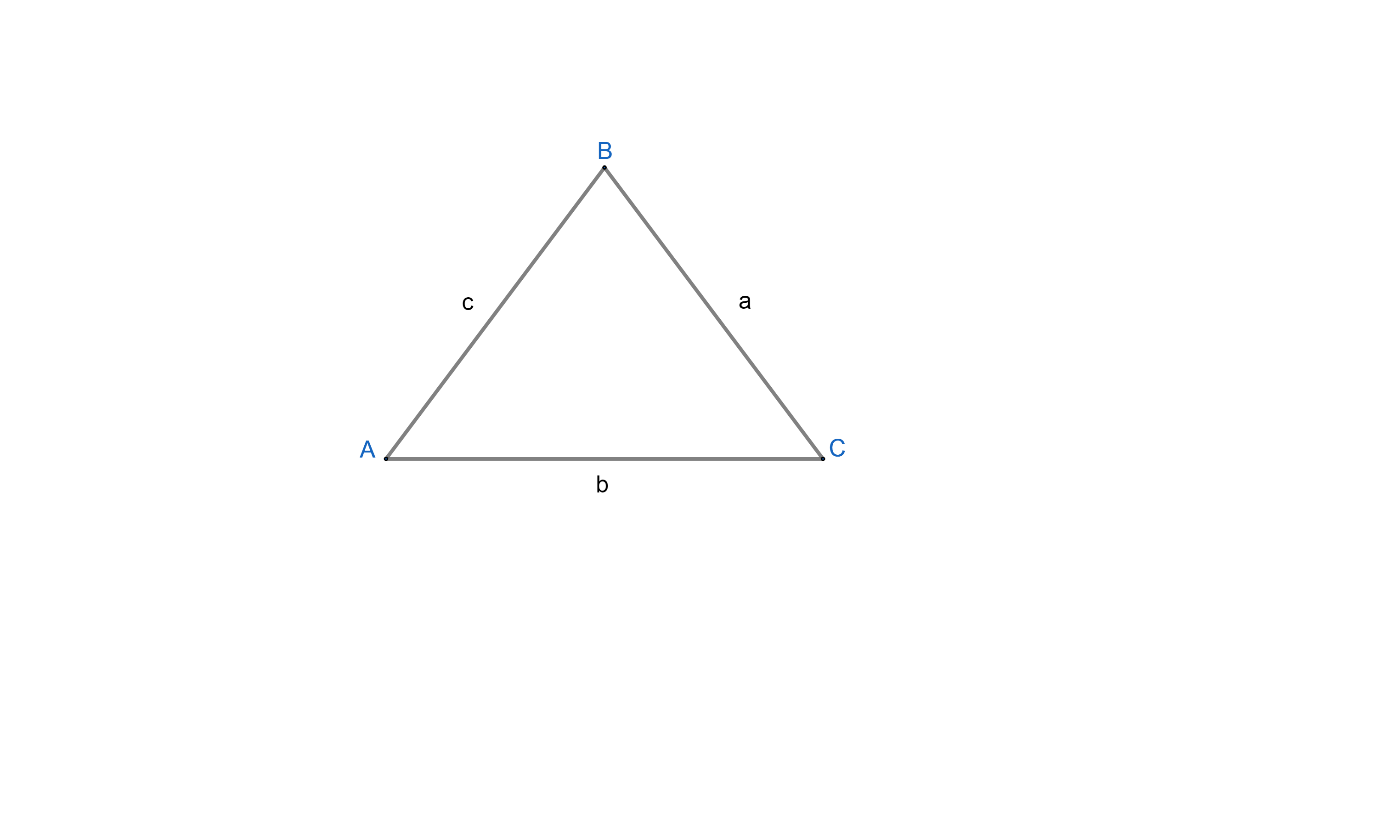
Now, we will first draw a $\Delta ABC$ and label its sides a, b, c.
Now, we know that according to cosine rule,
$\begin{align}
& \cos A=\dfrac{{{b}^{2}}+{{c}^{2}}-{{a}^{2}}}{2bc}..........\left( 1 \right) \\
& \cos B=\dfrac{{{a}^{2}}+{{c}^{2}}-{{b}^{2}}}{2ac}..........\left( 2 \right) \\
& \cos C=\dfrac{{{a}^{2}}+{{b}^{2}}-{{c}^{2}}}{2ab}..........\left( 3 \right) \\
\end{align}$
Now, we will take left – hand side and prove it to be equal to right hand side. Now, in L.H.S we have,
$\dfrac{\cos A}{a}+\dfrac{\cos B}{b}+\dfrac{\cos C}{c}$
Now, we will substitute the value of $\cos A,\cos B,\cos C$ from equation (1), (2), (3) in L.H.S. So, we get,
\[\begin{align}
& \dfrac{\cos A}{a}+\dfrac{\cos B}{b}+\dfrac{\cos C}{c}=\dfrac{{{b}^{2}}+{{c}^{2}}-{{a}^{2}}}{2abc}+\dfrac{{{a}^{2}}+{{c}^{2}}-{{b}^{2}}}{2abc}+\dfrac{{{a}^{2}}+{{b}^{2}}-{{c}^{2}}}{2abc} \\
& =\dfrac{{{b}^{2}}+{{c}^{2}}-{{a}^{2}}+{{a}^{2}}+{{c}^{2}}-{{b}^{2}}+{{a}^{2}}+{{b}^{2}}-{{c}^{2}}}{2abc} \\
\end{align}\]
Now, on further simplifying we get,
$\dfrac{\cos A}{a}+\dfrac{\cos B}{b}+\dfrac{\cos C}{c}=\dfrac{\left( {{a}^{2}}+{{b}^{2}}+{{c}^{2}} \right)}{2abc}$
Since, L.H.S = R.H.S
Hence, we have proved that $\dfrac{\cos A}{a}+\dfrac{\cos B}{b}+\dfrac{\cos C}{c}=\dfrac{\left( {{a}^{2}}+{{b}^{2}}+{{c}^{2}} \right)}{2abc}$.
Note: To solve these types of questions one must remember cosine rule, sine rule to simplify the solution.
Sine rule is:
$\dfrac{\sin A}{a}=\dfrac{\sin B}{b}=\dfrac{\sin C}{c}=k$
Complete step-by-step answer:
We have been given a$\Delta ABC$ and we have to prove that $\dfrac{\cos A}{a}+\dfrac{\cos B}{b}+\dfrac{\cos C}{c}=\dfrac{\left( {{a}^{2}}+{{b}^{2}}+{{c}^{2}} \right)}{2abc}$.
Now, we will first draw a $\Delta ABC$ and label its sides a, b, c.
Now, we know that according to cosine rule,
$\begin{align}
& \cos A=\dfrac{{{b}^{2}}+{{c}^{2}}-{{a}^{2}}}{2bc}..........\left( 1 \right) \\
& \cos B=\dfrac{{{a}^{2}}+{{c}^{2}}-{{b}^{2}}}{2ac}..........\left( 2 \right) \\
& \cos C=\dfrac{{{a}^{2}}+{{b}^{2}}-{{c}^{2}}}{2ab}..........\left( 3 \right) \\
\end{align}$
Now, we will take left – hand side and prove it to be equal to right hand side. Now, in L.H.S we have,
$\dfrac{\cos A}{a}+\dfrac{\cos B}{b}+\dfrac{\cos C}{c}$
Now, we will substitute the value of $\cos A,\cos B,\cos C$ from equation (1), (2), (3) in L.H.S. So, we get,
\[\begin{align}
& \dfrac{\cos A}{a}+\dfrac{\cos B}{b}+\dfrac{\cos C}{c}=\dfrac{{{b}^{2}}+{{c}^{2}}-{{a}^{2}}}{2abc}+\dfrac{{{a}^{2}}+{{c}^{2}}-{{b}^{2}}}{2abc}+\dfrac{{{a}^{2}}+{{b}^{2}}-{{c}^{2}}}{2abc} \\
& =\dfrac{{{b}^{2}}+{{c}^{2}}-{{a}^{2}}+{{a}^{2}}+{{c}^{2}}-{{b}^{2}}+{{a}^{2}}+{{b}^{2}}-{{c}^{2}}}{2abc} \\
\end{align}\]
Now, on further simplifying we get,
$\dfrac{\cos A}{a}+\dfrac{\cos B}{b}+\dfrac{\cos C}{c}=\dfrac{\left( {{a}^{2}}+{{b}^{2}}+{{c}^{2}} \right)}{2abc}$
Since, L.H.S = R.H.S
Hence, we have proved that $\dfrac{\cos A}{a}+\dfrac{\cos B}{b}+\dfrac{\cos C}{c}=\dfrac{\left( {{a}^{2}}+{{b}^{2}}+{{c}^{2}} \right)}{2abc}$.
Note: To solve these types of questions one must remember cosine rule, sine rule to simplify the solution.
Sine rule is:
$\dfrac{\sin A}{a}=\dfrac{\sin B}{b}=\dfrac{\sin C}{c}=k$
Recently Updated Pages
Master Class 11 Business Studies: Engaging Questions & Answers for Success

Master Class 11 Computer Science: Engaging Questions & Answers for Success
Master Class 11 Economics: Engaging Questions & Answers for Success
Master Class 11 Social Science: Engaging Questions & Answers for Success
Master Class 11 Chemistry: Engaging Questions & Answers for Success
Master Class 11 English: Engaging Questions & Answers for Success
Trending doubts
One Metric ton is equal to kg A 10000 B 1000 C 100 class 11 physics CBSE
Discuss the various forms of bacteria class 11 biology CBSE
Draw a diagram of a plant cell and label at least eight class 11 biology CBSE
State the laws of reflection of light
Explain zero factorial class 11 maths CBSE
10 examples of friction in our daily life