




In any $\Delta ABC$, prove that
$a\sin \left( B-C \right)+b\sin \left( C-A \right)+c\sin \left( A-B \right)=0$
Answer
 Verified
624.9k+ views
Hint: Try to simplify the left-hand side of the equation given in the question using the formula of sin(X-Y) followed by the application of the sine rule of a triangle.
Complete step-by-step answer:
Before starting with the solution, let us draw a diagram for better visualisation.
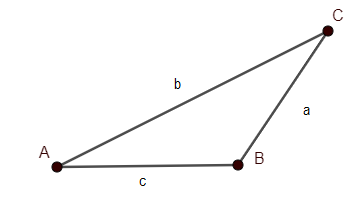
Now starting with the left-hand side of the equation that is given in the question. To start the simplification, we need to use the formula sin(X-Y) = cosYsinX – sinYcosX.
$a\sin \left( B-C \right)+b\sin \left( C-A \right)+c\sin \left( A-B \right)$
\[=a\left( \sin B\cos C-\cos B\sin C \right)+b\left( \sin C\operatorname{cosA}-\cos C\sin A \right)+c\left( \sin A\cos B-\cos A\sin B \right)\]
Now we know, according to the sine rule of the triangle: $\dfrac{a}{\sin A}=\dfrac{b}{\sin B}=\dfrac{c}{\sin C}=k$ and in other terms, it can be written as:
$\begin{align}
& \dfrac{a}{k}=\sin A \\
& \dfrac{b}{k}=\sin B \\
& \dfrac{c}{k}=\sin C \\
\end{align}$
So, applying this to our expression, we get
\[=a\left( \dfrac{b}{k}\cos C-\dfrac{c}{k}\cos B \right)+b\left(
\dfrac{c}{k}\operatorname{cosA}-\dfrac{a}{k}\cos C \right)+c\left( \dfrac{a}{k}\cos
B-\dfrac{b}{k}\cos A \right)\]
Now we will take $\dfrac{1}{k}$ common from all the terms. On doing so, we get
\[=\dfrac{1}{k}\left( a\left( b\cos C-c\cos B \right)+b\left( c\operatorname{cosA}-a\cos C \right)+c\left( a\cos B-b\cos A \right) \right)\]
To further simplify the expression, we will multiply and open all the brackets. This will give us:
\[=\dfrac{1}{k}\left( ab\cos C-ac\cos B+bc\operatorname{cosA}-ab\cos C+ca\cos B-bc\cos A \right)\]
In the above expression we can clearly see that each term is getting cancelled out, giving the final expression to be:
\[=\dfrac{1}{k}\times 0\]
Now from the conditions of sine rule, we know that k is not equal to zero, so we can say that $\dfrac{1}{k}$ is finite. We also know that a finite number multiplied by zero gives the product as zero. Therefore, our expression is:
\[=\dfrac{1}{k}\times 0=0\]
The left-hand side of the equation given in the question is equal to the right-hand side of the equation which is equal to zero. Hence, we can say that we have proved the equation given in the question.
Note: Be careful about the calculation and the signs while opening the brackets. Also, remember that, infinity multiplied by zero can is not always zero; it can be a finite number or infinity as well.
Complete step-by-step answer:
Before starting with the solution, let us draw a diagram for better visualisation.
Now starting with the left-hand side of the equation that is given in the question. To start the simplification, we need to use the formula sin(X-Y) = cosYsinX – sinYcosX.
$a\sin \left( B-C \right)+b\sin \left( C-A \right)+c\sin \left( A-B \right)$
\[=a\left( \sin B\cos C-\cos B\sin C \right)+b\left( \sin C\operatorname{cosA}-\cos C\sin A \right)+c\left( \sin A\cos B-\cos A\sin B \right)\]
Now we know, according to the sine rule of the triangle: $\dfrac{a}{\sin A}=\dfrac{b}{\sin B}=\dfrac{c}{\sin C}=k$ and in other terms, it can be written as:
$\begin{align}
& \dfrac{a}{k}=\sin A \\
& \dfrac{b}{k}=\sin B \\
& \dfrac{c}{k}=\sin C \\
\end{align}$
So, applying this to our expression, we get
\[=a\left( \dfrac{b}{k}\cos C-\dfrac{c}{k}\cos B \right)+b\left(
\dfrac{c}{k}\operatorname{cosA}-\dfrac{a}{k}\cos C \right)+c\left( \dfrac{a}{k}\cos
B-\dfrac{b}{k}\cos A \right)\]
Now we will take $\dfrac{1}{k}$ common from all the terms. On doing so, we get
\[=\dfrac{1}{k}\left( a\left( b\cos C-c\cos B \right)+b\left( c\operatorname{cosA}-a\cos C \right)+c\left( a\cos B-b\cos A \right) \right)\]
To further simplify the expression, we will multiply and open all the brackets. This will give us:
\[=\dfrac{1}{k}\left( ab\cos C-ac\cos B+bc\operatorname{cosA}-ab\cos C+ca\cos B-bc\cos A \right)\]
In the above expression we can clearly see that each term is getting cancelled out, giving the final expression to be:
\[=\dfrac{1}{k}\times 0\]
Now from the conditions of sine rule, we know that k is not equal to zero, so we can say that $\dfrac{1}{k}$ is finite. We also know that a finite number multiplied by zero gives the product as zero. Therefore, our expression is:
\[=\dfrac{1}{k}\times 0=0\]
The left-hand side of the equation given in the question is equal to the right-hand side of the equation which is equal to zero. Hence, we can say that we have proved the equation given in the question.
Note: Be careful about the calculation and the signs while opening the brackets. Also, remember that, infinity multiplied by zero can is not always zero; it can be a finite number or infinity as well.
Recently Updated Pages
Basicity of sulphurous acid and sulphuric acid are

Master Class 11 Business Studies: Engaging Questions & Answers for Success
Master Class 11 Computer Science: Engaging Questions & Answers for Success
Master Class 11 Economics: Engaging Questions & Answers for Success
Master Class 11 Social Science: Engaging Questions & Answers for Success
Master Class 11 English: Engaging Questions & Answers for Success
Trending doubts
One Metric ton is equal to kg A 10000 B 1000 C 100 class 11 physics CBSE
The largest wind power cluster is located in the state class 11 social science CBSE
Explain zero factorial class 11 maths CBSE
State and prove Bernoullis theorem class 11 physics CBSE
Which among the following are examples of coming together class 11 social science CBSE
Can anyone list 10 advantages and disadvantages of friction