




In any $\Delta ABC$, prove that $ac\cos B-bc\cos A=\left( {{a}^{2}}-{{b}^{2}} \right)$.
Answer
 Verified
631.2k+ views
Hint: We will be using the concept of solution of triangles to solve the problem. We will be using cosine rules to relate the cosine of angle B and A with the sides of the triangle then we will use this value of cosB and cosA and substitute it in the left hand side of the equation to be proved then we will further simplify the equation to prove it to be equal to right hand side.
Complete Step-by-Step solution:
We have been given a $\Delta ABC$ and we have to prove that $ ac\cos B-bc\cos A=\left( {{a}^{2}}-{{b}^{2}} \right)$.
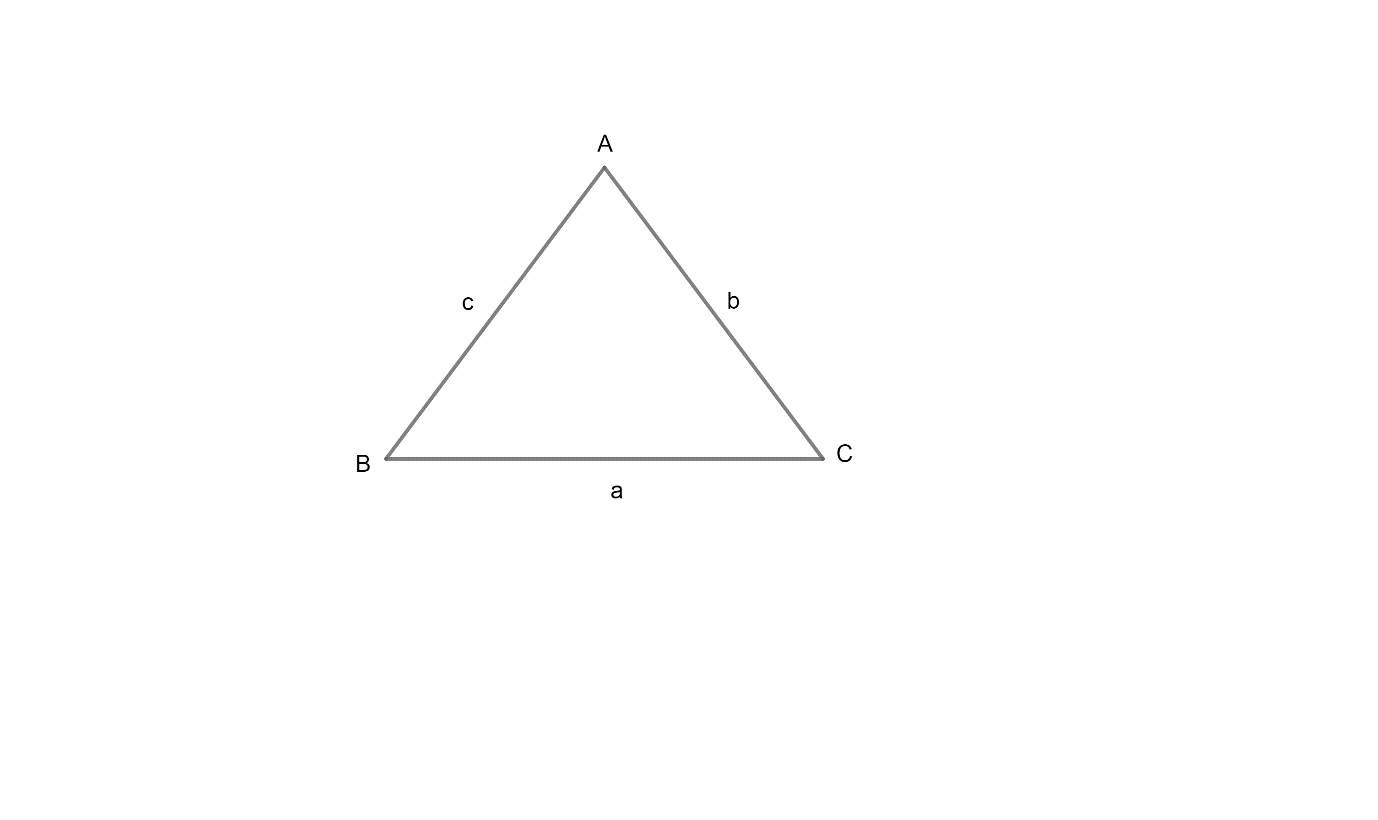
We will first draw a $\Delta ABC$ and mark its sides a, b, c.
Now, we know that according to cosine rule,
$\begin{align}
& \cos B=\dfrac{{{a}^{2}}+{{c}^{2}}-{{b}^{2}}}{2ac}..........\left( 1 \right) \\
& \cos A=\dfrac{{{b}^{2}}+{{c}^{2}}-{{a}^{2}}}{2bc}..........\left( 2 \right) \\
\end{align}$
Now, we will take the left – hand side and prove it equal to the right hand side. So, we have L.H.S as,
$ac\cos B-bc\cos A$
Now, we will substitute equation (1) & (2), so, we get,
\[\begin{align}
& =ac\left( \dfrac{{{a}^{2}}+{{c}^{2}}-{{b}^{2}}}{2ac} \right)-bc\left( \dfrac{{{b}^{2}}+{{c}^{2}}-{{a}^{2}}}{2bc} \right) \\
& ac\cos B-bc\cos A=\dfrac{{{a}^{2}}+{{c}^{2}}-{{b}^{2}}}{2}-\dfrac{\left( {{b}^{2}}+{{c}^{2}}-{{a}^{2}} \right)}{2} \\
& =\dfrac{1}{2}\left( {{a}^{2}}+{{c}^{2}}-{{b}^{2}}-{{b}^{2}}-{{c}^{2}}+{{a}^{2}} \right) \\
& =\dfrac{1}{2}\left( 2{{a}^{2}}-2{{b}^{2}} \right) \\
& ={{a}^{2}}-{{b}^{2}} \\
& ac\cos B-bc\cos A=\left( {{a}^{2}}-{{b}^{2}} \right) \\
\end{align}\]
Since, we have L.H.S = R.H.S
Hence, \[ac\cos B-bc\cos A=\left( {{a}^{2}}-{{b}^{2}} \right)\] is proved.
Note: To solve these types of questions it is important to notice that we have used cosine rule to relate the value of the cosB and cosA with the sides of the triangle because in the right hand side of the equation to be proved we have only sides of triangle therefore we have used the cosine rule.
Complete Step-by-Step solution:
We have been given a $\Delta ABC$ and we have to prove that $ ac\cos B-bc\cos A=\left( {{a}^{2}}-{{b}^{2}} \right)$.
We will first draw a $\Delta ABC$ and mark its sides a, b, c.
Now, we know that according to cosine rule,
$\begin{align}
& \cos B=\dfrac{{{a}^{2}}+{{c}^{2}}-{{b}^{2}}}{2ac}..........\left( 1 \right) \\
& \cos A=\dfrac{{{b}^{2}}+{{c}^{2}}-{{a}^{2}}}{2bc}..........\left( 2 \right) \\
\end{align}$
Now, we will take the left – hand side and prove it equal to the right hand side. So, we have L.H.S as,
$ac\cos B-bc\cos A$
Now, we will substitute equation (1) & (2), so, we get,
\[\begin{align}
& =ac\left( \dfrac{{{a}^{2}}+{{c}^{2}}-{{b}^{2}}}{2ac} \right)-bc\left( \dfrac{{{b}^{2}}+{{c}^{2}}-{{a}^{2}}}{2bc} \right) \\
& ac\cos B-bc\cos A=\dfrac{{{a}^{2}}+{{c}^{2}}-{{b}^{2}}}{2}-\dfrac{\left( {{b}^{2}}+{{c}^{2}}-{{a}^{2}} \right)}{2} \\
& =\dfrac{1}{2}\left( {{a}^{2}}+{{c}^{2}}-{{b}^{2}}-{{b}^{2}}-{{c}^{2}}+{{a}^{2}} \right) \\
& =\dfrac{1}{2}\left( 2{{a}^{2}}-2{{b}^{2}} \right) \\
& ={{a}^{2}}-{{b}^{2}} \\
& ac\cos B-bc\cos A=\left( {{a}^{2}}-{{b}^{2}} \right) \\
\end{align}\]
Since, we have L.H.S = R.H.S
Hence, \[ac\cos B-bc\cos A=\left( {{a}^{2}}-{{b}^{2}} \right)\] is proved.
Note: To solve these types of questions it is important to notice that we have used cosine rule to relate the value of the cosB and cosA with the sides of the triangle because in the right hand side of the equation to be proved we have only sides of triangle therefore we have used the cosine rule.
Recently Updated Pages
Master Class 11 English: Engaging Questions & Answers for Success

Master Class 11 Maths: Engaging Questions & Answers for Success
Class 11 Question and Answer - Your Ultimate Solutions Guide
Master Class 11 Biology: Engaging Questions & Answers for Success
Master Class 11 Physics: Engaging Questions & Answers for Success
Master Class 11 Accountancy: Engaging Questions & Answers for Success
Trending doubts
Explain the Treaty of Vienna of 1815 class 10 social science CBSE
Who Won 36 Oscar Awards? Record Holder Revealed
What is the median of the first 10 natural numbers class 10 maths CBSE
Why is it 530 pm in india when it is 1200 afternoon class 10 social science CBSE
Why is there a time difference of about 5 hours between class 10 social science CBSE
What is the full form of POSCO class 10 social science CBSE