




In angiosperms, functional megaspore develops into
(a) Embryo sac
(b) Ovule
(c) Endosperm
(d) Pollen sac
Answer
 Verified
615.6k+ views
Hint: In angiosperms, functional megaspore develops into a female gametophyte which is located in the nucellus. In plants, fertilization occurs in this location and forms the egg cell or nucleus developing into an embryo after fertilization.
Complete Step by Step Answer: The functional megaspore grows into an Embryo sac in angiosperms. An Embryo sac is a female gametophyte located in the nucleus and is formed from functional megaspore.
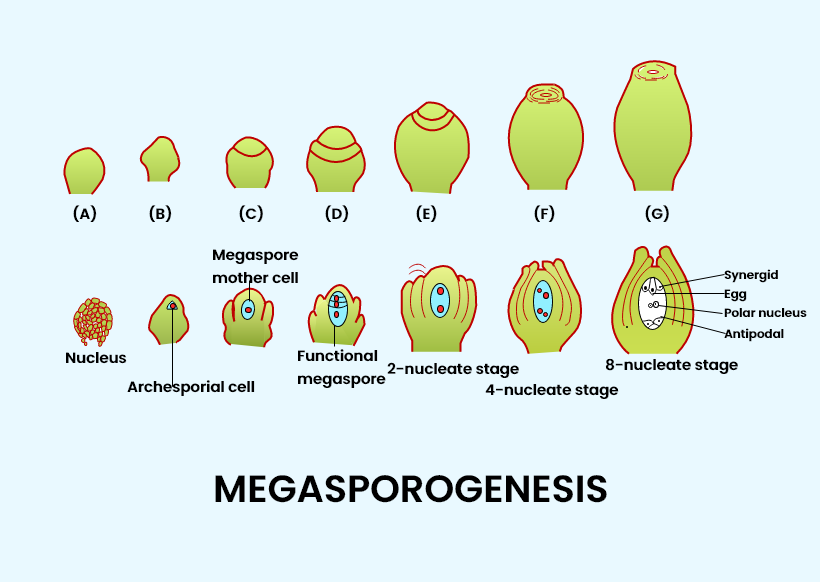 The nucleus of chalazal functional megaspore (fourth from micropyle) divides mitotically to form two nuclei which move to opposite poles, forming the 2 nucleate embryo sac. Two sequential mitotic nuclear divisions results in the formation of 4-nucleates and later the 8-nucleate stages of the embryo sac. One nucleus from each pole moves to the middle to form polar nuclei.
At this stage, the following changes occur - Three of the nuclei (n) get organized as the cells of the micropylar end forming egg apparatus. One is the egg cell (n) and two are the synergids (n). - three nuclei get organized as the antipodal cell (n) at the chalazal end. - Two nuclei in the center are called the polar nuclei (n). - This constitutes a 7-celled and 8-nucleated embryo sac.
So, the answer is “Embryo sac”.
Additional Information: The process of formation of megaspores from the megaspore mother cell (MMC) is called megasporogenesis. Ovules typically discern a single mother cell of the megaspore in the nucellus micropylar area.
The MMC undergoes meiosis and forms a four haploid megaspore linear tetrad. From which three degenerates (micropylar end) and three functional (chalazal end) remain.
Note: - MMC is a large cell containing dense cytoplasm and a prominent nucleus. - To ensure the formation of haploid female gametophyte before fertilization MMC undergoes meiosis. - These mitotic divisions are strictly free nuclear i.e.; nuclear divisions are not followed immediately by cell wall formation. - In the majority of angiosperms, one of the megaspores is functional while the three degenerates. Only the functional megaspore (n) develops into the female gametophyte. This process of embryo sac formation from a single megaspore is termed as Monosporic development. - Polygonum type of embryo sac is found in 80% of flowering plants. This development has been studied in Polygonum by Strasburger.
Complete Step by Step Answer: The functional megaspore grows into an Embryo sac in angiosperms. An Embryo sac is a female gametophyte located in the nucleus and is formed from functional megaspore.
At this stage, the following changes occur - Three of the nuclei (n) get organized as the cells of the micropylar end forming egg apparatus. One is the egg cell (n) and two are the synergids (n). - three nuclei get organized as the antipodal cell (n) at the chalazal end. - Two nuclei in the center are called the polar nuclei (n). - This constitutes a 7-celled and 8-nucleated embryo sac.
So, the answer is “Embryo sac”.
Additional Information: The process of formation of megaspores from the megaspore mother cell (MMC) is called megasporogenesis. Ovules typically discern a single mother cell of the megaspore in the nucellus micropylar area.
The MMC undergoes meiosis and forms a four haploid megaspore linear tetrad. From which three degenerates (micropylar end) and three functional (chalazal end) remain.
Note: - MMC is a large cell containing dense cytoplasm and a prominent nucleus. - To ensure the formation of haploid female gametophyte before fertilization MMC undergoes meiosis. - These mitotic divisions are strictly free nuclear i.e.; nuclear divisions are not followed immediately by cell wall formation. - In the majority of angiosperms, one of the megaspores is functional while the three degenerates. Only the functional megaspore (n) develops into the female gametophyte. This process of embryo sac formation from a single megaspore is termed as Monosporic development. - Polygonum type of embryo sac is found in 80% of flowering plants. This development has been studied in Polygonum by Strasburger.
Recently Updated Pages
Master Class 12 Economics: Engaging Questions & Answers for Success

Master Class 12 English: Engaging Questions & Answers for Success
Master Class 12 Social Science: Engaging Questions & Answers for Success
Master Class 12 Maths: Engaging Questions & Answers for Success
Master Class 12 Physics: Engaging Questions & Answers for Success
Master Class 9 General Knowledge: Engaging Questions & Answers for Success
Trending doubts
One Metric ton is equal to kg A 10000 B 1000 C 100 class 11 physics CBSE
Difference Between Prokaryotic Cells and Eukaryotic Cells
Two of the body parts which do not appear in MRI are class 11 biology CBSE
Find the value of the expression given below sin 30circ class 11 maths CBSE
1 ton equals to A 100 kg B 1000 kg C 10 kg D 10000 class 11 physics CBSE
Draw a diagram of nephron and explain its structur class 11 biology CBSE