



In an obtuse angled triangle, the sum of the squares on the sides making the obtuse angle is
(a) less than the square on third side
(b) greater than the square on the third side
(c) equal to the square on the third side
(d) none of these
Answer
 Verified
637.2k+ views
Hint: First, we should know that obtuse angle is the angle greater than 90 degree. We can take three sides as variable a, b, c. Then, we should know the property of it which states that “the side opposite to the obtuse angle is the longest side”. From this, we can take example and see that whether the condition ${{a}^{2}}+{{b}^{2}}<{{c}^{2}}$ is satisfied or not.
Complete step-by-step answer:
Here, we will first see what the obtuse angle in the triangle is.
The obtuse angle in a triangle can be any one of the three angles in the triangle whose angle should be greater than 90 degree. And the remaining two angles should be less than 90 degrees. Then, such a triangle is called an obtuse angle triangle. Figure is as shown below.
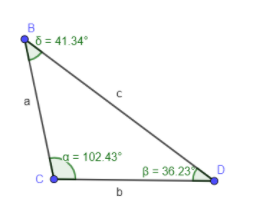
Here, we can take any triangle suppose BCD whose angle C is greater than 90 degree and angle b and angle D is less than 90 degree which we can see in above figure. So, this is called an obtuse angle triangle.
Now, let us consider sides of this triangle BCD as a, b, c. We can draw as:
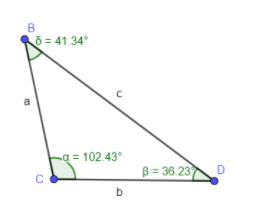
Now, there is the property of obtuse angle triangle which states that” the side opposite to the obtuse angle is the longest side”. So, from this we can know that side c is the longest side. If we take a as 5, b as 7 and c as 10 then squaring sides a and b, we get
${{a}^{2}}+{{b}^{2}}={{5}^{2}}+{{7}^{2}}=25+49=74$
If we square the longest side i.e. c we get, ${{c}^{2}}={{10}^{2}}=100$
$\therefore {{a}^{2}}+{{b}^{2}}<{{c}^{2}}$
Thus, the sum of the squares on the sides making the obtuse angle is less than the third side.
Option (a) is the correct answer.
Note: This is similar to the property that the third side of a triangle should be less than the sum of any two sides of a triangle. For example: let's take $a=4,b=6,c=8$ then, if we add a + b , we get 4+6 i.e. 10 so, now the third side i.e. side c should be less than 10 which is 8 here. But when you take square of side c, we get a greater side as compared to square of both sides. So, it is the same for obtuse angle triangles also.
Complete step-by-step answer:
Here, we will first see what the obtuse angle in the triangle is.
The obtuse angle in a triangle can be any one of the three angles in the triangle whose angle should be greater than 90 degree. And the remaining two angles should be less than 90 degrees. Then, such a triangle is called an obtuse angle triangle. Figure is as shown below.
Here, we can take any triangle suppose BCD whose angle C is greater than 90 degree and angle b and angle D is less than 90 degree which we can see in above figure. So, this is called an obtuse angle triangle.
Now, let us consider sides of this triangle BCD as a, b, c. We can draw as:
Now, there is the property of obtuse angle triangle which states that” the side opposite to the obtuse angle is the longest side”. So, from this we can know that side c is the longest side. If we take a as 5, b as 7 and c as 10 then squaring sides a and b, we get
${{a}^{2}}+{{b}^{2}}={{5}^{2}}+{{7}^{2}}=25+49=74$
If we square the longest side i.e. c we get, ${{c}^{2}}={{10}^{2}}=100$
$\therefore {{a}^{2}}+{{b}^{2}}<{{c}^{2}}$
Thus, the sum of the squares on the sides making the obtuse angle is less than the third side.
Option (a) is the correct answer.
Note: This is similar to the property that the third side of a triangle should be less than the sum of any two sides of a triangle. For example: let's take $a=4,b=6,c=8$ then, if we add a + b , we get 4+6 i.e. 10 so, now the third side i.e. side c should be less than 10 which is 8 here. But when you take square of side c, we get a greater side as compared to square of both sides. So, it is the same for obtuse angle triangles also.
Recently Updated Pages
Master Class 11 English: Engaging Questions & Answers for Success

Master Class 11 Social Science: Engaging Questions & Answers for Success
Master Class 11 Maths: Engaging Questions & Answers for Success
Master Class 11 Biology: Engaging Questions & Answers for Success
Master Class 11 Physics: Engaging Questions & Answers for Success
Master Class 11 Chemistry: Engaging Questions & Answers for Success
Trending doubts