




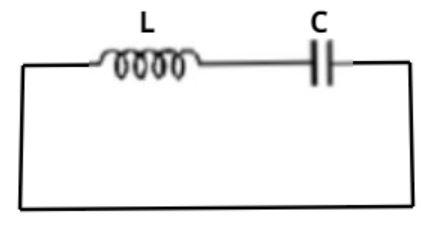
In an LC circuit the capacitor has maximum charge ${q_0}$. The value of ${\left( {\dfrac{{dI}}{{dt}}} \right)_{\max }}$, where I is the current in the circuit and $t$ is time, is
$\left( A \right)\dfrac{{{q_o}}}{{LC}}$
$\left( B \right)\dfrac{{{q_o}}}{{\sqrt {LC} }}$
$\left( C \right)\dfrac{{{q_o}}}{{LC}} - 1$
$\left( D \right)\dfrac{{{q_o}}}{{LC}} + 1$
Answer
 Verified
635.4k+ views
Hint: In this question the connection is series and in series connection current always remains the same, so according to the maximum power transfer theorem the power on both the components should be equal therefore voltage of both the components should be equal so use these concepts to reach the solution of the question.
Formula used – $\left( {{V_L}} \right) = L\left( {\dfrac{{dI}}{{dt}}} \right)$, $\left( {{V_C}} \right) = \dfrac{Q}{C}$
Complete Step-by-Step solution:
As we see that L and C are connected in series so for maximum case the voltage on both should be equal.
Let the voltage on inductor (L) = ${V_L}$ and voltage on capacitor (C) = ${V_C}$
$ \Rightarrow {V_L} = {V_C}$
$ \Rightarrow {\left( {{V_L}} \right)_{\max }} = {\left( {{V_C}} \right)_{\max }}$................ (1)
Now as we know that in series connection current remains the same.
So the voltage on inductor is
$ \Rightarrow {\left( {{V_L}} \right)_{\max }} = L{\left( {\dfrac{{dI}}{{dt}}} \right)_{\max }}$
And the voltage on capacitor is
$ \Rightarrow {\left( {{V_C}} \right)_{\max }} = \dfrac{{{Q_{\max }}}}{C}$
Now it is given that ${Q_{\max }} = {q_o}$
$ \Rightarrow {\left( {{V_C}} \right)_{\max }} = \dfrac{{{q_o}}}{C}$
Now according to equation (1) equate these two equations we have,
$ \Rightarrow L{\left( {\dfrac{{dI}}{{dt}}} \right)_{\max }} = \dfrac{{{q_o}}}{C}$
$ \Rightarrow {\left( {\dfrac{{dI}}{{dt}}} \right)_{\max }} = \dfrac{{{q_o}}}{{LC}}$
So this is the required answer.
Hence option (A) is the correct answer.
Note – Whenever we face such types of question the key concept is series connection as in series connection current remains same and we have to developed the condition for maximum phenomenon so that voltage on both the components should be equal so simplify equate them and write component general voltage formula as above and simplify we will get the required answer.
If the connection is in parallel, voltage remains the same but passing current from each component is different.
Formula used – $\left( {{V_L}} \right) = L\left( {\dfrac{{dI}}{{dt}}} \right)$, $\left( {{V_C}} \right) = \dfrac{Q}{C}$
Complete Step-by-Step solution:
As we see that L and C are connected in series so for maximum case the voltage on both should be equal.
Let the voltage on inductor (L) = ${V_L}$ and voltage on capacitor (C) = ${V_C}$
$ \Rightarrow {V_L} = {V_C}$
$ \Rightarrow {\left( {{V_L}} \right)_{\max }} = {\left( {{V_C}} \right)_{\max }}$................ (1)
Now as we know that in series connection current remains the same.
So the voltage on inductor is
$ \Rightarrow {\left( {{V_L}} \right)_{\max }} = L{\left( {\dfrac{{dI}}{{dt}}} \right)_{\max }}$
And the voltage on capacitor is
$ \Rightarrow {\left( {{V_C}} \right)_{\max }} = \dfrac{{{Q_{\max }}}}{C}$
Now it is given that ${Q_{\max }} = {q_o}$
$ \Rightarrow {\left( {{V_C}} \right)_{\max }} = \dfrac{{{q_o}}}{C}$
Now according to equation (1) equate these two equations we have,
$ \Rightarrow L{\left( {\dfrac{{dI}}{{dt}}} \right)_{\max }} = \dfrac{{{q_o}}}{C}$
$ \Rightarrow {\left( {\dfrac{{dI}}{{dt}}} \right)_{\max }} = \dfrac{{{q_o}}}{{LC}}$
So this is the required answer.
Hence option (A) is the correct answer.
Note – Whenever we face such types of question the key concept is series connection as in series connection current remains same and we have to developed the condition for maximum phenomenon so that voltage on both the components should be equal so simplify equate them and write component general voltage formula as above and simplify we will get the required answer.
If the connection is in parallel, voltage remains the same but passing current from each component is different.
Recently Updated Pages
Master Class 12 Business Studies: Engaging Questions & Answers for Success

Master Class 12 Biology: Engaging Questions & Answers for Success
Master Class 12 Chemistry: Engaging Questions & Answers for Success
Class 12 Question and Answer - Your Ultimate Solutions Guide
Master Class 11 Social Science: Engaging Questions & Answers for Success
Master Class 11 English: Engaging Questions & Answers for Success
Trending doubts
Explain the Treaty of Vienna of 1815 class 10 social science CBSE
Which Indian city is known as the "City of Victory"?
Which instrument is used to measure the Blood Pressure?
Who Won 36 Oscar Awards? Record Holder Revealed
What is the median of the first 10 natural numbers class 10 maths CBSE
Why is it 530 pm in india when it is 1200 afternoon class 10 social science CBSE