




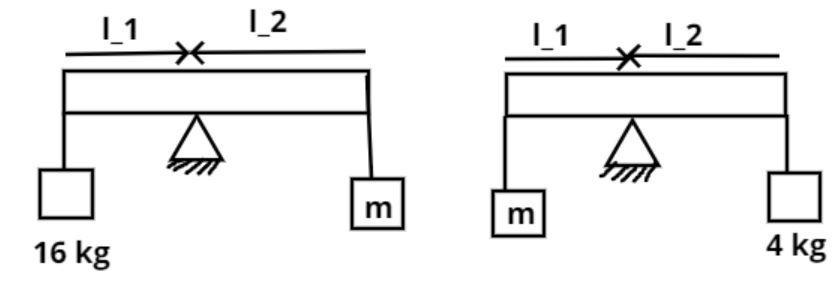
In an experiment with a beam balance, an unknown mass m is balanced by two known masses of 16 kg and 4 kg as shown in figure find m.
$\left( A \right)10kg$
$\left( B \right)6kg$
$\left( C \right)8kg$
$\left( D \right)12kg$
Answer
 Verified
618.6k+ views
Hint: In this question use the concept of equilibrium (i.e. at balance) so at the equilibrium mass multiplied by respective length is always equal to another mass multiplied by respective length of this mass that is from balance point so use these concepts to reach the solution of the question.
Formula used:
${m_1}{l_1} = {m_2}{l_2}$
Complete step by step answer:
After balancing the beam the beam kept in horizontal position as shown in the figure and made a straight angle i.e. 180 degree with the horizontal.
To make the balance we kept the beam at a certain point such that the known weight and the unknown weight balances each other w.r.t the length from the balance point.
It is given that an unknown mass m is balanced by two known masses of 16 kg and 4 kg as shown in figure.
So at balance known mass multiplied by the respective side length from the balance point is equal to unknown mass multiplied by respective side length from the balance point.
Let, ${m_1} = 16kg,{m_2} = m,{m_3} = 4kg$
From figure (1) we have,
$ \Rightarrow {m_1}{l_1} = {m_2}{l_2}$
$ \Rightarrow \dfrac{{{m_1}}}{{{m_2}}} = \dfrac{{{l_2}}}{{{l_1}}}$.................. (1)
And from figure (2) we have,
$ \Rightarrow {m_2}{l_1} = {m_3}{l_2}$
$ \Rightarrow \dfrac{{{m_2}}}{{{m_3}}} = \dfrac{{{l_2}}}{{{l_1}}}$.................. (2)
So from equation (2) and (3) we have,
$ \Rightarrow \dfrac{{{m_1}}}{{{m_2}}} = \dfrac{{{m_2}}}{{{m_3}}}$
Now substitute the values we have,
$ \Rightarrow \dfrac{{16}}{m} = \dfrac{m}{4}$
$ \Rightarrow {m^2} = 64$
Now take square root on both sides we have,
$ \Rightarrow \sqrt {{m^2}} = \sqrt {64} $
$ \Rightarrow m = \sqrt {8 \times 8} $
$ \Rightarrow m = 8kg$
So this is the required answer.
Hence option (C) is the correct answer.
Note:
Whenever we face such types of questions always recall the property that at balance or at equilibrium the mass multiply by the respective side length from the balance point is equal to unknown mass multiply by respective side length from the balance point so just equate them for both the figures as above and simplify, we will get the required unknown mass.
Formula used:
${m_1}{l_1} = {m_2}{l_2}$
Complete step by step answer:
After balancing the beam the beam kept in horizontal position as shown in the figure and made a straight angle i.e. 180 degree with the horizontal.
To make the balance we kept the beam at a certain point such that the known weight and the unknown weight balances each other w.r.t the length from the balance point.
It is given that an unknown mass m is balanced by two known masses of 16 kg and 4 kg as shown in figure.
So at balance known mass multiplied by the respective side length from the balance point is equal to unknown mass multiplied by respective side length from the balance point.
Let, ${m_1} = 16kg,{m_2} = m,{m_3} = 4kg$
From figure (1) we have,
$ \Rightarrow {m_1}{l_1} = {m_2}{l_2}$
$ \Rightarrow \dfrac{{{m_1}}}{{{m_2}}} = \dfrac{{{l_2}}}{{{l_1}}}$.................. (1)
And from figure (2) we have,
$ \Rightarrow {m_2}{l_1} = {m_3}{l_2}$
$ \Rightarrow \dfrac{{{m_2}}}{{{m_3}}} = \dfrac{{{l_2}}}{{{l_1}}}$.................. (2)
So from equation (2) and (3) we have,
$ \Rightarrow \dfrac{{{m_1}}}{{{m_2}}} = \dfrac{{{m_2}}}{{{m_3}}}$
Now substitute the values we have,
$ \Rightarrow \dfrac{{16}}{m} = \dfrac{m}{4}$
$ \Rightarrow {m^2} = 64$
Now take square root on both sides we have,
$ \Rightarrow \sqrt {{m^2}} = \sqrt {64} $
$ \Rightarrow m = \sqrt {8 \times 8} $
$ \Rightarrow m = 8kg$
So this is the required answer.
Hence option (C) is the correct answer.
Note:
Whenever we face such types of questions always recall the property that at balance or at equilibrium the mass multiply by the respective side length from the balance point is equal to unknown mass multiply by respective side length from the balance point so just equate them for both the figures as above and simplify, we will get the required unknown mass.
Recently Updated Pages
Master Class 11 Social Science: Engaging Questions & Answers for Success

Master Class 11 English: Engaging Questions & Answers for Success
Master Class 11 Maths: Engaging Questions & Answers for Success
Master Class 11 Chemistry: Engaging Questions & Answers for Success
Master Class 11 Biology: Engaging Questions & Answers for Success
Master Class 11 Physics: Engaging Questions & Answers for Success
Trending doubts
Differentiate between an exothermic and an endothermic class 11 chemistry CBSE
One Metric ton is equal to kg A 10000 B 1000 C 100 class 11 physics CBSE
Difference Between Prokaryotic Cells and Eukaryotic Cells
There are 720 permutations of the digits 1 2 3 4 5 class 11 maths CBSE
Two of the body parts which do not appear in MRI are class 11 biology CBSE
Which gas is abundant in air class 11 chemistry CBSE