




In an experiment to determine the focal length (f) of a concave mirror by the u−v method, a student places the object pin A on the principal axis at a distance x from the pole P. The student looks at the pin and its inverted image from a distance keeping the eye in line with PA. When the student shifts the eye towards the left, the image appears to the right of the object pin. Then:
A. x < f
B. f < x < 2f
C. x = 2f
D. x > 2f
Answer
 Verified
611.7k+ views
Hint: In case of mirrors usually there are three types used. Plain mirror, concave mirror and convex mirror. All will serve different purposes. Properties of different mirrors are different. In case of convex mirrors they always form virtual images. While concave mirrors form both virtual and real images and plain mirrors form virtual images. Inverted image in the sense it is real.
Complete answer:
Various positions of placing an object in front of a concave lens gives us various positions of images. If an object is placed between the pole and focus of the concave mirror then image will be formed on the other side of the mirror. That image formed can be enlarged or diminished and virtual.
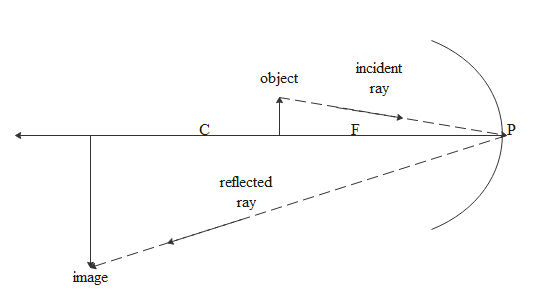
Now if we place objects between focus and center then the image is formed away from the center and the image will be real and inverted. The size of the image will be bigger than an object as shown in the diagram.
C is center and F is focus while P is the pole.
If we place the object away from the center then the image formed will be between center and focus. That image will be real and inverted and diminished.
In question it is given that the image is inverted and if the object is moved left then the image is moving right then it must have placed between center and focus. Then only this case will be possible.
So, the correct answer is “Option B”.
Note:
It is to be noted that the distance between pole and center would be radius and equal to twice of the focal length in case of thin lens or mirror. If lenses are not thin and thick then we have other relations to find out the relation between the focal length and radii of curvature of the lens.
Complete answer:
Various positions of placing an object in front of a concave lens gives us various positions of images. If an object is placed between the pole and focus of the concave mirror then image will be formed on the other side of the mirror. That image formed can be enlarged or diminished and virtual.
Now if we place objects between focus and center then the image is formed away from the center and the image will be real and inverted. The size of the image will be bigger than an object as shown in the diagram.
C is center and F is focus while P is the pole.
If we place the object away from the center then the image formed will be between center and focus. That image will be real and inverted and diminished.
In question it is given that the image is inverted and if the object is moved left then the image is moving right then it must have placed between center and focus. Then only this case will be possible.
So, the correct answer is “Option B”.
Note:
It is to be noted that the distance between pole and center would be radius and equal to twice of the focal length in case of thin lens or mirror. If lenses are not thin and thick then we have other relations to find out the relation between the focal length and radii of curvature of the lens.
Recently Updated Pages
Master Class 12 Business Studies: Engaging Questions & Answers for Success

Master Class 12 Biology: Engaging Questions & Answers for Success
Master Class 12 Chemistry: Engaging Questions & Answers for Success
Class 12 Question and Answer - Your Ultimate Solutions Guide
Master Class 11 Social Science: Engaging Questions & Answers for Success
Master Class 11 English: Engaging Questions & Answers for Success
Trending doubts
What is the full form of NDA a National Democratic class 10 social science CBSE
Explain the Treaty of Vienna of 1815 class 10 social science CBSE
Who Won 36 Oscar Awards? Record Holder Revealed
Bharatiya Janata Party was founded in the year A 1979 class 10 social science CBSE
What is the median of the first 10 natural numbers class 10 maths CBSE
Why is it 530 pm in india when it is 1200 afternoon class 10 social science CBSE