




In an experiment of verification of Ohm’s Law, following observations are obtained:
Potential difference V (in volt) 0.5 1.0 1.5 2.0 2.5 Current I (in ampere) 0.2 0.4 0.6 0.8 1
What will be current I when the potential difference V is 0.75 V?
A. 0.5 A
B. 0.3 A
C. 0.75 A
D. 0.6 A
| Potential difference V (in volt) | 0.5 | 1.0 | 1.5 | 2.0 | 2.5 |
| Current I (in ampere) | 0.2 | 0.4 | 0.6 | 0.8 | 1 |
Answer
 Verified
628.8k+ views
Hint: Question involving such data can easily be solved by using the Ohm’s Law. Ohm’s Law states that “the current through a conductor between two points is directly proportional to the voltage across the two points” or $P=IR$
Formula used:
The formula that we will be using to solve the given question is Ohm’s Law, i.e., $V=IR$
Complete answer:
From the above given observation, we can find out the resistance of the conductor.
Let the resistance be R
By Ohm’s Law, we know that
$V=IR$
Now for finding the value of R, we can take the data from any column of the observation table.
For example, let us take $V=0.5V$and $I=0.2A$
So,
$R=\dfrac{V}{\begin{align}
& I \\
& \\
\end{align}}$
$R=\dfrac{0.5}{0.2}=\dfrac{5}{2}$
$R=2.5\Omega $
For to find the current when the potential difference $V=0.75V$
Again, using Ohm’s Law
$V=IR$
$\implies I=\dfrac{V}{R}$
\[I=\dfrac{0.75}{2.5}=0.3A\]
$I=0.3A$
So, the current flowing through the conductor when the potential difference is 0.75V will 0.3A
Note:
You can also solve this problem by using the graph made from the observation table
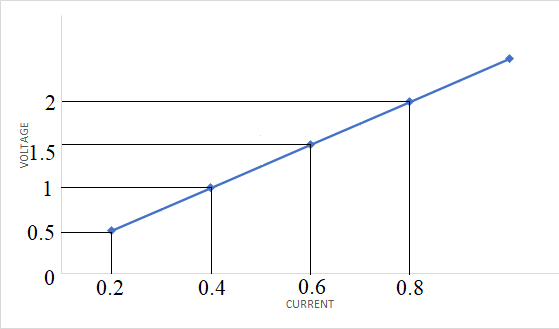
In the above graph, we can see the observation table gives data which forms a straight line. Now, we can say that the slope of this line will be equal to the resistance R of the conductor.
Since, the slope of a straight line (resistance) remains constant
$\dfrac{{{V}_{1}}}{{{I}_{1}}}=\dfrac{{{V}_{2}}}{{{I}_{2}}}$
So,
$\begin{align}
& \dfrac{0.75}{I}=\dfrac{0.5}{0.2} \\
& \\
& I=\dfrac{0.75}{2.5} \\
& \\
& I=0.3A \\
\end{align}$
Therefore, current flowing through the conductor when the potential difference is 0.75V will be 0.3A
Formula used:
The formula that we will be using to solve the given question is Ohm’s Law, i.e., $V=IR$
Complete answer:
From the above given observation, we can find out the resistance of the conductor.
Let the resistance be R
By Ohm’s Law, we know that
$V=IR$
Now for finding the value of R, we can take the data from any column of the observation table.
For example, let us take $V=0.5V$and $I=0.2A$
So,
$R=\dfrac{V}{\begin{align}
& I \\
& \\
\end{align}}$
$R=\dfrac{0.5}{0.2}=\dfrac{5}{2}$
$R=2.5\Omega $
For to find the current when the potential difference $V=0.75V$
Again, using Ohm’s Law
$V=IR$
$\implies I=\dfrac{V}{R}$
\[I=\dfrac{0.75}{2.5}=0.3A\]
$I=0.3A$
So, the current flowing through the conductor when the potential difference is 0.75V will 0.3A
Note:
You can also solve this problem by using the graph made from the observation table
In the above graph, we can see the observation table gives data which forms a straight line. Now, we can say that the slope of this line will be equal to the resistance R of the conductor.
Since, the slope of a straight line (resistance) remains constant
$\dfrac{{{V}_{1}}}{{{I}_{1}}}=\dfrac{{{V}_{2}}}{{{I}_{2}}}$
So,
$\begin{align}
& \dfrac{0.75}{I}=\dfrac{0.5}{0.2} \\
& \\
& I=\dfrac{0.75}{2.5} \\
& \\
& I=0.3A \\
\end{align}$
Therefore, current flowing through the conductor when the potential difference is 0.75V will be 0.3A
Recently Updated Pages
Master Class 11 English: Engaging Questions & Answers for Success

Master Class 11 Social Science: Engaging Questions & Answers for Success
Master Class 11 Maths: Engaging Questions & Answers for Success
Master Class 11 Biology: Engaging Questions & Answers for Success
Master Class 11 Physics: Engaging Questions & Answers for Success
Master Class 11 Chemistry: Engaging Questions & Answers for Success
Trending doubts
Explain the Treaty of Vienna of 1815 class 10 social science CBSE
What is the Total Duration of Football Match?
First Cotton Mill of India
In which year voting age was reduced from 21 to 18?
10 examples of evaporation in daily life with explanations
What planets have no moons Which one has only one moon class 10 physics CBSE