




In an acute-angled triangle, express a median in terms of its sides.
Answer
 Verified
638.4k+ views
Hint: To solve this question we will consider a \[\Delta ABC\] which will have median from point A to side BC and then we will construct a perpendicular from point A to side BC intersecting BC at E. Then, by using Pythagoras Theorem for a different right-angled triangle, we will find the required expression.
Complete step-by-step answer:
In this question, we have to prove that for an acute-angled triangle, we can express the median in terms of its sides. Let us consider an acute-angled triangle ABC which has a median from point A to side BC and name it AD.
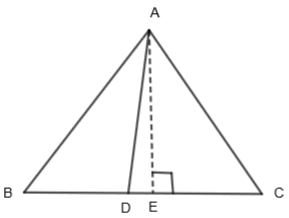
Now, we will construct an altitude on the side BC from point A intersecting BC at E. So, we will now use Pythagoras Theorem to find the required expression. We are applying Pythagoras Theorem in \[\Delta AED\]. So, we can write,
\[A{{E}^{2}}+E{{D}^{2}}=A{{D}^{2}}\]
\[A{{E}^{2}}=A{{D}^{2}}-E{{D}^{2}}....\left( i \right)\]
Now, in \[\Delta AEB\], we will apply the Pythagoras theorem. So, we will get,
\[A{{B}^{2}}=A{{E}^{2}}+B{{E}^{2}}....\left( ii \right)\]
Now, we will put the value of \[{{\left( AE \right)}^{2}}\] from equation (i) to equation (ii), we will get,
\[{{\left( AB \right)}^{2}}={{\left( AD \right)}^{2}}-{{\left( ED \right)}^{2}}+{{\left( BE \right)}^{2}}\]
Now from the figure, we can see that BE = BD + DE. So, we can write the equation as,
\[{{\left( AB \right)}^{2}}={{\left( AD \right)}^{2}}-{{\left( DE \right)}^{2}}+{{\left( BD+DE \right)}^{2}}\]
Now, we will expand \[{{\left( BD+DE \right)}^{2}}\] by using the formula
\[{{\left( a+b \right)}^{2}}={{a}^{2}}+{{b}^{2}}+2ab\]
So, we will get,
\[{{\left( AB \right)}^{2}}={{\left( AD \right)}^{2}}-{{\left( DE \right)}^{2}}+{{\left( BD \right)}^{2}}+{{\left( DE \right)}^{2}}+2\left( BD \right)\left( DE \right)\]
\[{{\left( AB \right)}^{2}}={{\left( AD \right)}^{2}}+{{\left( BD \right)}^{2}}+2\left( BD \right)\left( DE \right)\]
Now, we can see that AD bisects BC. So, we can say that
\[BD=DC=\dfrac{BC}{2}....\left( iii \right)\]
Therefore, we can write the equation as,
\[{{\left( AB \right)}^{2}}={{\left( AD \right)}^{2}}+{{\left( \dfrac{BC}{2} \right)}^{2}}+2.\left( \dfrac{BC}{2} \right)\left( DE \right)\]
\[{{\left( AB \right)}^{2}}={{\left( AD \right)}^{2}}+\dfrac{{{\left( BC \right)}^{2}}}{4}+\left( BC \right)\left( DE \right)....\left( iv \right)\]
Now, we will apply Pythagoras Theorem in \[\Delta AEC\]. So, we will get,
\[A{{C}^{2}}=A{{E}^{2}}+E{{C}^{2}}\]
Now, we will put the value of \[A{{E}^{2}}\] from equation (i). So, we will get,
\[{{\left( AC \right)}^{2}}={{\left( AD \right)}^{2}}-{{\left( ED \right)}^{2}}+{{\left( EC \right)}^{2}}\]
From the triangle, we can see that EC = CD – DE. So, we can write the equation as,
\[{{\left( AC \right)}^{2}}={{\left( AD \right)}^{2}}-{{\left( ED \right)}^{2}}+{{\left( CD-DE \right)}^{2}}\]
Now, we will expand \[{{\left( CD-DE \right)}^{2}}\] by using the formula \[{{\left( a-b \right)}^{2}}={{a}^{2}}+{{b}^{2}}-2ab\]. So, we will get,
\[{{\left( AC \right)}^{2}}={{\left( AD \right)}^{2}}-{{\left( ED \right)}^{2}}+{{\left( CD \right)}^{2}}+{{\left( ED \right)}^{2}}-2\left( CD \right)\left( ED \right)\]
\[{{\left( AC \right)}^{2}}={{\left( AD \right)}^{2}}+{{\left( CD \right)}^{2}}-2\left( CD \right)\left( DE \right)\]
From equation (iii), we will put the value of the CD. So, we will get,
\[{{\left( AC \right)}^{2}}={{\left( AD \right)}^{2}}+{{\left( \dfrac{BC}{2} \right)}^{2}}-2\left( \dfrac{BC}{2} \right)\left( DE \right)\]
\[{{\left( AC \right)}^{2}}={{\left( AD \right)}^{2}}+\dfrac{{{\left( BC \right)}^{2}}}{4}-\left( BC \right)\left( DE \right)....\left( v \right)\]
Now, we will add the equation (iv) and (v). So, we will get,
\[{{\left( AB \right)}^{2}}+{{\left( AC \right)}^{2}}={{\left( AD \right)}^{2}}+{{\left( AD \right)}^{2}}+\dfrac{{{\left( BC \right)}^{2}}}{4}+\dfrac{{{\left( BC \right)}^{2}}}{4}\]
\[A{{B}^{2}}+A{{C}^{2}}=2A{{D}^{2}}+\dfrac{B{{C}^{2}}}{2}\]
\[2A{{B}^{2}}+2A{{C}^{2}}=4A{{D}^{2}}+B{{C}^{2}}\]
\[4A{{D}^{2}}=2A{{B}^{2}}+2A{{C}^{2}}-B{{C}^{2}}\]
Hence, we have expressed the median AD in terms of side AB, AC and BC as
\[4A{{D}^{2}}=2A{{B}^{2}}+2A{{C}^{2}}-B{{C}^{2}}\]
Note: We have to remember this relation because if we will get this question in the exam, then we can verify the solution by checking the result because under pressure, we might make a lot of mistakes.
Complete step-by-step answer:
In this question, we have to prove that for an acute-angled triangle, we can express the median in terms of its sides. Let us consider an acute-angled triangle ABC which has a median from point A to side BC and name it AD.
Now, we will construct an altitude on the side BC from point A intersecting BC at E. So, we will now use Pythagoras Theorem to find the required expression. We are applying Pythagoras Theorem in \[\Delta AED\]. So, we can write,
\[A{{E}^{2}}+E{{D}^{2}}=A{{D}^{2}}\]
\[A{{E}^{2}}=A{{D}^{2}}-E{{D}^{2}}....\left( i \right)\]
Now, in \[\Delta AEB\], we will apply the Pythagoras theorem. So, we will get,
\[A{{B}^{2}}=A{{E}^{2}}+B{{E}^{2}}....\left( ii \right)\]
Now, we will put the value of \[{{\left( AE \right)}^{2}}\] from equation (i) to equation (ii), we will get,
\[{{\left( AB \right)}^{2}}={{\left( AD \right)}^{2}}-{{\left( ED \right)}^{2}}+{{\left( BE \right)}^{2}}\]
Now from the figure, we can see that BE = BD + DE. So, we can write the equation as,
\[{{\left( AB \right)}^{2}}={{\left( AD \right)}^{2}}-{{\left( DE \right)}^{2}}+{{\left( BD+DE \right)}^{2}}\]
Now, we will expand \[{{\left( BD+DE \right)}^{2}}\] by using the formula
\[{{\left( a+b \right)}^{2}}={{a}^{2}}+{{b}^{2}}+2ab\]
So, we will get,
\[{{\left( AB \right)}^{2}}={{\left( AD \right)}^{2}}-{{\left( DE \right)}^{2}}+{{\left( BD \right)}^{2}}+{{\left( DE \right)}^{2}}+2\left( BD \right)\left( DE \right)\]
\[{{\left( AB \right)}^{2}}={{\left( AD \right)}^{2}}+{{\left( BD \right)}^{2}}+2\left( BD \right)\left( DE \right)\]
Now, we can see that AD bisects BC. So, we can say that
\[BD=DC=\dfrac{BC}{2}....\left( iii \right)\]
Therefore, we can write the equation as,
\[{{\left( AB \right)}^{2}}={{\left( AD \right)}^{2}}+{{\left( \dfrac{BC}{2} \right)}^{2}}+2.\left( \dfrac{BC}{2} \right)\left( DE \right)\]
\[{{\left( AB \right)}^{2}}={{\left( AD \right)}^{2}}+\dfrac{{{\left( BC \right)}^{2}}}{4}+\left( BC \right)\left( DE \right)....\left( iv \right)\]
Now, we will apply Pythagoras Theorem in \[\Delta AEC\]. So, we will get,
\[A{{C}^{2}}=A{{E}^{2}}+E{{C}^{2}}\]
Now, we will put the value of \[A{{E}^{2}}\] from equation (i). So, we will get,
\[{{\left( AC \right)}^{2}}={{\left( AD \right)}^{2}}-{{\left( ED \right)}^{2}}+{{\left( EC \right)}^{2}}\]
From the triangle, we can see that EC = CD – DE. So, we can write the equation as,
\[{{\left( AC \right)}^{2}}={{\left( AD \right)}^{2}}-{{\left( ED \right)}^{2}}+{{\left( CD-DE \right)}^{2}}\]
Now, we will expand \[{{\left( CD-DE \right)}^{2}}\] by using the formula \[{{\left( a-b \right)}^{2}}={{a}^{2}}+{{b}^{2}}-2ab\]. So, we will get,
\[{{\left( AC \right)}^{2}}={{\left( AD \right)}^{2}}-{{\left( ED \right)}^{2}}+{{\left( CD \right)}^{2}}+{{\left( ED \right)}^{2}}-2\left( CD \right)\left( ED \right)\]
\[{{\left( AC \right)}^{2}}={{\left( AD \right)}^{2}}+{{\left( CD \right)}^{2}}-2\left( CD \right)\left( DE \right)\]
From equation (iii), we will put the value of the CD. So, we will get,
\[{{\left( AC \right)}^{2}}={{\left( AD \right)}^{2}}+{{\left( \dfrac{BC}{2} \right)}^{2}}-2\left( \dfrac{BC}{2} \right)\left( DE \right)\]
\[{{\left( AC \right)}^{2}}={{\left( AD \right)}^{2}}+\dfrac{{{\left( BC \right)}^{2}}}{4}-\left( BC \right)\left( DE \right)....\left( v \right)\]
Now, we will add the equation (iv) and (v). So, we will get,
\[{{\left( AB \right)}^{2}}+{{\left( AC \right)}^{2}}={{\left( AD \right)}^{2}}+{{\left( AD \right)}^{2}}+\dfrac{{{\left( BC \right)}^{2}}}{4}+\dfrac{{{\left( BC \right)}^{2}}}{4}\]
\[A{{B}^{2}}+A{{C}^{2}}=2A{{D}^{2}}+\dfrac{B{{C}^{2}}}{2}\]
\[2A{{B}^{2}}+2A{{C}^{2}}=4A{{D}^{2}}+B{{C}^{2}}\]
\[4A{{D}^{2}}=2A{{B}^{2}}+2A{{C}^{2}}-B{{C}^{2}}\]
Hence, we have expressed the median AD in terms of side AB, AC and BC as
\[4A{{D}^{2}}=2A{{B}^{2}}+2A{{C}^{2}}-B{{C}^{2}}\]
Note: We have to remember this relation because if we will get this question in the exam, then we can verify the solution by checking the result because under pressure, we might make a lot of mistakes.

Recently Updated Pages
Master Class 12 Business Studies: Engaging Questions & Answers for Success

Master Class 12 Biology: Engaging Questions & Answers for Success
Master Class 12 Chemistry: Engaging Questions & Answers for Success
Class 12 Question and Answer - Your Ultimate Solutions Guide
Master Class 11 Social Science: Engaging Questions & Answers for Success
Master Class 11 English: Engaging Questions & Answers for Success
Trending doubts
What is the Full Form of ICSE / ISC ?
Find the sum of series 1 + 2 + 3 + 4 + 5 + + 100 class 9 maths CBSE
What is the situation called when no party gets the class 9 social science CBSE
Fill the blanks with the suitable prepositions 1 The class 9 english CBSE
Difference Between Plant Cell and Animal Cell
How many hours before the closure of election must class 9 social science CBSE