




In an activity, students were asked to make a circular rangoli, Trishu, Sidak, Mini and Kavleen made rangolis having different diameters as $\dfrac{17}{20}$ inches, $\dfrac{3}{4}$ inches, $\dfrac{5}{6}$ inches and $\dfrac{7}{10}$ inches respectively. Who among them made the smallest one?
$\begin{align}
& \left( a \right)\text{kavleen} \\
& \left( b \right)\text{Trishu} \\
& \left( c \right)\text{Mini} \\
& \left( d \right)\text{Sidak} \\
\end{align}$
Answer
 Verified
649.5k+ views
Hint: To solve the question given above, we will first find out the radii of the rangolis made by Trishu, Sidak, Mini and Kavleen respectively. Then we will find the areas of their rangolis. Then, to determine which is the smallest rangoli, we will take the LCM of the denominator of the area and then we will multiply these areas by LCM. The area which will be the smallest after multiplication will be the smallest rangoli.
Complete step-by-step answer:
To determine, who has made the smallest rangoli, we will first find out the radii of each rangoli. Let the radii of rangoli made by Trishu, Sidak, Mini and Kavleen are ${{R}_{T,}}{{R}_{S}},{{R}_{M}}\text{ }and\text{ }{{R}_{K}}$ respectively. The diameter of their rangolis are ${{D}_{T}},{{D}_{S}},{{D}_{M}},\text{ }and\text{ }{{D}_{K}}$ respectively. Now, the relation between the diameter and radii of any circle is given by:
$Radius=\dfrac{Diameter}{2}$
Thus, $\begin{align}
& {{R}_{T}}=\dfrac{{{D}_{T}}}{2} \\
& \\
\end{align}$
$\begin{align}
& \Rightarrow {{R}_{T}}=\dfrac{\left( \dfrac{17}{20} \right)inches}{2} \\
& \Rightarrow {{R}_{T}}=\dfrac{17}{40}inches.........\left( 1 \right) \\
\end{align}$
Similarly, \[\begin{align}
& {{R}_{S}}=\dfrac{{{D}_{S}}}{2} \\
& \\
\end{align}\]
$\begin{align}
& \Rightarrow {{R}_{S}}=\dfrac{\left( \dfrac{3}{4} \right)inches}{2} \\
& \Rightarrow \,{{R}_{S}}=\dfrac{3}{8}inches.......\left( 2 \right) \\
\end{align}$
Similarly,$\begin{align}
& {{R}_{M}}=\dfrac{{{D}_{M}}}{2} \\
& \\
\end{align}$
$\begin{align}
& \Rightarrow {{R}_{M}}=\dfrac{\left( \dfrac{5}{6} \right)inches}{2} \\
& \Rightarrow {{R}_{M}}=\dfrac{5}{12}inches.......\left( 3 \right) \\
\end{align}$
Similarly, $\begin{align}
& {{R}_{K}}=\dfrac{{{D}_{K}}}{2} \\
& \\
\end{align}$
$\begin{align}
& \Rightarrow {{R}_{K}}=\dfrac{\left( \dfrac{7}{10} \right)inches}{2} \\
& \Rightarrow {{R}_{K}}=\dfrac{7}{20}inches..........\left( 4 \right) \\
\end{align}$
Now, we will calculate the area of rangolis made by each of them. The area of a circle with a given radius is calculated by the formula: $Area=\pi {{\left( radius \right)}^{2}}$
The area of their rangolis are ${{A}_{T}},{{A}_{S}},{{A}_{M}},\text{ }and\text{ }{{A}_{k}}$ respectively. Thus, we have: ${{A}_{T}}=\pi {{\left( \dfrac{17}{40} \right)}^{2}}inc{{h}^{2}}$
$\Rightarrow {{A}_{T}}=\dfrac{289\pi }{1600}inc{{h}^{2}}$
Similarly, ${{A}_{S}}=\pi {{\left( \dfrac{3}{8} \right)}^{2}}inc{{h}^{2}}$
$\Rightarrow {{A}_{S}}=\dfrac{9\pi }{64}inc{{h}^{2}}$
Similarly, ${{A}_{M}}=\pi {{\left( \dfrac{5}{12} \right)}^{2}}inc{{h}^{2}}$
$\Rightarrow {{A}_{M}}=\dfrac{25\pi }{144}inc{{h}^{2}}$
Similarly, ${{A}_{K}}=\pi {{\left( \dfrac{7}{20} \right)}^{2}}inc{{h}^{2}}$
$\Rightarrow {{A}_{M}}=\dfrac{49\pi }{400}inc{{h}^{2}}$
Now, we will take LCM of denominators. The denominators are: 1600, 64, 144 and 400.
Factors of 1600:
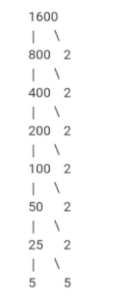
$\Rightarrow 1600=2\times 2\times 2\times 2\times 2\times 2\times 5\times 5$
Factors of 64:
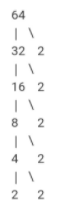
$\Rightarrow 64=2\times 2\times 2\times 2\times 2\times 2$
Factors of 144:
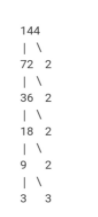
$\Rightarrow 144=2\times 2\times 2\times 2\times 3\times 3$
Factors of 400:
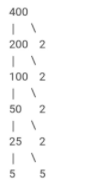
$\Rightarrow 400=2\times 2\times 2\times 2\times 5\times 5$
Thus, the LCM will be $=\left( 2\times 2\times 2\times 2 \right)\times \left( 2\times 2 \right)\times \left( 5\times 5 \right)\times \left( 3\times 3 \right)$
$\Rightarrow LCM=14400$
Now, we will multiply it to each area. Thus we will get:
$\begin{align}
& A_{T}^{1}=14400{{A}_{T}}=14400\times \dfrac{289\pi }{1600} \\
& A_{T}^{1}=2601\pi \text{ }inche{{s}^{2}} \\
& A_{s}^{1}=14400{{A}_{S}}=14400\times \dfrac{9\pi }{64} \\
& A_{S}^{1}=2025\pi inche{{s}^{2}} \\
& A_{M}^{1}=14400{{A}_{M}}=14400\times \dfrac{25\pi }{144} \\
& A_{M}^{1}=2500\pi \text{ }inche{{s}^{2}} \\
& A_{k}^{1}=14400{{A}_{K}}=14400\times \dfrac{49\pi }{400} \\
& A_{k}^{1}=1764\pi \text{ }inche{{s}^{2}} \\
\end{align}$
Here, we can see that $A_{K}^{1}$ is smallest among the four. So, the rangoli made by Kalveen will be the smallest.
Hence, option (a) is correct.
Note: Instead of finding the areas and taking LCM after that, we can directly take the LCM of the denominators of the diameter of rangolis. Thus, the denominators are: 20, 4, 6, 10.The LCM will be 60. Now, we will multiply this to each diameter. Thus, we get:
\[\begin{align}
& D_{T}^{1}=60{{D}_{T}}=60\times \dfrac{17}{20}=51 \\
& D_{S}^{1}=60{{D}_{S}}=60\times \dfrac{3}{4}=45 \\
& D_{M}^{1}=60{{D}_{M}}=60\times \dfrac{5}{6}=50 \\
& D_{K}^{1}=60{{D}_{K}}=60\times \dfrac{7}{10}=42 \\
\end{align}\]
Here \[D_{K}^{1}\] is smallest so that rangoli made by Kalveen is smallest.
Complete step-by-step answer:
To determine, who has made the smallest rangoli, we will first find out the radii of each rangoli. Let the radii of rangoli made by Trishu, Sidak, Mini and Kavleen are ${{R}_{T,}}{{R}_{S}},{{R}_{M}}\text{ }and\text{ }{{R}_{K}}$ respectively. The diameter of their rangolis are ${{D}_{T}},{{D}_{S}},{{D}_{M}},\text{ }and\text{ }{{D}_{K}}$ respectively. Now, the relation between the diameter and radii of any circle is given by:
$Radius=\dfrac{Diameter}{2}$
Thus, $\begin{align}
& {{R}_{T}}=\dfrac{{{D}_{T}}}{2} \\
& \\
\end{align}$
$\begin{align}
& \Rightarrow {{R}_{T}}=\dfrac{\left( \dfrac{17}{20} \right)inches}{2} \\
& \Rightarrow {{R}_{T}}=\dfrac{17}{40}inches.........\left( 1 \right) \\
\end{align}$
Similarly, \[\begin{align}
& {{R}_{S}}=\dfrac{{{D}_{S}}}{2} \\
& \\
\end{align}\]
$\begin{align}
& \Rightarrow {{R}_{S}}=\dfrac{\left( \dfrac{3}{4} \right)inches}{2} \\
& \Rightarrow \,{{R}_{S}}=\dfrac{3}{8}inches.......\left( 2 \right) \\
\end{align}$
Similarly,$\begin{align}
& {{R}_{M}}=\dfrac{{{D}_{M}}}{2} \\
& \\
\end{align}$
$\begin{align}
& \Rightarrow {{R}_{M}}=\dfrac{\left( \dfrac{5}{6} \right)inches}{2} \\
& \Rightarrow {{R}_{M}}=\dfrac{5}{12}inches.......\left( 3 \right) \\
\end{align}$
Similarly, $\begin{align}
& {{R}_{K}}=\dfrac{{{D}_{K}}}{2} \\
& \\
\end{align}$
$\begin{align}
& \Rightarrow {{R}_{K}}=\dfrac{\left( \dfrac{7}{10} \right)inches}{2} \\
& \Rightarrow {{R}_{K}}=\dfrac{7}{20}inches..........\left( 4 \right) \\
\end{align}$
Now, we will calculate the area of rangolis made by each of them. The area of a circle with a given radius is calculated by the formula: $Area=\pi {{\left( radius \right)}^{2}}$
The area of their rangolis are ${{A}_{T}},{{A}_{S}},{{A}_{M}},\text{ }and\text{ }{{A}_{k}}$ respectively. Thus, we have: ${{A}_{T}}=\pi {{\left( \dfrac{17}{40} \right)}^{2}}inc{{h}^{2}}$
$\Rightarrow {{A}_{T}}=\dfrac{289\pi }{1600}inc{{h}^{2}}$
Similarly, ${{A}_{S}}=\pi {{\left( \dfrac{3}{8} \right)}^{2}}inc{{h}^{2}}$
$\Rightarrow {{A}_{S}}=\dfrac{9\pi }{64}inc{{h}^{2}}$
Similarly, ${{A}_{M}}=\pi {{\left( \dfrac{5}{12} \right)}^{2}}inc{{h}^{2}}$
$\Rightarrow {{A}_{M}}=\dfrac{25\pi }{144}inc{{h}^{2}}$
Similarly, ${{A}_{K}}=\pi {{\left( \dfrac{7}{20} \right)}^{2}}inc{{h}^{2}}$
$\Rightarrow {{A}_{M}}=\dfrac{49\pi }{400}inc{{h}^{2}}$
Now, we will take LCM of denominators. The denominators are: 1600, 64, 144 and 400.
Factors of 1600:
$\Rightarrow 1600=2\times 2\times 2\times 2\times 2\times 2\times 5\times 5$
Factors of 64:
$\Rightarrow 64=2\times 2\times 2\times 2\times 2\times 2$
Factors of 144:
$\Rightarrow 144=2\times 2\times 2\times 2\times 3\times 3$
Factors of 400:
$\Rightarrow 400=2\times 2\times 2\times 2\times 5\times 5$
Thus, the LCM will be $=\left( 2\times 2\times 2\times 2 \right)\times \left( 2\times 2 \right)\times \left( 5\times 5 \right)\times \left( 3\times 3 \right)$
$\Rightarrow LCM=14400$
Now, we will multiply it to each area. Thus we will get:
$\begin{align}
& A_{T}^{1}=14400{{A}_{T}}=14400\times \dfrac{289\pi }{1600} \\
& A_{T}^{1}=2601\pi \text{ }inche{{s}^{2}} \\
& A_{s}^{1}=14400{{A}_{S}}=14400\times \dfrac{9\pi }{64} \\
& A_{S}^{1}=2025\pi inche{{s}^{2}} \\
& A_{M}^{1}=14400{{A}_{M}}=14400\times \dfrac{25\pi }{144} \\
& A_{M}^{1}=2500\pi \text{ }inche{{s}^{2}} \\
& A_{k}^{1}=14400{{A}_{K}}=14400\times \dfrac{49\pi }{400} \\
& A_{k}^{1}=1764\pi \text{ }inche{{s}^{2}} \\
\end{align}$
Here, we can see that $A_{K}^{1}$ is smallest among the four. So, the rangoli made by Kalveen will be the smallest.
Hence, option (a) is correct.
Note: Instead of finding the areas and taking LCM after that, we can directly take the LCM of the denominators of the diameter of rangolis. Thus, the denominators are: 20, 4, 6, 10.The LCM will be 60. Now, we will multiply this to each diameter. Thus, we get:
\[\begin{align}
& D_{T}^{1}=60{{D}_{T}}=60\times \dfrac{17}{20}=51 \\
& D_{S}^{1}=60{{D}_{S}}=60\times \dfrac{3}{4}=45 \\
& D_{M}^{1}=60{{D}_{M}}=60\times \dfrac{5}{6}=50 \\
& D_{K}^{1}=60{{D}_{K}}=60\times \dfrac{7}{10}=42 \\
\end{align}\]
Here \[D_{K}^{1}\] is smallest so that rangoli made by Kalveen is smallest.
Recently Updated Pages
Basicity of sulphurous acid and sulphuric acid are

Master Class 12 Economics: Engaging Questions & Answers for Success
Master Class 12 Biology: Engaging Questions & Answers for Success
Master Class 11 English: Engaging Questions & Answers for Success
Master Class 11 Physics: Engaging Questions & Answers for Success
Master Class 11 Computer Science: Engaging Questions & Answers for Success
Trending doubts
What is the Total Duration of Football Match?
Explain the Treaty of Vienna of 1815 class 10 social science CBSE
In football, which nation is called "La Roja"?
Why is there a time difference of about 5 hours between class 10 social science CBSE
10 examples of evaporation in daily life with explanations
What is the full form of POSCO class 10 social science CBSE