




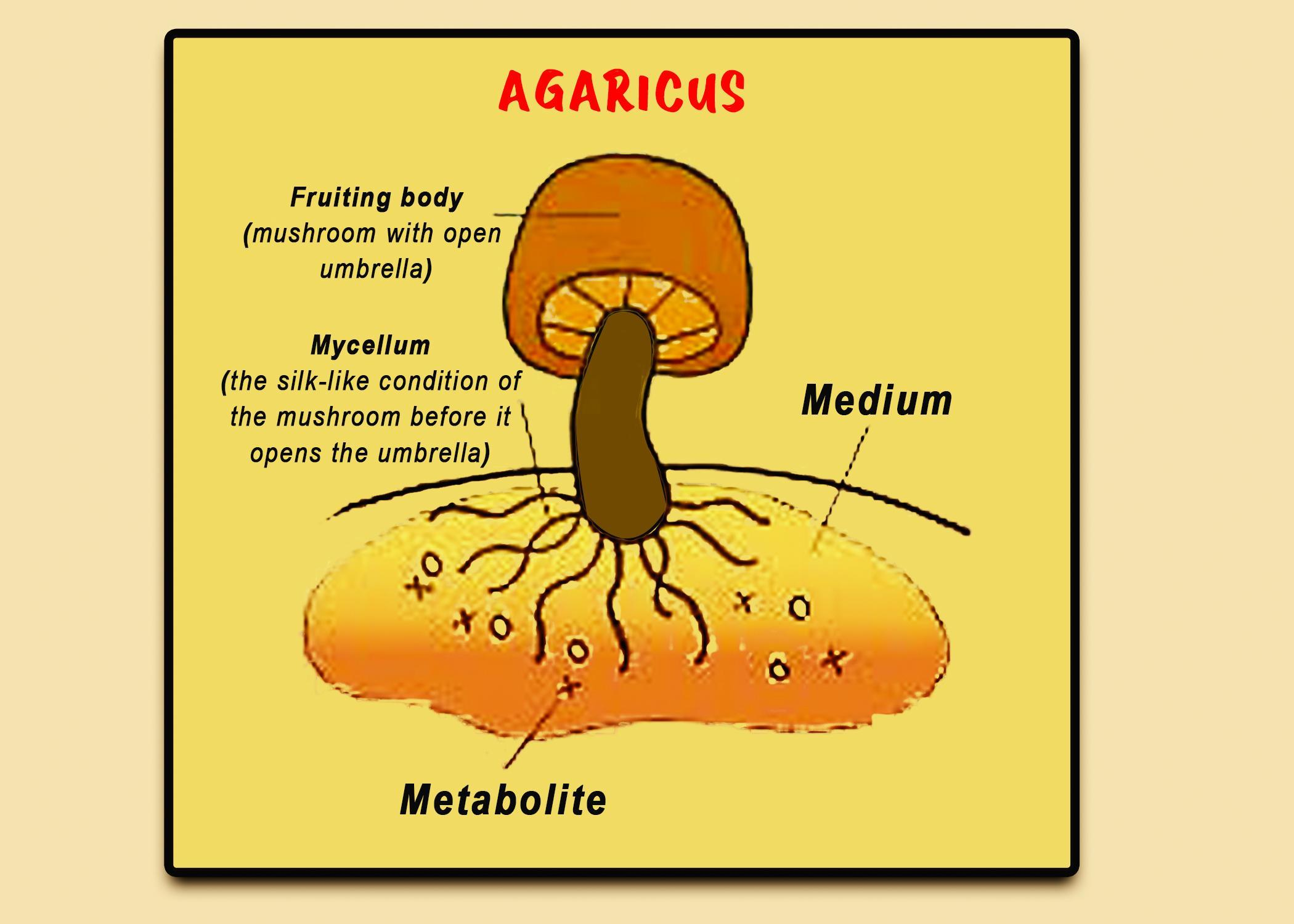
In Agaricus, the fruiting body is made up of……………………. mycelium
Answer
 Verified
603.3k+ views
Hint: Agaricus comes under Basidiomycetes or club fungi in kingdom Fungi. It is called “Gill fungi” because gill-like pores are present in its fruiting body. Its other name is fairy rings because its fruiting body looks like rings.
Complete answer:
- In basidiomycetes, mycelium is septate and uni or binucleate and is branched.
- In mycelium septum is called dolipore septum. One big pore is present between every septum. These septa allow cytoplasm and nucleus to pass from one cell to another cell.
- The clamped connection is present in basidiomycetes.
- Asexual spores are not present. Vegetative reproduction is by fragmentation.
- Sexual reproduction is mainly by somatogamy where two somatic cells of different strains come close and their apical ends fuse. The basidium is formed.
- Both nuclei come together (dikaryon) and karyogamy takes place which on meiosis forms haploid spores.
- Fungal hyphae grow to form a fruiting body. It is called the basidiocarp.
- Basidiospores are exogenous in origin.
Additional information:
- Basidiomycetes are commonly known by different names. These include mushrooms, bracket fungi, and puffballs.
- They are the most advanced fungi. They are very good decomposers of wood.
- Mycelium can be primary as well as secondary.
- Common rust and smut fungi belong to basidiomycetes.
- They lack sex organs.
- Basidium undergoes karyogamy followed by meiosis to form four basidiospores.
- Their hyphae spread like a fan.
- Cell wall is made up of chitin and polysaccharides.
So in Agaricus, mycelium is branched and separated.
Note: In fungi, there is a mass of interwoven hyphae called mycelium. Chitin is a polymer of N-acetylglucosamine. They have heterotrophic nutrition. They don’t possess chlorophyll. They are multicellular eukaryotes. They are highly capable of recycling nutrients.
Complete answer:
- In basidiomycetes, mycelium is septate and uni or binucleate and is branched.
- In mycelium septum is called dolipore septum. One big pore is present between every septum. These septa allow cytoplasm and nucleus to pass from one cell to another cell.
- The clamped connection is present in basidiomycetes.
- Asexual spores are not present. Vegetative reproduction is by fragmentation.
- Sexual reproduction is mainly by somatogamy where two somatic cells of different strains come close and their apical ends fuse. The basidium is formed.
- Both nuclei come together (dikaryon) and karyogamy takes place which on meiosis forms haploid spores.
- Fungal hyphae grow to form a fruiting body. It is called the basidiocarp.
- Basidiospores are exogenous in origin.
Additional information:
- Basidiomycetes are commonly known by different names. These include mushrooms, bracket fungi, and puffballs.
- They are the most advanced fungi. They are very good decomposers of wood.
- Mycelium can be primary as well as secondary.
- Common rust and smut fungi belong to basidiomycetes.
- They lack sex organs.
- Basidium undergoes karyogamy followed by meiosis to form four basidiospores.
- Their hyphae spread like a fan.
- Cell wall is made up of chitin and polysaccharides.
So in Agaricus, mycelium is branched and separated.
Note: In fungi, there is a mass of interwoven hyphae called mycelium. Chitin is a polymer of N-acetylglucosamine. They have heterotrophic nutrition. They don’t possess chlorophyll. They are multicellular eukaryotes. They are highly capable of recycling nutrients.
Recently Updated Pages
Master Class 11 English: Engaging Questions & Answers for Success

Master Class 11 Social Science: Engaging Questions & Answers for Success
Master Class 11 Maths: Engaging Questions & Answers for Success
Master Class 11 Biology: Engaging Questions & Answers for Success
Master Class 11 Physics: Engaging Questions & Answers for Success
Master Class 11 Chemistry: Engaging Questions & Answers for Success
Trending doubts
One Metric ton is equal to kg A 10000 B 1000 C 100 class 11 physics CBSE
Difference Between Prokaryotic Cells and Eukaryotic Cells
Two of the body parts which do not appear in MRI are class 11 biology CBSE
Find the value of the expression given below sin 30circ class 11 maths CBSE
Draw a diagram of a plant cell and label at least eight class 11 biology CBSE
10 examples of friction in our daily life