




In △ABC, with radius of circumcircle as 2 and radius of incircle as \[\sqrt{3}-1\] , let AD,BE and CF be perpendicular from A,B and C upon the opposite sides of the triangle intersecting each other at O, then Arithmetic mean of OA,OB and OC is
A. \[\dfrac{2}{3}(\sqrt{3}+1)\]
B. \[\dfrac{2}{3}\left( \sqrt{3}-1 \right)\]
C. \[\dfrac{\sqrt{3}+1}{3}\]
D. \[\dfrac{\sqrt{3}-1}{3}\]
Answer
 Verified
609.9k+ views
Hint: By drawing and pointing the triangle and drawing the perpendiculars on three sides and writing the arithmetic mean we are almost to the solution, by simplifying all the trigonometric properties we get the solution.
Complete step-by-step answer:
Given △ABC with radius of circumcircle as 2 and radius of incircle as \[\sqrt{3}-1\].
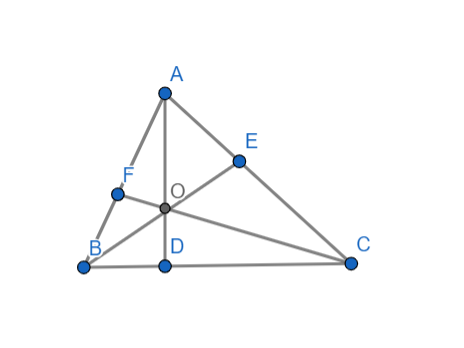
Given △ABC with radius of circumcircle as 2 and radius of incircle as \[\sqrt{3}-1\].
\[\begin{align}
& OA=2R\cos A \\
& OB=2R\cos B \\
& OC=2R\cos C \\
\end{align}\]
Arithmetic mean of of OA,OB and OC,
\[=\dfrac{2R}{3}\left( \cos A+\cos B+\cos C \right)\]. . . . . . . . . . . . . . . . . . . . . . . . . . . . . . . . (a)
\[\left( \cos A+\cos B+\cos C \right)\]= \[\left( 1+4\sin \dfrac{A}{2}\sin \dfrac{B}{2}\sin \dfrac{C}{2} \right)\] . . . . . . . . . . . . . . . . . . . . . . . . . . . . . . . . . . . . . (1)
We have to substitute the value of equation (1) in (a),
\[=\dfrac{2R}{3}\left( 1+4\sin \dfrac{A}{2}\sin \dfrac{B}{2}\sin \dfrac{C}{2} \right)\]
Since r= \[\left( 1+4R\sin \dfrac{A}{2}\sin \dfrac{B}{2}\sin \dfrac{C}{2} \right)\]
We get \[=\dfrac{2R}{3}\left( 1+r \right)\]
\[=\dfrac{2R}{3}+\dfrac{2r}{3}\]
By substituting the values of R and r in the above equation we get
\[=\dfrac{2}{3}\left( 2+\sqrt{3}-1 \right)\]
\[=\dfrac{2}{3}\left( \sqrt{3}+1 \right)\]
Therefore the option is A.
Note: Drawing of the figure plays a key role in this type of problem. Finding the arithmetic mean of all the perpendicular drawn from o. As there are many trigonometric properties care should be taken while solving.
Complete step-by-step answer:
Given △ABC with radius of circumcircle as 2 and radius of incircle as \[\sqrt{3}-1\].
Given △ABC with radius of circumcircle as 2 and radius of incircle as \[\sqrt{3}-1\].
\[\begin{align}
& OA=2R\cos A \\
& OB=2R\cos B \\
& OC=2R\cos C \\
\end{align}\]
Arithmetic mean of of OA,OB and OC,
\[=\dfrac{2R}{3}\left( \cos A+\cos B+\cos C \right)\]. . . . . . . . . . . . . . . . . . . . . . . . . . . . . . . . (a)
\[\left( \cos A+\cos B+\cos C \right)\]= \[\left( 1+4\sin \dfrac{A}{2}\sin \dfrac{B}{2}\sin \dfrac{C}{2} \right)\] . . . . . . . . . . . . . . . . . . . . . . . . . . . . . . . . . . . . . (1)
We have to substitute the value of equation (1) in (a),
\[=\dfrac{2R}{3}\left( 1+4\sin \dfrac{A}{2}\sin \dfrac{B}{2}\sin \dfrac{C}{2} \right)\]
Since r= \[\left( 1+4R\sin \dfrac{A}{2}\sin \dfrac{B}{2}\sin \dfrac{C}{2} \right)\]
We get \[=\dfrac{2R}{3}\left( 1+r \right)\]
\[=\dfrac{2R}{3}+\dfrac{2r}{3}\]
By substituting the values of R and r in the above equation we get
\[=\dfrac{2}{3}\left( 2+\sqrt{3}-1 \right)\]
\[=\dfrac{2}{3}\left( \sqrt{3}+1 \right)\]
Therefore the option is A.
Note: Drawing of the figure plays a key role in this type of problem. Finding the arithmetic mean of all the perpendicular drawn from o. As there are many trigonometric properties care should be taken while solving.
Recently Updated Pages
Master Class 11 English: Engaging Questions & Answers for Success

Master Class 11 Maths: Engaging Questions & Answers for Success
Master Class 11 Biology: Engaging Questions & Answers for Success
Master Class 11 Physics: Engaging Questions & Answers for Success
Master Class 11 Accountancy: Engaging Questions & Answers for Success
Class 11 Question and Answer - Your Ultimate Solutions Guide
Trending doubts
One Metric ton is equal to kg A 10000 B 1000 C 100 class 11 physics CBSE
Discuss the various forms of bacteria class 11 biology CBSE
Draw a diagram of a plant cell and label at least eight class 11 biology CBSE
State the laws of reflection of light
Explain zero factorial class 11 maths CBSE
10 examples of friction in our daily life