



In a Wheatstone's bridge all the four arms have equal resistance R. If the resistance of the galvanometer arm is also R, the equivalent resistance of the combination is?
Answer
 Verified
671.1k+ views
Hint-: We need to find the equivalent resistance using series and parallel combination series.
Complete step by step solution:
Given, In a Wheatstone's bridge all the four arms have equal resistance R. If the resistance of the galvanometer arm is also R.
In the balanced condition of Wheatstone's bridge there will be no current flowing through the arms.
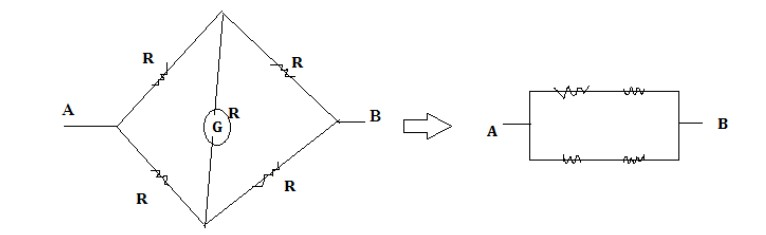
As all the four arms have equal resistance R so it is a balanced $\left( {\dfrac{P}{Q} = \dfrac{R}{S}} \right)$ Wheatstone bridge circuit. Thus, as per condition no current flows in the galvanometer arm and its resistance will not work. Let us find the equivalent resistance.
The equivalent resistance is
$\eqalign{
& {R_{AB}} = \dfrac{{(R + R) + (R + R)}}{{(R + R) + (R + R)}} \cr
& \;\;\;\;\;\;{\text{ = }}\dfrac{{4{R^2}}}{{4R}} \cr
& \;\;\;\;\;\; = R \cr} $
The diagram below shows the equivalent resistance,
Additional information:
A Wheatstone bridge is an electrical circuit that is used to measure an unknown electrical resistance by balancing the two legs of a bridge circuit, one leg of which includes the unknown component.
The Wheatstone bridge is in balanced condition when no current flows through the coil and the potential difference across the galvanometer is zero. This condition occurs when the potential difference across the a to b and a to d are equal, and the potential differences across the b to c and c to d remain the same.
Note: A student needs to remember that in the balanced condition of Wheatstone's bridge there will be no current flowing.
Complete step by step solution:
Given, In a Wheatstone's bridge all the four arms have equal resistance R. If the resistance of the galvanometer arm is also R.
In the balanced condition of Wheatstone's bridge there will be no current flowing through the arms.
As all the four arms have equal resistance R so it is a balanced $\left( {\dfrac{P}{Q} = \dfrac{R}{S}} \right)$ Wheatstone bridge circuit. Thus, as per condition no current flows in the galvanometer arm and its resistance will not work. Let us find the equivalent resistance.
The equivalent resistance is
$\eqalign{
& {R_{AB}} = \dfrac{{(R + R) + (R + R)}}{{(R + R) + (R + R)}} \cr
& \;\;\;\;\;\;{\text{ = }}\dfrac{{4{R^2}}}{{4R}} \cr
& \;\;\;\;\;\; = R \cr} $
The diagram below shows the equivalent resistance,
Additional information:
A Wheatstone bridge is an electrical circuit that is used to measure an unknown electrical resistance by balancing the two legs of a bridge circuit, one leg of which includes the unknown component.
The Wheatstone bridge is in balanced condition when no current flows through the coil and the potential difference across the galvanometer is zero. This condition occurs when the potential difference across the a to b and a to d are equal, and the potential differences across the b to c and c to d remain the same.
Note: A student needs to remember that in the balanced condition of Wheatstone's bridge there will be no current flowing.
Recently Updated Pages
Which will be the least stable resonating structure class 11 chemistry CBSE

How many 5 digit telephone numbers can be construc-class-11-maths-CBSE
How do you find the angle of the resultant vector class 11 physics CBSE
Draw labelled diagram of the following i Gram seed class 11 biology CBSE
1 Quintal is equal to a 110 kg b 10 kg c 100kg d 1000 class 11 physics CBSE
What is the need and importance of classification class 11 biology CBSE
Trending doubts
Find the value of the expression given below sin 30circ class 11 maths CBSE
One Metric ton is equal to kg A 10000 B 1000 C 100 class 11 physics CBSE
10 examples of friction in our daily life
Draw a diagram of a plant cell and label at least eight class 11 biology CBSE
Difference between physical and chemical change class 11 chemistry CBSE
Proton was discovered by A Thomson B Rutherford C Chadwick class 11 chemistry CBSE