




In a $ \vartriangle PQR $ , $ P{R^2} - P{Q^2} = Q{R^2} $ and $ M $ is a point on side $ PR $ such that $ QM \bot PR $ , prove that $ Q{M^2} = PM \times MR $ .
Answer
 Verified
524.1k+ views
Hint: Given that in a $ \vartriangle PQR $ ,
$ P{R^2} - P{Q^2} = Q{R^2} $ and $ QM \bot PR $
We have to prove that $ Q{M^2} = PM \times MR $
Since, $ P{R^2} - P{Q^2} = Q{R^2} $
$ \Rightarrow P{R^2} = P{Q^2} + Q{R^2} $
From Pythagoras theorem, we know that for a right angled triangle sum of squares of opposite side and adjacent side is equal to the square of hypotenuse side.
So from the above definition we can say that the $ \vartriangle PQR $ is a right angled triangle.
Also, it is given that $ M $ is a point on side $ PR $ such that $ QM $ is perpendicular to $ PR $
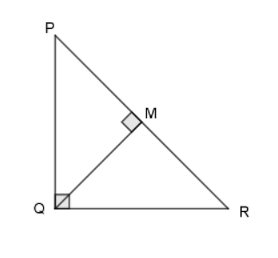
Using the concept of similar triangles we can solve this problem.
Complete step-by-step answer:
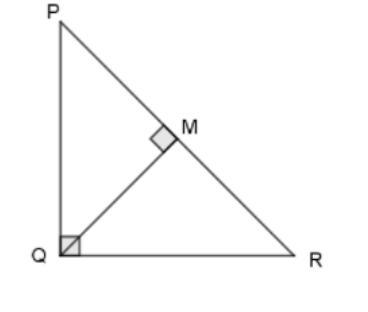
Given $ P{R^2} - P{Q^2} = Q{R^2} $
$ \Rightarrow P{R^2} = P{Q^2} + Q{R^2} $
Therefore the $ \vartriangle PQR $ is a right angled triangle at $ Q $ .
Given $ QM \bot PR $
From figure,
In $ \vartriangle QMR $ ,
$ \angle MQR + \angle M + \angle R = {180^ \circ } $
We know that $ \angle M = {90^ \circ } $
$ \therefore \angle MQR = {180^ \circ } - {90^ \circ } - \angle R $
$ \Rightarrow \angle MQR = {90^ \circ } - \angle R $
In $ \vartriangle PQR $ ,
$ \angle P + \angle Q + \angle R = {180^ \circ } $
$ \angle Q = {90^ \circ } $
$ \therefore \angle P = {90^ \circ } - \angle R $
Now in $ \vartriangle QMR $ and $ \vartriangle PMQ $
$ \angle M = \angle M $ (Both being $ {90^ \circ } $ )
$ \angle MQR = \angle QPM $ (Both are equal to $ \left( {{{90}^ \circ } - \angle R} \right) $ )
From AA similarity criteria theorem, if two angles of one triangle are respectively equal to two angles of another triangle, then the two triangles are said to be similar.
$ \therefore \vartriangle QMR \sim \vartriangle PMQ $
Now according to the theorem of area of similar triangles, the ratio of areas of two similar triangles is equal to the square of ratio of their corresponding sides
$ \therefore \dfrac{{ar\left( {\vartriangle QMR} \right)}}{{ar\left( {\vartriangle PMQ} \right)}} = \dfrac{{{{\left( {QM} \right)}^2}}}{{{{\left( {PM} \right)}^2}}} $
$ \Rightarrow \dfrac{{\dfrac{1}{2} \times RM \times QM}}{{\dfrac{1}{2} \times PM \times QM}} = \dfrac{{{{\left( {QM} \right)}^2}}}{{{{\left( {PM} \right)}^2}}} $ ( $ \because $ area of triangle = $ \dfrac{1}{2} $ $ \times $ base $ \times $ height)
On cancellation we get,
$ Q{M^2} = PM \times RM $
Hence proved.
Note: AA similarity criteria theorem states that “if two angles of one triangle are respectively equal to two angles of another triangle, then the two triangles are said to be similar”.
Since it is known that $ \vartriangle QMR \sim \vartriangle PMQ $ the ratio of their corresponding sides are also equal
$ \dfrac{{QM}}{{PM}} = \dfrac{{RM}}{{QM}} = \dfrac{{QR}}{{PQ}} $
Therefore, in $ \vartriangle QMR $ and $ \vartriangle PMQ $
$ QM $ and $ PM $ are corresponding sides.
Also the Area of similar triangles theorem states that “The ratio of areas of two similar triangles is equal to the square of ratio of their corresponding sides”.
$ P{R^2} - P{Q^2} = Q{R^2} $ and $ QM \bot PR $
We have to prove that $ Q{M^2} = PM \times MR $
Since, $ P{R^2} - P{Q^2} = Q{R^2} $
$ \Rightarrow P{R^2} = P{Q^2} + Q{R^2} $
From Pythagoras theorem, we know that for a right angled triangle sum of squares of opposite side and adjacent side is equal to the square of hypotenuse side.
So from the above definition we can say that the $ \vartriangle PQR $ is a right angled triangle.
Also, it is given that $ M $ is a point on side $ PR $ such that $ QM $ is perpendicular to $ PR $
Using the concept of similar triangles we can solve this problem.
Complete step-by-step answer:
Given $ P{R^2} - P{Q^2} = Q{R^2} $
$ \Rightarrow P{R^2} = P{Q^2} + Q{R^2} $
Therefore the $ \vartriangle PQR $ is a right angled triangle at $ Q $ .
Given $ QM \bot PR $
From figure,
In $ \vartriangle QMR $ ,
$ \angle MQR + \angle M + \angle R = {180^ \circ } $
We know that $ \angle M = {90^ \circ } $
$ \therefore \angle MQR = {180^ \circ } - {90^ \circ } - \angle R $
$ \Rightarrow \angle MQR = {90^ \circ } - \angle R $
In $ \vartriangle PQR $ ,
$ \angle P + \angle Q + \angle R = {180^ \circ } $
$ \angle Q = {90^ \circ } $
$ \therefore \angle P = {90^ \circ } - \angle R $
Now in $ \vartriangle QMR $ and $ \vartriangle PMQ $
$ \angle M = \angle M $ (Both being $ {90^ \circ } $ )
$ \angle MQR = \angle QPM $ (Both are equal to $ \left( {{{90}^ \circ } - \angle R} \right) $ )
From AA similarity criteria theorem, if two angles of one triangle are respectively equal to two angles of another triangle, then the two triangles are said to be similar.
$ \therefore \vartriangle QMR \sim \vartriangle PMQ $
Now according to the theorem of area of similar triangles, the ratio of areas of two similar triangles is equal to the square of ratio of their corresponding sides
$ \therefore \dfrac{{ar\left( {\vartriangle QMR} \right)}}{{ar\left( {\vartriangle PMQ} \right)}} = \dfrac{{{{\left( {QM} \right)}^2}}}{{{{\left( {PM} \right)}^2}}} $
$ \Rightarrow \dfrac{{\dfrac{1}{2} \times RM \times QM}}{{\dfrac{1}{2} \times PM \times QM}} = \dfrac{{{{\left( {QM} \right)}^2}}}{{{{\left( {PM} \right)}^2}}} $ ( $ \because $ area of triangle = $ \dfrac{1}{2} $ $ \times $ base $ \times $ height)
On cancellation we get,
$ Q{M^2} = PM \times RM $
Hence proved.
Note: AA similarity criteria theorem states that “if two angles of one triangle are respectively equal to two angles of another triangle, then the two triangles are said to be similar”.
Since it is known that $ \vartriangle QMR \sim \vartriangle PMQ $ the ratio of their corresponding sides are also equal
$ \dfrac{{QM}}{{PM}} = \dfrac{{RM}}{{QM}} = \dfrac{{QR}}{{PQ}} $
Therefore, in $ \vartriangle QMR $ and $ \vartriangle PMQ $
$ QM $ and $ PM $ are corresponding sides.
Also the Area of similar triangles theorem states that “The ratio of areas of two similar triangles is equal to the square of ratio of their corresponding sides”.
Recently Updated Pages
Master Class 9 Social Science: Engaging Questions & Answers for Success

Master Class 9 Science: Engaging Questions & Answers for Success
Master Class 9 Maths: Engaging Questions & Answers for Success
Master Class 9 General Knowledge: Engaging Questions & Answers for Success
Class 9 Question and Answer - Your Ultimate Solutions Guide
Master Class 8 Social Science: Engaging Questions & Answers for Success
Trending doubts
21st March is celebrated as A World environment day class 9 biology CBSE
Here 1 km is equal to how many miles class 9 maths CBSE
Which are the Top 10 Largest States of India?
What is the difference between Atleast and Atmost in class 9 maths CBSE
Which of the following is the smallest negative nu-class-9-maths-CBSE
Differentiate between the Western and the Eastern class 9 social science CBSE