




In a $\vartriangle ABC$ , two sides are given, BC=2, AB=1. The median from the vertex A to the side BC is also given as AD=3, find the value of AC using Apollonius theorem.
Answer
 Verified
620.7k+ views
Hint- It can be solved by simple geometry. In geometry, Apollonius’s theorem is a theorem which relates the length of a median of a triangle with the length of its sides. It states that “the sum of the squares of any two sides of any triangle is equal to twice the square of half of the third side together with twice the square of the median bisecting the third side.
Complete step-by-step solution-
In a triangle ABC,
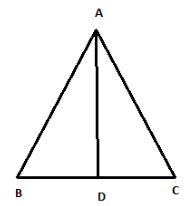
Two sides are given AB=1 , BC=2 and
Median AD=3
We have to find the third side of the triangle and we fill find using Apollonius Theorem
And it states that the sum of the squares of any two sides of any triangle is equal to twice the square of half of the third side together with twice the square of the median bisecting the third side.
Mathematically, the above statement is formulated as
$
\Rightarrow A{B^2} + A{C^2} = 2[A{D^2} + {(BC/2)^2}] \\
\\
$
Here, AB and AC are the sides of the triangle and AD is the median on the side third side BC
Assigning the values of the above sides, we get
$
\Rightarrow {1^2} + A{C^2} = 2[{3^2} + {(2/2)^2}] \\
\Rightarrow 1 + A{C^2} = 2[9 + 1] \\
\Rightarrow A{C^2} = 20 - 1 \\
\Rightarrow AC = \sqrt {19} \\
\Rightarrow AC = 4.35 \\
$
The value of the third side AC is 4.35
Note-The thing that we have to notice in this question is that median is not always perpendicular to the side on which it bisects. A line which passes through the midpoint of a segment and is perpendicular on the segment is called the perpendicular bisector whereas a segment joining a vertex to the midpoint of the opposite side is called a median.
Complete step-by-step solution-
In a triangle ABC,
Two sides are given AB=1 , BC=2 and
Median AD=3
We have to find the third side of the triangle and we fill find using Apollonius Theorem
And it states that the sum of the squares of any two sides of any triangle is equal to twice the square of half of the third side together with twice the square of the median bisecting the third side.
Mathematically, the above statement is formulated as
$
\Rightarrow A{B^2} + A{C^2} = 2[A{D^2} + {(BC/2)^2}] \\
\\
$
Here, AB and AC are the sides of the triangle and AD is the median on the side third side BC
Assigning the values of the above sides, we get
$
\Rightarrow {1^2} + A{C^2} = 2[{3^2} + {(2/2)^2}] \\
\Rightarrow 1 + A{C^2} = 2[9 + 1] \\
\Rightarrow A{C^2} = 20 - 1 \\
\Rightarrow AC = \sqrt {19} \\
\Rightarrow AC = 4.35 \\
$
The value of the third side AC is 4.35
Note-The thing that we have to notice in this question is that median is not always perpendicular to the side on which it bisects. A line which passes through the midpoint of a segment and is perpendicular on the segment is called the perpendicular bisector whereas a segment joining a vertex to the midpoint of the opposite side is called a median.
Recently Updated Pages
Master Class 10 English: Engaging Questions & Answers for Success

Master Class 10 Social Science: Engaging Questions & Answers for Success
Master Class 10 Computer Science: Engaging Questions & Answers for Success
Class 10 Question and Answer - Your Ultimate Solutions Guide
Master Class 10 General Knowledge: Engaging Questions & Answers for Success
Master Class 10 Maths: Engaging Questions & Answers for Success
Trending doubts
A boat goes 24 km upstream and 28 km downstream in class 10 maths CBSE
State and explain Ohms law class 10 physics CBSE
Distinguish between soap and detergent class 10 chemistry CBSE
a Why did Mendel choose pea plants for his experiments class 10 biology CBSE
What is a "free hit" awarded for in limited-overs cricket?
Draw the diagram of the sectional view of the human class 10 biology CBSE