




In a triangle \[\vartriangle ABC\] if \[a\cos A = b\cos B\], then prove that the triangle is either a right angled triangle or an isosceles triangle.
Answer
 Verified
636.3k+ views
Hint: Here we write the values \[a,b\] in terms of angles opposite to them using the Law of sines which states that Ratio of length of a side of a triangle to the sine of the angle opposite to that side is same for all sides and angles of a triangle and then solve using the trigonometric formulas.
* Sum of all three angles of a triangle is always \[{180^ \circ }\].
* Right angled triangle is a triangle where one angle is \[{90^ \circ }\].
* An isosceles triangle is a triangle having two sides equal to each other, also the angles opposite to equal sides are equal.
Complete step by step solution:
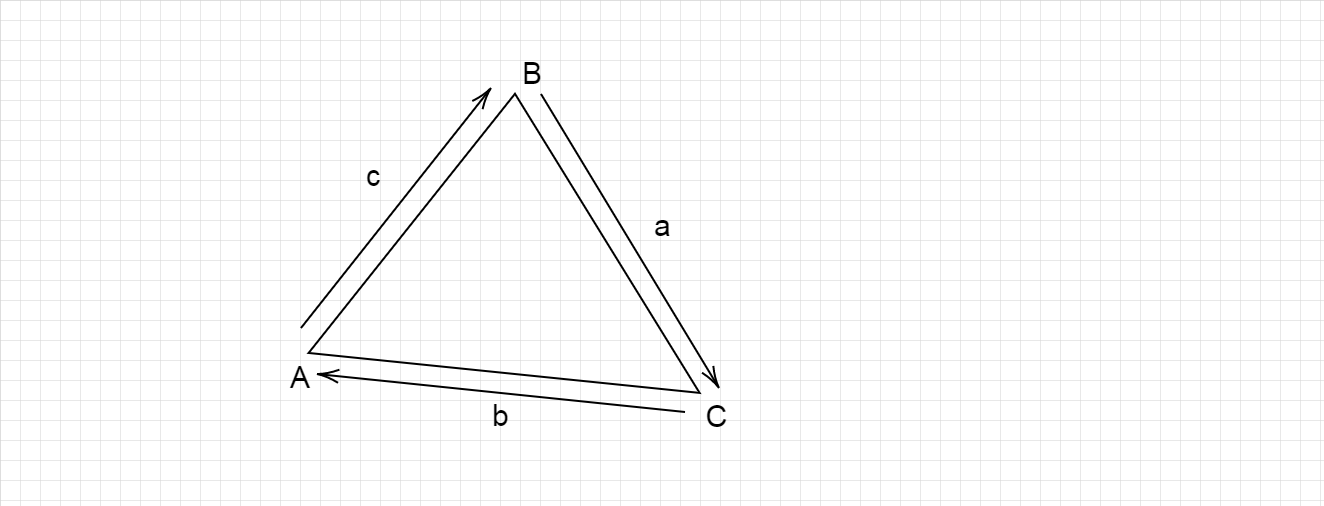
We draw a \[\vartriangle ABC\] with angles \[A,B,C\] and sides \[a,b,c\].
Since, we know sum of three angles of a triangle is \[{180^ \circ }\]
\[A + B + C = {180^ \circ }\]
Therefore, equation can be written as
\[
A + B = {180^ \circ } - C \\
B + C = {180^ \circ } - A \\
C + A = {180^ \circ } - B \\
\] \[...(i)\]
From the diagram, angle opposite to the side \[a\] is \[A\], angle opposite to the side \[b\] is \[B\], angle opposite to the side \[c\] is \[C\].
Therefore, from Law of Sines.
\[\dfrac{{\sin A}}{a} = \dfrac{{\sin B}}{b} = \dfrac{{\sin C}}{c} = k\](say)
Taking LCM on right side we can write
\[a = \dfrac{{\sin A}}{k},b = \dfrac{{\sin B}}{k},c = \dfrac{{\sin C}}{k}\] \[...(ii)\]
Substitute values from equation \[(ii)\] in \[a\cos A = b\cos B\] and solve.
\[\dfrac{{\sin A}}{k} \times \cos A = \dfrac{{\sin B}}{k} \times \cos B\]
Cancel out the denominator on both sides as it is equal on both sides.
\[\sin A\cos A = \sin B\cos B\]
Multiply both sides of the equations by \[2\]
\[2\sin A\cos A = 2\sin B\cos B\]
Using the trigonometric identity \[\sin 2\theta = 2\sin \theta \cos \theta \] we can write,
\[\sin 2A = \sin 2B\]
\[\sin 2A - \sin 2B = 0\]
Using the trigonometric identity \[\sin \alpha - \sin \beta = 2\cos \left( {\dfrac{{\alpha + \beta }}{2}} \right).\sin \left( {\dfrac{{\alpha - \beta }}{2}} \right)\]
Therefore \[\sin 2A - \sin 2B = 2\cos \left( {\dfrac{{2A + 2B}}{2}} \right).\sin \left( {\dfrac{{2A - 2B}}{2}} \right) = 0\]
\[2\cos \left( {\dfrac{{2(A + B)}}{2}} \right).\sin \left( {\dfrac{{2(A - B)}}{2}} \right) = 0\]
\[2\cos \left( {A + B} \right).\sin \left( {A - B} \right) = 0\]
Substitute the value of \[A + B = {180^ \circ } - C\] from equation \[(i)\]
\[2\cos \left( {{{180}^ \circ } - C} \right).\sin \left( {A - B} \right) = 0\]
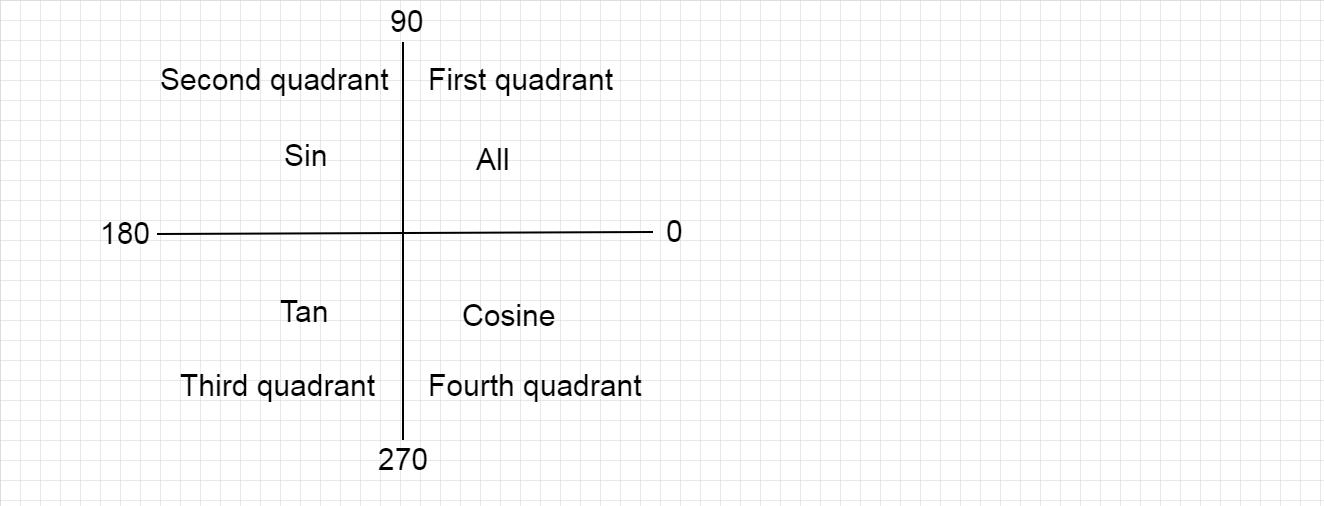
Now we know \[\cos ({180^ \circ } - C) = - \cos C\]because cosine is negative in the fourth quadrant.
\[2( - \cos C).\sin \left( {A - B} \right) = 0\]
\[\cos C.\sin \left( {A - B} \right) = 0\]
If product of two numbers is zero implies either one of them is zero or both of them is zero.
Taking \[\cos C = 0\]
We know \[\cos \dfrac{\pi }{2} = 0\]
Therefore, \[C = \dfrac{\pi }{2}\]
Which means angle \[C\] is \[{90^ \circ }\]. Therefore, \[\vartriangle ABC\] is a right angled triangle.
Now, taking \[\sin (A - B) = 0\]
We know \[\sin {0^ \circ } = 0\]
Therefore, \[A - B = 0\]
\[A = B\]
Therefore, in \[\vartriangle ABC\], two angles are equal. Therefore, \[\vartriangle ABC\] is an isosceles triangle.
Note:
Students are likely to make mistakes while calculating the values like \[\cos ({180^ \circ } - C)\], they can refer to the quadrant diagram for easy conversions. Also, ratio in law of sines holds both ways, therefore \[\dfrac{{\sin A}}{a} = \dfrac{{\sin B}}{b} = \dfrac{{\sin C}}{c}\] is same as \[\dfrac{a}{{\sin A}} = \dfrac{b}{{\sin B}} = \dfrac{c}{{\sin C}}\].
* Sum of all three angles of a triangle is always \[{180^ \circ }\].
* Right angled triangle is a triangle where one angle is \[{90^ \circ }\].
* An isosceles triangle is a triangle having two sides equal to each other, also the angles opposite to equal sides are equal.
Complete step by step solution:
We draw a \[\vartriangle ABC\] with angles \[A,B,C\] and sides \[a,b,c\].
Since, we know sum of three angles of a triangle is \[{180^ \circ }\]
\[A + B + C = {180^ \circ }\]
Therefore, equation can be written as
\[
A + B = {180^ \circ } - C \\
B + C = {180^ \circ } - A \\
C + A = {180^ \circ } - B \\
\] \[...(i)\]
From the diagram, angle opposite to the side \[a\] is \[A\], angle opposite to the side \[b\] is \[B\], angle opposite to the side \[c\] is \[C\].
Therefore, from Law of Sines.
\[\dfrac{{\sin A}}{a} = \dfrac{{\sin B}}{b} = \dfrac{{\sin C}}{c} = k\](say)
Taking LCM on right side we can write
\[a = \dfrac{{\sin A}}{k},b = \dfrac{{\sin B}}{k},c = \dfrac{{\sin C}}{k}\] \[...(ii)\]
Substitute values from equation \[(ii)\] in \[a\cos A = b\cos B\] and solve.
\[\dfrac{{\sin A}}{k} \times \cos A = \dfrac{{\sin B}}{k} \times \cos B\]
Cancel out the denominator on both sides as it is equal on both sides.
\[\sin A\cos A = \sin B\cos B\]
Multiply both sides of the equations by \[2\]
\[2\sin A\cos A = 2\sin B\cos B\]
Using the trigonometric identity \[\sin 2\theta = 2\sin \theta \cos \theta \] we can write,
\[\sin 2A = \sin 2B\]
\[\sin 2A - \sin 2B = 0\]
Using the trigonometric identity \[\sin \alpha - \sin \beta = 2\cos \left( {\dfrac{{\alpha + \beta }}{2}} \right).\sin \left( {\dfrac{{\alpha - \beta }}{2}} \right)\]
Therefore \[\sin 2A - \sin 2B = 2\cos \left( {\dfrac{{2A + 2B}}{2}} \right).\sin \left( {\dfrac{{2A - 2B}}{2}} \right) = 0\]
\[2\cos \left( {\dfrac{{2(A + B)}}{2}} \right).\sin \left( {\dfrac{{2(A - B)}}{2}} \right) = 0\]
\[2\cos \left( {A + B} \right).\sin \left( {A - B} \right) = 0\]
Substitute the value of \[A + B = {180^ \circ } - C\] from equation \[(i)\]
\[2\cos \left( {{{180}^ \circ } - C} \right).\sin \left( {A - B} \right) = 0\]
Now we know \[\cos ({180^ \circ } - C) = - \cos C\]because cosine is negative in the fourth quadrant.
\[2( - \cos C).\sin \left( {A - B} \right) = 0\]
\[\cos C.\sin \left( {A - B} \right) = 0\]
If product of two numbers is zero implies either one of them is zero or both of them is zero.
Taking \[\cos C = 0\]
We know \[\cos \dfrac{\pi }{2} = 0\]
Therefore, \[C = \dfrac{\pi }{2}\]
Which means angle \[C\] is \[{90^ \circ }\]. Therefore, \[\vartriangle ABC\] is a right angled triangle.
Now, taking \[\sin (A - B) = 0\]
We know \[\sin {0^ \circ } = 0\]
Therefore, \[A - B = 0\]
\[A = B\]
Therefore, in \[\vartriangle ABC\], two angles are equal. Therefore, \[\vartriangle ABC\] is an isosceles triangle.
Note:
Students are likely to make mistakes while calculating the values like \[\cos ({180^ \circ } - C)\], they can refer to the quadrant diagram for easy conversions. Also, ratio in law of sines holds both ways, therefore \[\dfrac{{\sin A}}{a} = \dfrac{{\sin B}}{b} = \dfrac{{\sin C}}{c}\] is same as \[\dfrac{a}{{\sin A}} = \dfrac{b}{{\sin B}} = \dfrac{c}{{\sin C}}\].
Recently Updated Pages
Master Class 11 English: Engaging Questions & Answers for Success

Master Class 11 Social Science: Engaging Questions & Answers for Success
Master Class 11 Maths: Engaging Questions & Answers for Success
Master Class 11 Biology: Engaging Questions & Answers for Success
Master Class 11 Physics: Engaging Questions & Answers for Success
Master Class 11 Chemistry: Engaging Questions & Answers for Success
Trending doubts
One Metric ton is equal to kg A 10000 B 1000 C 100 class 11 physics CBSE
What is cell theory Who formulated it class 11 biology CBSE
Phyllotaxy is the arrangement of ALeaflets BLeaves class 11 biology CBSE
Difference Between Prokaryotic Cells and Eukaryotic Cells
The symbiotic association of fungi and algae is called class 11 biology CBSE
Cell theory was formulated by A Schleiden and Schwann class 11 biology CBSE