




In a triangle PQR, X and Y are 2 points on PQ and QR respectively. If $PQ=QR$ and $QX=QY$ show that $PX=RY$ .
Answer
 Verified
627.6k+ views
Hint: First draw a picture and mark the lines which are equal. Now, by close observation using the lines which are equal tell the relation between lines required. By geometry’s basic properties we can say that when a point lies on a line segment, then it directly divides it into 2 parts. When we sum that 2 parts length together the result obtained will be the length of the whole old line segment. Using this property, divide the line segment in the question and then solve it as a normal algebraic equation.
Complete step-by-step answer:
Triangle: It is a 2-dimensional figure with 3 sides. It is a closed figure. It is represented by 2 length (generally) one is height and the other one is base length.
Given in question 2 sides are equal. Hence, it is an isosceles triangle.
Aim: to prove lengths of PX and RY are equal.
Given: $PQ=QR$ , $QX=QY$
First, we need to construct an isosceles triangle.
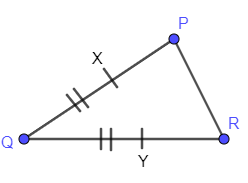
Drawing two line-segments with a point in common, angle doesn’t matter but lengths must be the same.
Mark the common point as Q and the remaining two points as P and R.
So, now we got $PQ=QR$ . Next join P and R to make a triangle.
Take 2 points X, Y at equal distance from Q on PQ and PR respectively.
Now we also got $QX=QY$
As X, Y lies on PQ, QR respectively, we can write them as:
$PQ=PX+QX$ , $QR=QY+RY$
As we know $PQ=QR$ , equating these both equations, we get
$PX+QX=QY+RY$
By cancelling the common terms, (We know $QX=QY$ ), we get
$PX=RY$
By the above equation, we can say the length of line segments PX and RY are equal.
Hence, proved.
Note: Here students must be careful while writing the equations on line segments as if you change one variable the whole proof may conclude another equation which may be wrong.
Complete step-by-step answer:
Triangle: It is a 2-dimensional figure with 3 sides. It is a closed figure. It is represented by 2 length (generally) one is height and the other one is base length.
Given in question 2 sides are equal. Hence, it is an isosceles triangle.
Aim: to prove lengths of PX and RY are equal.
Given: $PQ=QR$ , $QX=QY$
First, we need to construct an isosceles triangle.
Drawing two line-segments with a point in common, angle doesn’t matter but lengths must be the same.
Mark the common point as Q and the remaining two points as P and R.
So, now we got $PQ=QR$ . Next join P and R to make a triangle.
Take 2 points X, Y at equal distance from Q on PQ and PR respectively.
Now we also got $QX=QY$
As X, Y lies on PQ, QR respectively, we can write them as:
$PQ=PX+QX$ , $QR=QY+RY$
As we know $PQ=QR$ , equating these both equations, we get
$PX+QX=QY+RY$
By cancelling the common terms, (We know $QX=QY$ ), we get
$PX=RY$
By the above equation, we can say the length of line segments PX and RY are equal.
Hence, proved.
Note: Here students must be careful while writing the equations on line segments as if you change one variable the whole proof may conclude another equation which may be wrong.
Recently Updated Pages
Master Class 9 Social Science: Engaging Questions & Answers for Success

Master Class 9 Science: Engaging Questions & Answers for Success
Master Class 9 Maths: Engaging Questions & Answers for Success
Master Class 9 General Knowledge: Engaging Questions & Answers for Success
Class 9 Question and Answer - Your Ultimate Solutions Guide
Master Class 8 Social Science: Engaging Questions & Answers for Success
Trending doubts
Find the sum of series 1 + 2 + 3 + 4 + 5 + + 100 class 9 maths CBSE
What is the Full Form of ISI and RAW
Fill the blanks with the suitable prepositions 1 The class 9 english CBSE
Difference Between Plant Cell and Animal Cell
Who is eligible for RTE class 9 social science CBSE
What is pollution? How many types of pollution? Define it