




In a triangle \[\Delta ABC\], if a, b, c are in H.P., then \[{{\sin }^{2}}\left( \dfrac{A}{2} \right)\], \[{{\sin }^{2}}\left( \dfrac{B}{2} \right),{{\sin }^{2}}\left( \dfrac{C}{2} \right)\] are in: -
(a) A.P.
(b) G.P.
(c) H.P.
(d) A.G.P.
Answer
 Verified
571.5k+ views
Hint: Take the reciprocal of a, b, c and consider them to be in A. P. Now, form relations between \[{{\sin }^{2}}\left( \dfrac{A}{2} \right)\], \[{{\sin }^{2}}\left( \dfrac{B}{2} \right),{{\sin }^{2}}\left( \dfrac{C}{2} \right)\] to get a sequence of known form. Check which of the options is correct. Use the formulas: - \[{{\sin }^{2}}\left( \dfrac{A}{2} \right)=\dfrac{\left( s-b \right)\left( s-c \right)}{bc},{{\sin }^{2}}\left( \dfrac{B}{2} \right)=\dfrac{\left( s-a \right)\left( s-c \right)}{ac}\] and \[{{\sin }^{2}}\left( \dfrac{C}{2} \right)=\dfrac{\left( s-a \right)\left( s-b \right)}{ab}\] , where ‘s’ is the semi – perimeter of the triangle.
Complete step-by-step solution
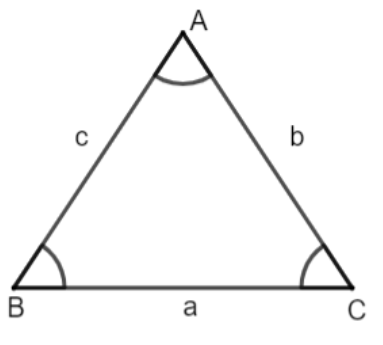
Here, we have been given that in a \[\Delta ABC\], a, b, c are in H.P, i.e. harmonic progression. Here, a, b and c are the sides of the \[\Delta ABC\] lying opposite to the angles A, B, and C respectively.
Now, we know that if some terms are in H.P. then their reciprocal will be in A.P. So, we have,
\[\Rightarrow \] a, b, c are in H.P.
\[\Rightarrow \dfrac{1}{a},\dfrac{1}{b},\dfrac{1}{c}\] are in A.P.
Multiplying all the terms with abc, we get,
\[\Rightarrow \dfrac{abc}{a},\dfrac{abc}{b},\dfrac{abc}{c}\] are in A.P.
\[\Rightarrow \] bc, ac, ab are in A.P.
Multiplying all the terms with semi – perimeter s, we get,
\[\Rightarrow \] sbc, sac, sab are in A.P.
Subtracting abc from all the terms, we get,
\[\Rightarrow \] sbc – abc, sac – abc, sab – abc are in A.P.
\[\Rightarrow \] bc (s – a), ac (s – b), ab (s – c) are in A.P.
Now, we know that: -
\[\begin{align}
& \Rightarrow {{\sin }^{2}}\left( \dfrac{A}{2} \right)=\dfrac{\left( s-b \right)\left( s-c \right)}{bc} \\
& \Rightarrow {{\sin }^{2}}\left( \dfrac{B}{2} \right)=\dfrac{\left( s-a \right)\left( s-c \right)}{ac} \\
& \Rightarrow {{\sin }^{2}}\left( \dfrac{C}{2} \right)=\dfrac{\left( s-a \right)\left( s-b \right)}{ab} \\
\end{align}\]
So, substituting the values of bc, ac and ab, we get,
\[\Rightarrow \dfrac{\left( s-a \right)\left( s-b \right)\left( s-c \right)}{{{\sin }^{2}}\left( \dfrac{A}{2} \right)},\dfrac{\left( s-a \right)\left( s-b \right)\left( s-c \right)}{{{\sin }^{2}}\left( \dfrac{B}{2} \right)},\dfrac{\left( s-a \right)\left( s-b \right)\left( s-c \right)}{{{\sin }^{2}}\left( \dfrac{C}{2} \right)}\] are in A.P.
Canceling the common numerator from all the three terms, we get,
\[\Rightarrow \dfrac{1}{{{\sin }^{2}}\left( \dfrac{A}{2} \right)},\dfrac{1}{{{\sin }^{2}}\left( \dfrac{B}{2} \right)},\dfrac{1}{{{\sin }^{2}}\left( \dfrac{C}{2} \right)}\] are in A.P.
Taking reciprocal of the above terms, we can say that,
\[\Rightarrow {{\sin }^{2}}\left( \dfrac{A}{2} \right),{{\sin }^{2}}\left( \dfrac{B}{2} \right),{{\sin }^{2}}\left( \dfrac{C}{2} \right)\] are in H.P.
Hence, the option (c) is the correct answer.
Note: One may note that multiplying, dividing, adding, and subtracting does not change the sequence of terms in arithmetic progression. That means they remain in the sequence of an arithmetic progression. This is an important property of A.P. which is used above. Note that you must try not try to change sine of the given half angles into the cosine form using the identity: - \[\Rightarrow {{\sin }^{2}}\left( \dfrac{\theta }{2} \right)=\dfrac{1-\cos \theta }{2}\]. In this way also we will get the answer but the calculation will be too hard to handle.
Complete step-by-step solution
Here, we have been given that in a \[\Delta ABC\], a, b, c are in H.P, i.e. harmonic progression. Here, a, b and c are the sides of the \[\Delta ABC\] lying opposite to the angles A, B, and C respectively.
Now, we know that if some terms are in H.P. then their reciprocal will be in A.P. So, we have,
\[\Rightarrow \] a, b, c are in H.P.
\[\Rightarrow \dfrac{1}{a},\dfrac{1}{b},\dfrac{1}{c}\] are in A.P.
Multiplying all the terms with abc, we get,
\[\Rightarrow \dfrac{abc}{a},\dfrac{abc}{b},\dfrac{abc}{c}\] are in A.P.
\[\Rightarrow \] bc, ac, ab are in A.P.
Multiplying all the terms with semi – perimeter s, we get,
\[\Rightarrow \] sbc, sac, sab are in A.P.
Subtracting abc from all the terms, we get,
\[\Rightarrow \] sbc – abc, sac – abc, sab – abc are in A.P.
\[\Rightarrow \] bc (s – a), ac (s – b), ab (s – c) are in A.P.
Now, we know that: -
\[\begin{align}
& \Rightarrow {{\sin }^{2}}\left( \dfrac{A}{2} \right)=\dfrac{\left( s-b \right)\left( s-c \right)}{bc} \\
& \Rightarrow {{\sin }^{2}}\left( \dfrac{B}{2} \right)=\dfrac{\left( s-a \right)\left( s-c \right)}{ac} \\
& \Rightarrow {{\sin }^{2}}\left( \dfrac{C}{2} \right)=\dfrac{\left( s-a \right)\left( s-b \right)}{ab} \\
\end{align}\]
So, substituting the values of bc, ac and ab, we get,
\[\Rightarrow \dfrac{\left( s-a \right)\left( s-b \right)\left( s-c \right)}{{{\sin }^{2}}\left( \dfrac{A}{2} \right)},\dfrac{\left( s-a \right)\left( s-b \right)\left( s-c \right)}{{{\sin }^{2}}\left( \dfrac{B}{2} \right)},\dfrac{\left( s-a \right)\left( s-b \right)\left( s-c \right)}{{{\sin }^{2}}\left( \dfrac{C}{2} \right)}\] are in A.P.
Canceling the common numerator from all the three terms, we get,
\[\Rightarrow \dfrac{1}{{{\sin }^{2}}\left( \dfrac{A}{2} \right)},\dfrac{1}{{{\sin }^{2}}\left( \dfrac{B}{2} \right)},\dfrac{1}{{{\sin }^{2}}\left( \dfrac{C}{2} \right)}\] are in A.P.
Taking reciprocal of the above terms, we can say that,
\[\Rightarrow {{\sin }^{2}}\left( \dfrac{A}{2} \right),{{\sin }^{2}}\left( \dfrac{B}{2} \right),{{\sin }^{2}}\left( \dfrac{C}{2} \right)\] are in H.P.
Hence, the option (c) is the correct answer.
Note: One may note that multiplying, dividing, adding, and subtracting does not change the sequence of terms in arithmetic progression. That means they remain in the sequence of an arithmetic progression. This is an important property of A.P. which is used above. Note that you must try not try to change sine of the given half angles into the cosine form using the identity: - \[\Rightarrow {{\sin }^{2}}\left( \dfrac{\theta }{2} \right)=\dfrac{1-\cos \theta }{2}\]. In this way also we will get the answer but the calculation will be too hard to handle.
Recently Updated Pages
Master Class 10 Computer Science: Engaging Questions & Answers for Success

Master Class 10 General Knowledge: Engaging Questions & Answers for Success
Master Class 10 English: Engaging Questions & Answers for Success
Master Class 10 Social Science: Engaging Questions & Answers for Success
Master Class 10 Maths: Engaging Questions & Answers for Success
Master Class 10 Science: Engaging Questions & Answers for Success
Trending doubts
What is the median of the first 10 natural numbers class 10 maths CBSE
The draft of the Preamble of the Indian Constitution class 10 social science CBSE
Which women's tennis player has 24 Grand Slam singles titles?
Who gave "Inqilab Zindabad" slogan?
Why is there a time difference of about 5 hours between class 10 social science CBSE
Who is the Brand Ambassador of Incredible India?