



In a triangle ABC with $\angle BCA = 90^\circ $, the perpendicular bisector of AB intersects segments AB and AC at X and Y , respectively. If the ratio of the area of quadrilateral BXYC to the area of triangle ABC is $13:18$ and $BC = 12$, then what is the length of AC?
Answer
 Verified
564.9k+ views
Hint: We will use a three step process to solve this problem. In the first step, we will find the ratio of area of triangle AYX to area of triangle ABC by using the given ratio of the area of quadrilateral BXYC to the area of triangle ABC. In the second step, we will use the area of similar triangle theorems. And finally, we will use the Pythagoras theorem to get our final answer.
Complete step-by-step answer:
We can draw the diagram of the given representation as shown in the figure below.
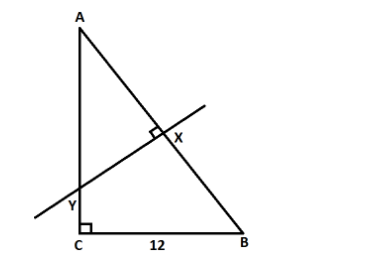
It is given that the ratio of the area of quadrilateral BXYC to the area of triangle ABC is $13:18$.
It is clear from the diagram that
\[Area{\text{ }}of{\text{ }}ABC = Area{\text{ }}of{\text{ }}AYX + Area{\text{ }}of{\text{ }}BXYC\]
Dividing both the sides by Area of ABC
\[ \Rightarrow 1 = \dfrac{{Area{\text{ }}of{\text{ }}AYX}}{{Area{\text{ }}of{\text{ }}ABC}} + \dfrac{{{\text{ }}Area{\text{ }}of{\text{ }}BXYC}}{{Area{\text{ }}of{\text{ }}ABC}}\]
\[ \Rightarrow 1 = \dfrac{{Area{\text{ }}of{\text{ }}AYX}}{{Area{\text{ }}of{\text{ }}ABC}} + \dfrac{{13}}{{18}}\]
\[ \Rightarrow \dfrac{{Area{\text{ }}of{\text{ }}AYX}}{{Area{\text{ }}of{\text{ }}ABC}} = 1 - \dfrac{{13}}{{18}}\]
\[ \Rightarrow \dfrac{{Area{\text{ }}of{\text{ }}AYX}}{{Area{\text{ }}of{\text{ }}ABC}} = \dfrac{5}{{18}}\]
From the diagram, we can say that ABC and AYX are similar triangles.
As per the theorem of area of similar triangles, the ratio of the areas of two similar triangles is the same as the ratio of the square of their sides.
\[ \Rightarrow \dfrac{{A{X^2}}}{{A{C^2}}} = \dfrac{5}{{18}}\]
As XY is the perpendicular bisector of AB, $AX = \dfrac{{AB}}{2}$
\[
\Rightarrow \dfrac{{{{\left( {\dfrac{{AB}}{2}} \right)}^2}}}{{A{C^2}}} = \dfrac{5}{{18}} \\
\Rightarrow \dfrac{{A{B^2}}}{{4 \times A{C^2}}} = \dfrac{5}{{18}} \;
\]
Now, in right angle triangle ABC with $\angle BCA = 90^\circ $, as per the Pythagoras law,
$A{B^2} = A{C^2} + B{C^2} = A{C^2} + {12^2}$
\[
\Rightarrow \dfrac{{A{C^2} + {{12}^2}}}{{4 \times A{C^2}}} = \dfrac{5}{{18}} \\
\Rightarrow 18A{C^2} + \left( {18 \times {{12}^2}} \right) = 20A{C^2} \\
\Rightarrow 2A{C^2} = 18 \times {12^2} \\
\Rightarrow A{C^2} = 9 \times {12^2} \\
\Rightarrow A{C^2} = {3^2} \times {12^2} \\
\Rightarrow AC = 36 \;
\]
Thus, the length of AC is 36.
So, the correct answer is “36”.
Note: In this type of question, we need to analyze the given data and think of useful theorems which can be applied to get to the answers easily. For example, here, we have applied two theorems. First, area of similar triangle theorem and then Pythagoras theorem to determine our final answer, the length of AC.
Complete step-by-step answer:
We can draw the diagram of the given representation as shown in the figure below.
It is given that the ratio of the area of quadrilateral BXYC to the area of triangle ABC is $13:18$.
It is clear from the diagram that
\[Area{\text{ }}of{\text{ }}ABC = Area{\text{ }}of{\text{ }}AYX + Area{\text{ }}of{\text{ }}BXYC\]
Dividing both the sides by Area of ABC
\[ \Rightarrow 1 = \dfrac{{Area{\text{ }}of{\text{ }}AYX}}{{Area{\text{ }}of{\text{ }}ABC}} + \dfrac{{{\text{ }}Area{\text{ }}of{\text{ }}BXYC}}{{Area{\text{ }}of{\text{ }}ABC}}\]
\[ \Rightarrow 1 = \dfrac{{Area{\text{ }}of{\text{ }}AYX}}{{Area{\text{ }}of{\text{ }}ABC}} + \dfrac{{13}}{{18}}\]
\[ \Rightarrow \dfrac{{Area{\text{ }}of{\text{ }}AYX}}{{Area{\text{ }}of{\text{ }}ABC}} = 1 - \dfrac{{13}}{{18}}\]
\[ \Rightarrow \dfrac{{Area{\text{ }}of{\text{ }}AYX}}{{Area{\text{ }}of{\text{ }}ABC}} = \dfrac{5}{{18}}\]
From the diagram, we can say that ABC and AYX are similar triangles.
As per the theorem of area of similar triangles, the ratio of the areas of two similar triangles is the same as the ratio of the square of their sides.
\[ \Rightarrow \dfrac{{A{X^2}}}{{A{C^2}}} = \dfrac{5}{{18}}\]
As XY is the perpendicular bisector of AB, $AX = \dfrac{{AB}}{2}$
\[
\Rightarrow \dfrac{{{{\left( {\dfrac{{AB}}{2}} \right)}^2}}}{{A{C^2}}} = \dfrac{5}{{18}} \\
\Rightarrow \dfrac{{A{B^2}}}{{4 \times A{C^2}}} = \dfrac{5}{{18}} \;
\]
Now, in right angle triangle ABC with $\angle BCA = 90^\circ $, as per the Pythagoras law,
$A{B^2} = A{C^2} + B{C^2} = A{C^2} + {12^2}$
\[
\Rightarrow \dfrac{{A{C^2} + {{12}^2}}}{{4 \times A{C^2}}} = \dfrac{5}{{18}} \\
\Rightarrow 18A{C^2} + \left( {18 \times {{12}^2}} \right) = 20A{C^2} \\
\Rightarrow 2A{C^2} = 18 \times {12^2} \\
\Rightarrow A{C^2} = 9 \times {12^2} \\
\Rightarrow A{C^2} = {3^2} \times {12^2} \\
\Rightarrow AC = 36 \;
\]
Thus, the length of AC is 36.
So, the correct answer is “36”.
Note: In this type of question, we need to analyze the given data and think of useful theorems which can be applied to get to the answers easily. For example, here, we have applied two theorems. First, area of similar triangle theorem and then Pythagoras theorem to determine our final answer, the length of AC.
Recently Updated Pages
Master Class 8 Social Science: Engaging Questions & Answers for Success

Master Class 8 English: Engaging Questions & Answers for Success
Class 8 Question and Answer - Your Ultimate Solutions Guide
Master Class 8 Maths: Engaging Questions & Answers for Success
Master Class 8 Science: Engaging Questions & Answers for Success
Master Class 9 General Knowledge: Engaging Questions & Answers for Success
Trending doubts
What is BLO What is the full form of BLO class 8 social science CBSE
Citizens of India can vote at the age of A 18 years class 8 social science CBSE
Full form of STD, ISD and PCO
Advantages and disadvantages of science
Right to vote is a AFundamental Right BFundamental class 8 social science CBSE
What are the 12 elements of nature class 8 chemistry CBSE