




In a triangle ABC, right angled at the vertex A, if the position vectors of A, B and C are respectively \[3\hat{i}+\hat{j}-\hat{k},-\hat{i}+3\hat{j}+p\hat{k}\] and \[5\hat{i}+q\hat{j}-4\hat{k}\], then the point \[\left( p,q \right)\] lies on a line:
(a) Making an obtuse angle with the positive direction of x-axis
(b) Making an acute angle with the positive direction of x-axis
(c) Parallel to x-axis
(d) Parallel to y-axis
Answer
 Verified
648.6k+ views
Hint: In this question, as given that triangle is right angled at A. Now, we need to find the vectors AC and AB and then do the dot product for these two vectors and equate to zero as the angle between them is right angle which can be done using the formula \[a\cdot b=\left| a \right|\left| b \right|\cos \theta \]. Then simply further to get the equation in p and q and then calculate the slope to get the result.
Complete step-by-step answer:
Now, given the position vectors in the question as
\[\begin{align}
& \vec{A}=3\hat{i}+\hat{j}-\hat{k} \\
& \vec{B}=-\hat{i}+3\hat{j}+p\hat{k} \\
& \vec{C}=5\hat{i}+q\hat{j}-4\hat{k} \\
\end{align}\]
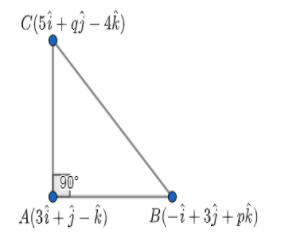
Now, let us find the vectors AB and AC
\[\overrightarrow{AB}=\vec{B}-\vec{A}\]
Now, on substituting the respective position vectors we get,
\[\Rightarrow \overrightarrow{AB}=\left( -\hat{i}+3\hat{j}+p\hat{k} \right)-\left( 3\hat{i}+\hat{j}-\hat{k} \right)\]
Now, this can be further written as
\[\Rightarrow \overrightarrow{AB}=\left( -1-3 \right)\hat{i}+\left( 3-1 \right)\hat{j}+\left( p+1 \right)\hat{k}\]
Now, on further simplification we get,
\[\therefore \overrightarrow{AB}=-4\hat{i}+2\hat{j}+\left( p+1 \right)\hat{k}\]
Now, let us find the vector AC
\[\overrightarrow{AC}=\vec{C}-\vec{A}\]
Now, on substituting the respective position vectors we get,
\[\Rightarrow \overrightarrow{AC}=\left( 5\hat{i}+q\hat{j}-4\hat{k} \right)-\left( 3\hat{i}+\hat{j}-\hat{k} \right)\]
Now, this can be further written as
\[\Rightarrow \overrightarrow{AC}=\left( 5-3 \right)\hat{i}+\left( q-1 \right)\hat{j}+\left( -4+1 \right)\hat{k}\]
Now, on further simplification we get,
\[\therefore \overrightarrow{AC}=2\hat{i}+\left( q-1 \right)\hat{j}-3\hat{k}\]
As we already know that dot product between any two vectors is given by the formula
\[a\cdot b=\left| a \right|\left| b \right|\cos \theta \]
Here, given that the triangle is right angled at A
Let now find the dot product between the vectors AB and AC
\[\Rightarrow \overrightarrow{AB}\cdot \overrightarrow{AC}=\left| \overrightarrow{AB} \right|\left| \overrightarrow{AC} \right|\cos {{90}^{\circ }}\]
Now, on further substituting the respective values we get,
\[\Rightarrow \left( -4\hat{i}+2\hat{j}+\left( p+1 \right)\hat{k} \right)\cdot \left( 2\hat{i}+\left( q-1 \right)\hat{j}-3\hat{k} \right)=\left| \overrightarrow{AB} \right|\left| \overrightarrow{AC} \right|\times 0\]
Now, this can be further written as
\[\Rightarrow \left( -4\hat{i}+2\hat{j}+\left( p+1 \right)\hat{k} \right)\cdot \left( 2\hat{i}+\left( q-1 \right)\hat{j}-3\hat{k} \right)=0\]
As we already know from the properties of dot product that
\[\begin{align}
& \hat{i}\cdot \hat{i}=\hat{j}\cdot \hat{j}=\hat{k}\cdot \hat{k}=1 \\
& \hat{i}\cdot \hat{j}=\hat{j}\cdot \hat{k}=\hat{k}.\hat{i}=0 \\
\end{align}\]
Now, using the above conditions we can write the equation further as
\[\Rightarrow -4\times 2+2\left( q-1 \right)-3\left( p+1 \right)=0\]
Now, this can be further written on simplification as
\[\Rightarrow -8+2q-2-3p-3=0\]
Now, on further simplification we get,
\[\Rightarrow 2q-3p-13=0\]
Now, to find the angle made by this line we need to find the slope of the line
As we already know that slope of a line is given by the formula
\[m=\dfrac{-b}{a}=\tan \theta \]
Now, on comparing the line with \[ax+by+c=0\]we get,
\[a=2,b=-3,c=-13\]
Now, slope of the line is given by
\[\Rightarrow \tan \theta =\dfrac{-b}{a}\]
Now, on substituting the respective values we get,
\[\Rightarrow \tan \theta =\dfrac{-\left( -3 \right)}{2}\]
Now, the angle can be written as
\[\Rightarrow \theta ={{\tan }^{-1}}\left( \dfrac{3}{2} \right)\]
Now, on further simplification we get,
\[\therefore \theta \simeq {{56}^{\circ }}\]
Thus, the line \[2q-3p-13=0\]makes acute angle with the x-axis
Hence, the correct option is (b).
Note:
Instead of using the dot product we can also find the equation of line using the Pythagoras theorem and then simplify further. Both the methods give the same equation but this method would be a bit lengthy. Instead of using the slope formula to find the angle made by the line we can also use the formula for the angle between two lines and then substitute the respective values to simplify further. It is important to note that the angle makes an acute angle as the slope is positive but to be sure about the result we find the angle also.
Complete step-by-step answer:
Now, given the position vectors in the question as
\[\begin{align}
& \vec{A}=3\hat{i}+\hat{j}-\hat{k} \\
& \vec{B}=-\hat{i}+3\hat{j}+p\hat{k} \\
& \vec{C}=5\hat{i}+q\hat{j}-4\hat{k} \\
\end{align}\]
Now, let us find the vectors AB and AC
\[\overrightarrow{AB}=\vec{B}-\vec{A}\]
Now, on substituting the respective position vectors we get,
\[\Rightarrow \overrightarrow{AB}=\left( -\hat{i}+3\hat{j}+p\hat{k} \right)-\left( 3\hat{i}+\hat{j}-\hat{k} \right)\]
Now, this can be further written as
\[\Rightarrow \overrightarrow{AB}=\left( -1-3 \right)\hat{i}+\left( 3-1 \right)\hat{j}+\left( p+1 \right)\hat{k}\]
Now, on further simplification we get,
\[\therefore \overrightarrow{AB}=-4\hat{i}+2\hat{j}+\left( p+1 \right)\hat{k}\]
Now, let us find the vector AC
\[\overrightarrow{AC}=\vec{C}-\vec{A}\]
Now, on substituting the respective position vectors we get,
\[\Rightarrow \overrightarrow{AC}=\left( 5\hat{i}+q\hat{j}-4\hat{k} \right)-\left( 3\hat{i}+\hat{j}-\hat{k} \right)\]
Now, this can be further written as
\[\Rightarrow \overrightarrow{AC}=\left( 5-3 \right)\hat{i}+\left( q-1 \right)\hat{j}+\left( -4+1 \right)\hat{k}\]
Now, on further simplification we get,
\[\therefore \overrightarrow{AC}=2\hat{i}+\left( q-1 \right)\hat{j}-3\hat{k}\]
As we already know that dot product between any two vectors is given by the formula
\[a\cdot b=\left| a \right|\left| b \right|\cos \theta \]
Here, given that the triangle is right angled at A
Let now find the dot product between the vectors AB and AC
\[\Rightarrow \overrightarrow{AB}\cdot \overrightarrow{AC}=\left| \overrightarrow{AB} \right|\left| \overrightarrow{AC} \right|\cos {{90}^{\circ }}\]
Now, on further substituting the respective values we get,
\[\Rightarrow \left( -4\hat{i}+2\hat{j}+\left( p+1 \right)\hat{k} \right)\cdot \left( 2\hat{i}+\left( q-1 \right)\hat{j}-3\hat{k} \right)=\left| \overrightarrow{AB} \right|\left| \overrightarrow{AC} \right|\times 0\]
Now, this can be further written as
\[\Rightarrow \left( -4\hat{i}+2\hat{j}+\left( p+1 \right)\hat{k} \right)\cdot \left( 2\hat{i}+\left( q-1 \right)\hat{j}-3\hat{k} \right)=0\]
As we already know from the properties of dot product that
\[\begin{align}
& \hat{i}\cdot \hat{i}=\hat{j}\cdot \hat{j}=\hat{k}\cdot \hat{k}=1 \\
& \hat{i}\cdot \hat{j}=\hat{j}\cdot \hat{k}=\hat{k}.\hat{i}=0 \\
\end{align}\]
Now, using the above conditions we can write the equation further as
\[\Rightarrow -4\times 2+2\left( q-1 \right)-3\left( p+1 \right)=0\]
Now, this can be further written on simplification as
\[\Rightarrow -8+2q-2-3p-3=0\]
Now, on further simplification we get,
\[\Rightarrow 2q-3p-13=0\]
Now, to find the angle made by this line we need to find the slope of the line
As we already know that slope of a line is given by the formula
\[m=\dfrac{-b}{a}=\tan \theta \]
Now, on comparing the line with \[ax+by+c=0\]we get,
\[a=2,b=-3,c=-13\]
Now, slope of the line is given by
\[\Rightarrow \tan \theta =\dfrac{-b}{a}\]
Now, on substituting the respective values we get,
\[\Rightarrow \tan \theta =\dfrac{-\left( -3 \right)}{2}\]
Now, the angle can be written as
\[\Rightarrow \theta ={{\tan }^{-1}}\left( \dfrac{3}{2} \right)\]
Now, on further simplification we get,
\[\therefore \theta \simeq {{56}^{\circ }}\]
Thus, the line \[2q-3p-13=0\]makes acute angle with the x-axis
Hence, the correct option is (b).
Note:
Instead of using the dot product we can also find the equation of line using the Pythagoras theorem and then simplify further. Both the methods give the same equation but this method would be a bit lengthy. Instead of using the slope formula to find the angle made by the line we can also use the formula for the angle between two lines and then substitute the respective values to simplify further. It is important to note that the angle makes an acute angle as the slope is positive but to be sure about the result we find the angle also.
Recently Updated Pages
Basicity of sulphurous acid and sulphuric acid are

Master Class 12 Economics: Engaging Questions & Answers for Success
Master Class 12 Biology: Engaging Questions & Answers for Success
Master Class 11 English: Engaging Questions & Answers for Success
Master Class 11 Physics: Engaging Questions & Answers for Success
Master Class 11 Computer Science: Engaging Questions & Answers for Success
Trending doubts
Draw a labelled sketch of the human eye class 12 physics CBSE
The chemical formula of tear gas is A CO Cl 2 B C 10 class 12 chemistry CBSE
Draw ray diagrams each showing i myopic eye and ii class 12 physics CBSE
Which are the Top 10 Largest Countries of the World?
Differentiate between homogeneous and heterogeneous class 12 chemistry CBSE
Which is the correct genotypic ratio of mendel dihybrid class 12 biology CBSE