




In a triangle ABC, right angled at B, AB=24cm, BC=7cm. Determine
$
(i){\text{ sinA,cosA}} \\
{\text{(ii)sinC,cosC}} \\
$
Answer
 Verified
633k+ views
Hint – In this question first of all use the Pythagoras theorem to get the value of side AC, that is ${\left( {{\text{AC}}} \right)^2} = {\left( {{\text{AB}}} \right)^2} + {\left( {{\text{BC}}} \right)^2}$, then use the concept that in triangle ABC when we consider angle A the perpendicular become BC and base become AB and hypotenuse remains same and we consider angle C the perpendicular become AB and base become BC and hypotenuse remains same. This will help get the values of the respective trigonometric angles.
Complete step-by-step answer:
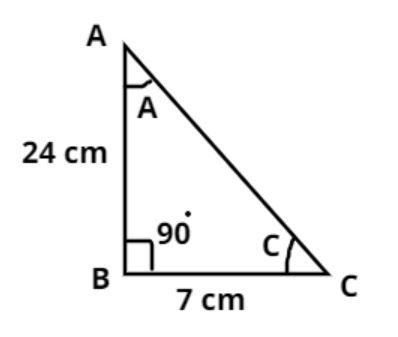
The pictorial representation of the above problem is shown having right angle at B as shown in the figure.
It is given that AB = 24 cm, and BC = 7 cm.
Now apply Pythagoras theorem in triangle ABC we have,
$ \Rightarrow {\left( {{\text{Hypotenuse}}} \right)^2} = {\left( {{\text{perpendicular}}} \right)^2} + {\left( {{\text{base}}} \right)^2}$
$ \Rightarrow {\left( {{\text{AC}}} \right)^2} = {\left( {{\text{AB}}} \right)^2} + {\left( {{\text{BC}}} \right)^2}$
Now substitute the value we have,
$ \Rightarrow {\left( {{\text{AC}}} \right)^2} = {\left( {24} \right)^2} + {\left( 7 \right)^2} = 576 + 49 = 625 = {\left( {25} \right)^2}$
$ \Rightarrow AC = 25$ cm.
$\left( i \right)\sin A,\cos A$
Now as we know that sine is the ratio of perpendicular to hypotenuse.
So in triangle ABC when we consider angle A the perpendicular becomes BC and base becomes AB and hypotenuse remains the same.
$ \Rightarrow \sin A = \dfrac{{BC}}{{AC}} = \dfrac{7}{{25}}$
And cosine is the ratio of base to hypotenuse.
$ \Rightarrow \cos A = \dfrac{{AB}}{{AC}} = \dfrac{{24}}{{25}}$
$\left( {ii} \right)\sin C,\cos C$
Now as we know that sine is the ratio of perpendicular to hypotenuse.
So in triangle ABC when we consider angle C the perpendicular becomes AB and base becomes BC and hypotenuse remains the same.
$ \Rightarrow \sin C = \dfrac{{AB}}{{AC}} = \dfrac{{24}}{{25}}$
And cosine is the ratio of base to hypotenuse.
$ \Rightarrow \cos C = \dfrac{{BC}}{{AC}} = \dfrac{7}{{25}}$
So this is the required answer.
Note – It is advised to remember the direct formula for basic trigonometric ratios like $\sin \theta = \dfrac{P}{H},\cos \theta = \dfrac{B}{H},\tan \theta = \dfrac{P}{B}$ and $\cos ec\theta = \dfrac{H}{P},\sec \theta = \dfrac{H}{B},\cot \theta = \dfrac{B}{P}$. The trick point while considering different angles in a triangle is that the hypotenuse remains the same always however for the angles that are non-90 degrees the side which is exactly in front of it acts as perpendicular.
Complete step-by-step answer:
The pictorial representation of the above problem is shown having right angle at B as shown in the figure.
It is given that AB = 24 cm, and BC = 7 cm.
Now apply Pythagoras theorem in triangle ABC we have,
$ \Rightarrow {\left( {{\text{Hypotenuse}}} \right)^2} = {\left( {{\text{perpendicular}}} \right)^2} + {\left( {{\text{base}}} \right)^2}$
$ \Rightarrow {\left( {{\text{AC}}} \right)^2} = {\left( {{\text{AB}}} \right)^2} + {\left( {{\text{BC}}} \right)^2}$
Now substitute the value we have,
$ \Rightarrow {\left( {{\text{AC}}} \right)^2} = {\left( {24} \right)^2} + {\left( 7 \right)^2} = 576 + 49 = 625 = {\left( {25} \right)^2}$
$ \Rightarrow AC = 25$ cm.
$\left( i \right)\sin A,\cos A$
Now as we know that sine is the ratio of perpendicular to hypotenuse.
So in triangle ABC when we consider angle A the perpendicular becomes BC and base becomes AB and hypotenuse remains the same.
$ \Rightarrow \sin A = \dfrac{{BC}}{{AC}} = \dfrac{7}{{25}}$
And cosine is the ratio of base to hypotenuse.
$ \Rightarrow \cos A = \dfrac{{AB}}{{AC}} = \dfrac{{24}}{{25}}$
$\left( {ii} \right)\sin C,\cos C$
Now as we know that sine is the ratio of perpendicular to hypotenuse.
So in triangle ABC when we consider angle C the perpendicular becomes AB and base becomes BC and hypotenuse remains the same.
$ \Rightarrow \sin C = \dfrac{{AB}}{{AC}} = \dfrac{{24}}{{25}}$
And cosine is the ratio of base to hypotenuse.
$ \Rightarrow \cos C = \dfrac{{BC}}{{AC}} = \dfrac{7}{{25}}$
So this is the required answer.
Note – It is advised to remember the direct formula for basic trigonometric ratios like $\sin \theta = \dfrac{P}{H},\cos \theta = \dfrac{B}{H},\tan \theta = \dfrac{P}{B}$ and $\cos ec\theta = \dfrac{H}{P},\sec \theta = \dfrac{H}{B},\cot \theta = \dfrac{B}{P}$. The trick point while considering different angles in a triangle is that the hypotenuse remains the same always however for the angles that are non-90 degrees the side which is exactly in front of it acts as perpendicular.
Recently Updated Pages
Master Class 12 Business Studies: Engaging Questions & Answers for Success

Master Class 12 Biology: Engaging Questions & Answers for Success
Master Class 12 Chemistry: Engaging Questions & Answers for Success
Class 12 Question and Answer - Your Ultimate Solutions Guide
Master Class 11 Social Science: Engaging Questions & Answers for Success
Master Class 11 English: Engaging Questions & Answers for Success
Trending doubts
Explain the Treaty of Vienna of 1815 class 10 social science CBSE
Who Won 36 Oscar Awards? Record Holder Revealed
What is the median of the first 10 natural numbers class 10 maths CBSE
Why is it 530 pm in india when it is 1200 afternoon class 10 social science CBSE
What is the full form of POSCO class 10 social science CBSE
The highest temperature in Karnataka is recorded in class 10 social science CBSE