




In a triangle ABC $\dfrac{{{r}_{1}}+{{r}_{2}}}{1+\cos C}$ is equal to?
(a) $\dfrac{2ab}{c\Delta }$
(b) $\dfrac{\left( a+b \right)}{c\Delta }$
(c) $\dfrac{abc}{2\Delta }$
(d) $\dfrac{abc}{{{\Delta }^{2}}}$
Answer
 Verified
534.3k+ views
Hint: Assume the given expression $\dfrac{{{r}_{1}}+{{r}_{2}}}{1+\cos C}$ as E. Here, ${{r}_{1}}$ and ${{r}_{2}}$ are radii of ex – circles of triangle ABC opposite the vertex A and B respectively. Now, substitute the value of relations ${{r}_{1}}=\dfrac{\Delta }{\left( s-a \right)}$ and ${{r}_{2}}=\dfrac{\Delta }{\left( s-b \right)}$ in the assumed expression E, where s is the semi – perimeter given as $s=\dfrac{a+b+c}{2}$ while a, b and c are the sides opposite to the vertex A, B and C of the triangle respectively. Use the formula for the area of the triangle given as $\Delta =\sqrt{s\left( s-a \right)\left( s-b \right)\left( s-c \right)}$ to simplify the expression and get the answer.
Complete step by step solution:
Here we have been provided with a triangle ABC and we have to determine the value of the expression $\dfrac{{{r}_{1}}+{{r}_{2}}}{1+\cos C}$ in terms of a, b, c and $\Delta $. First we need to understand the symbols used here.
Now, let us assume the given expression as E, so we have,
$\Rightarrow E=\dfrac{{{r}_{1}}+{{r}_{2}}}{1+\cos C}$
Here, ${{r}_{1}}$ and ${{r}_{2}}$ are radii of ex – circles of triangle ABC opposite the vertex A and B respectively. Ex – circles are formed by the three sides of a triangle in which two sides are extended and with the condition that all the three sides are working as tangents. An illustration is shown below.
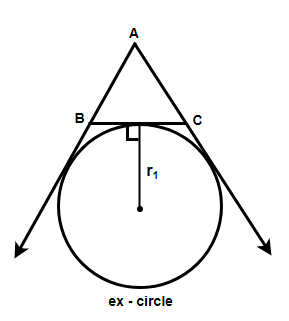
The values of ${{r}_{1}}$ and ${{r}_{2}}$ is given by the relations: ${{r}_{1}}=\dfrac{\Delta }{\left( s-a \right)}$ and ${{r}_{2}}=\dfrac{\Delta }{\left( s-b \right)}$ where $\Delta $ is the area of the triangle and s is the semi – perimeter given as $s=\dfrac{a+b+c}{2}$. So substituting the values of ${{r}_{1}}$ and ${{r}_{2}}$ in the expression E we get,
$\begin{align}
& \Rightarrow E=\dfrac{\dfrac{\Delta }{\left( s-a \right)}+\dfrac{\Delta }{\left( s-b \right)}}{1+\cos C} \\
& \Rightarrow E=\dfrac{\Delta \left( \dfrac{1}{\left( s-a \right)}+\dfrac{1}{\left( s-b \right)} \right)}{1+\cos C} \\
& \Rightarrow E=\dfrac{\Delta \left( 2s-\left( a+b \right) \right)}{\left( s-a \right)\left( s-b \right)\left( 1+\cos C \right)} \\
\end{align}$
Using the cosine formula $\cos C=\dfrac{{{a}^{2}}+{{b}^{2}}-{{c}^{2}}}{2ab}$ and the semi perimeter formula $s=\dfrac{a+b+c}{2}$ we get,
\[\begin{align}
& \Rightarrow E=\dfrac{\Delta \left( \left( a+b+c \right)-\left( a+b \right) \right)}{\left( s-a \right)\left( s-b \right)\left( 1+\dfrac{{{a}^{2}}+{{b}^{2}}-{{c}^{2}}}{2ab} \right)} \\
& \Rightarrow E=\dfrac{\Delta \times c\times 2ab}{\left( s-a \right)\left( s-b \right)\left( 2ab+{{a}^{2}}+{{b}^{2}}-{{c}^{2}} \right)} \\
\end{align}\]
Using the algebraic identity ${{x}^{2}}+{{y}^{2}}-2xy={{\left( x+y \right)}^{2}}$ we get,
\[\Rightarrow E=\dfrac{2abc\Delta }{\left( s-a \right)\left( s-b \right)\left( {{\left( a+b \right)}^{2}}-{{c}^{2}} \right)}\]
Using the algebraic identity ${{x}^{2}}-{{y}^{2}}=\left( x+y \right)\left( x-y \right)$ we get,
\[\begin{align}
& \Rightarrow E=\dfrac{2abc\Delta }{\left( s-a \right)\left( s-b \right)\left( a+b+c \right)\left( a+b-c \right)} \\
& \Rightarrow E=\dfrac{2abc\Delta }{\left( s-a \right)\left( s-b \right)\times 2s\left( a+b-c \right)} \\
\end{align}\]
Multiplying the numerator and denominator with $\left( s-c \right)$ we get,
\[\Rightarrow E=\dfrac{abc\Delta \times \left( s-c \right)}{s\left( s-a \right)\left( s-b \right)\left( s-c \right)\left( a+b-c \right)}\]
We know that the area of a triangle is given as $\Delta =\sqrt{s\left( s-a \right)\left( s-b \right)\left( s-c \right)}$ so substituting this in the above relation we get,
\[\Rightarrow E=\dfrac{abc\Delta \times \left( s-c \right)}{{{\Delta }^{2}}\left( a+b-c \right)}\]
Again substituting the value $s=\dfrac{a+b+c}{2}$ in the numerator and simplifying we get,
\[\begin{align}
& \Rightarrow E=\dfrac{abc\times \left( \dfrac{a+b+c}{2}-c \right)}{\Delta \left( a+b-c \right)} \\
& \Rightarrow E=\dfrac{abc\times \left( \dfrac{a+b-c}{2} \right)}{\Delta \left( a+b-c \right)} \\
& \therefore E=\dfrac{abc}{2\Delta } \\
\end{align}\]
Hence option (c) is the correct answer.
Note: Remember that there are three ex – circles of a triangle, one in – circle and one circum – circle. So there are three ex – radii denoted with ${{r}_{1}},{{r}_{2}}$ and \[{{r}_{3}}\], one in – radius given as $r=\dfrac{\Delta }{s}$ and one circum – radius given as $R=\dfrac{abc}{4\Delta }$. Remember all the formulas of the topic properties of triangle as they will not be proved everywhere but directly used.
Complete step by step solution:
Here we have been provided with a triangle ABC and we have to determine the value of the expression $\dfrac{{{r}_{1}}+{{r}_{2}}}{1+\cos C}$ in terms of a, b, c and $\Delta $. First we need to understand the symbols used here.
Now, let us assume the given expression as E, so we have,
$\Rightarrow E=\dfrac{{{r}_{1}}+{{r}_{2}}}{1+\cos C}$
Here, ${{r}_{1}}$ and ${{r}_{2}}$ are radii of ex – circles of triangle ABC opposite the vertex A and B respectively. Ex – circles are formed by the three sides of a triangle in which two sides are extended and with the condition that all the three sides are working as tangents. An illustration is shown below.
The values of ${{r}_{1}}$ and ${{r}_{2}}$ is given by the relations: ${{r}_{1}}=\dfrac{\Delta }{\left( s-a \right)}$ and ${{r}_{2}}=\dfrac{\Delta }{\left( s-b \right)}$ where $\Delta $ is the area of the triangle and s is the semi – perimeter given as $s=\dfrac{a+b+c}{2}$. So substituting the values of ${{r}_{1}}$ and ${{r}_{2}}$ in the expression E we get,
$\begin{align}
& \Rightarrow E=\dfrac{\dfrac{\Delta }{\left( s-a \right)}+\dfrac{\Delta }{\left( s-b \right)}}{1+\cos C} \\
& \Rightarrow E=\dfrac{\Delta \left( \dfrac{1}{\left( s-a \right)}+\dfrac{1}{\left( s-b \right)} \right)}{1+\cos C} \\
& \Rightarrow E=\dfrac{\Delta \left( 2s-\left( a+b \right) \right)}{\left( s-a \right)\left( s-b \right)\left( 1+\cos C \right)} \\
\end{align}$
Using the cosine formula $\cos C=\dfrac{{{a}^{2}}+{{b}^{2}}-{{c}^{2}}}{2ab}$ and the semi perimeter formula $s=\dfrac{a+b+c}{2}$ we get,
\[\begin{align}
& \Rightarrow E=\dfrac{\Delta \left( \left( a+b+c \right)-\left( a+b \right) \right)}{\left( s-a \right)\left( s-b \right)\left( 1+\dfrac{{{a}^{2}}+{{b}^{2}}-{{c}^{2}}}{2ab} \right)} \\
& \Rightarrow E=\dfrac{\Delta \times c\times 2ab}{\left( s-a \right)\left( s-b \right)\left( 2ab+{{a}^{2}}+{{b}^{2}}-{{c}^{2}} \right)} \\
\end{align}\]
Using the algebraic identity ${{x}^{2}}+{{y}^{2}}-2xy={{\left( x+y \right)}^{2}}$ we get,
\[\Rightarrow E=\dfrac{2abc\Delta }{\left( s-a \right)\left( s-b \right)\left( {{\left( a+b \right)}^{2}}-{{c}^{2}} \right)}\]
Using the algebraic identity ${{x}^{2}}-{{y}^{2}}=\left( x+y \right)\left( x-y \right)$ we get,
\[\begin{align}
& \Rightarrow E=\dfrac{2abc\Delta }{\left( s-a \right)\left( s-b \right)\left( a+b+c \right)\left( a+b-c \right)} \\
& \Rightarrow E=\dfrac{2abc\Delta }{\left( s-a \right)\left( s-b \right)\times 2s\left( a+b-c \right)} \\
\end{align}\]
Multiplying the numerator and denominator with $\left( s-c \right)$ we get,
\[\Rightarrow E=\dfrac{abc\Delta \times \left( s-c \right)}{s\left( s-a \right)\left( s-b \right)\left( s-c \right)\left( a+b-c \right)}\]
We know that the area of a triangle is given as $\Delta =\sqrt{s\left( s-a \right)\left( s-b \right)\left( s-c \right)}$ so substituting this in the above relation we get,
\[\Rightarrow E=\dfrac{abc\Delta \times \left( s-c \right)}{{{\Delta }^{2}}\left( a+b-c \right)}\]
Again substituting the value $s=\dfrac{a+b+c}{2}$ in the numerator and simplifying we get,
\[\begin{align}
& \Rightarrow E=\dfrac{abc\times \left( \dfrac{a+b+c}{2}-c \right)}{\Delta \left( a+b-c \right)} \\
& \Rightarrow E=\dfrac{abc\times \left( \dfrac{a+b-c}{2} \right)}{\Delta \left( a+b-c \right)} \\
& \therefore E=\dfrac{abc}{2\Delta } \\
\end{align}\]
Hence option (c) is the correct answer.
Note: Remember that there are three ex – circles of a triangle, one in – circle and one circum – circle. So there are three ex – radii denoted with ${{r}_{1}},{{r}_{2}}$ and \[{{r}_{3}}\], one in – radius given as $r=\dfrac{\Delta }{s}$ and one circum – radius given as $R=\dfrac{abc}{4\Delta }$. Remember all the formulas of the topic properties of triangle as they will not be proved everywhere but directly used.
Recently Updated Pages
Master Class 10 Computer Science: Engaging Questions & Answers for Success

Master Class 10 General Knowledge: Engaging Questions & Answers for Success
Master Class 10 English: Engaging Questions & Answers for Success
Master Class 10 Social Science: Engaging Questions & Answers for Success
Master Class 10 Maths: Engaging Questions & Answers for Success
Master Class 10 Science: Engaging Questions & Answers for Success
Trending doubts
What is the median of the first 10 natural numbers class 10 maths CBSE
Which women's tennis player has 24 Grand Slam singles titles?
Who is the Brand Ambassador of Incredible India?
Why is there a time difference of about 5 hours between class 10 social science CBSE
Write a letter to the principal requesting him to grant class 10 english CBSE
A moving boat is observed from the top of a 150 m high class 10 maths CBSE