



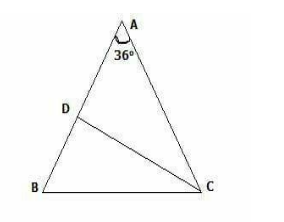
In a triangle ABC , AB = AC and $ \angle A = {36^o} $ . If the internal bisector of $ \angle C $ meets AB at point D, then:
AD = BC
AD = AC
AD = AB
AB = AC = BC
Answer
 Verified
546.3k+ views
Hint: In order to solve this question we will first use the property of an isosceles triangle to find the angles which are unknown to us then as stated in question the line AD bisects the $ \angle C $ so the half angle be calculated. Now the half angle is known to us as well as the angle $ \angle B $ is calculated so we can find out the angle at which the D is touching AB on triangle BCD.
Complete step by step solution:
For solving this question as it is given in question that $ \angle A = {36^o} $ and AB = AC so according to the property of an isosceles triangle the two angles will be equal so we will let it as:
$ \angle B = \angle C = {x^o} $
Now according to the property that the sum of all the angles of triangle is equal to $ {180^o} $
Now using this property we can write all the terms as:
$ \angle A + \angle B + \angle C = {180^o} $
As we already know that two angles are equal and the value of one angle is already known so we will write it as:
$ {36^o} + {x^o} + {x^o} = {180^o} $
Now on further this we will get:
$ 2{x^o} = {144^o} $
On further solving we will get the value of:
$ {x^o} = {72^o} $
So the values of angle B and C will be $ {72^o} $
The value of angle bisector of $ \angle C $ will be $ {36^o} $
Now as it is given in question that the line AD bisects the angle C and meets AB at D so we will bisects the angle C and find the value of $ \angle BCD $ so now in $ \Delta BCD $ :
So according to property of triangle:
$ \angle BCD + \angle B + \angle BDC = {180^o} $
Now putting all the known values and find the unknown:
$ {36^o} + {72^o} + \angle BDC = {180^o} $
Now substituting all the values to other side and finding the value of $ \angle BDC $ we will get:
$ \angle BDC = {72^o} $
So we observed that the values of angle $ \angle BDC = {72^o} $ and $ \angle B = {72^o} $ as these two are equal so it means it is an isosceles triangle so according to its property we can say that:
AD = BC
So, the correct answer is “Option A”.
Note: While solving these types of problems we have to keep in mind that we are going in correct way to solve this question because if we directly go to find which two lines are equal we will not able to find it without finding the angle C so first to solve that and then we so of finding the rest.
Complete step by step solution:
For solving this question as it is given in question that $ \angle A = {36^o} $ and AB = AC so according to the property of an isosceles triangle the two angles will be equal so we will let it as:
$ \angle B = \angle C = {x^o} $
Now according to the property that the sum of all the angles of triangle is equal to $ {180^o} $
Now using this property we can write all the terms as:
$ \angle A + \angle B + \angle C = {180^o} $
As we already know that two angles are equal and the value of one angle is already known so we will write it as:
$ {36^o} + {x^o} + {x^o} = {180^o} $
Now on further this we will get:
$ 2{x^o} = {144^o} $
On further solving we will get the value of:
$ {x^o} = {72^o} $
So the values of angle B and C will be $ {72^o} $
The value of angle bisector of $ \angle C $ will be $ {36^o} $
Now as it is given in question that the line AD bisects the angle C and meets AB at D so we will bisects the angle C and find the value of $ \angle BCD $ so now in $ \Delta BCD $ :
So according to property of triangle:
$ \angle BCD + \angle B + \angle BDC = {180^o} $
Now putting all the known values and find the unknown:
$ {36^o} + {72^o} + \angle BDC = {180^o} $
Now substituting all the values to other side and finding the value of $ \angle BDC $ we will get:
$ \angle BDC = {72^o} $
So we observed that the values of angle $ \angle BDC = {72^o} $ and $ \angle B = {72^o} $ as these two are equal so it means it is an isosceles triangle so according to its property we can say that:
AD = BC
So, the correct answer is “Option A”.
Note: While solving these types of problems we have to keep in mind that we are going in correct way to solve this question because if we directly go to find which two lines are equal we will not able to find it without finding the angle C so first to solve that and then we so of finding the rest.
Recently Updated Pages
Master Class 12 Business Studies: Engaging Questions & Answers for Success

Master Class 12 Biology: Engaging Questions & Answers for Success
Master Class 12 Chemistry: Engaging Questions & Answers for Success
Class 12 Question and Answer - Your Ultimate Solutions Guide
Master Class 11 Social Science: Engaging Questions & Answers for Success
Master Class 11 English: Engaging Questions & Answers for Success
Trending doubts
Find the sum of series 1 + 2 + 3 + 4 + 5 + + 100 class 9 maths CBSE
Fill the blanks with the suitable prepositions 1 The class 9 english CBSE
Difference Between Plant Cell and Animal Cell
How many hours before the closure of election must class 9 social science CBSE
What is pollution? How many types of pollution? Define it
What is the Full Form of ICSE / ISC ?