



In a triangle, ABC, a = 7, b = 5, c = 3. \[{{p}_{1}},{{p}_{2}},{{p}_{3}}\] are the altitudes from A, B, C. Then find the last digit of \[4{{\left( a{{p}_{1}}+b{{p}_{2}}+c{{p}_{3}} \right)}^{2}}\].
Answer
 Verified
610.8k+ views
Hint: First of all, find the area of the triangle by Heron’s formula that is \[\sqrt{s\left( s-a \right)\left( s-b \right)\left( s-c \right)}\]. Now, also find the value of the area of the triangle by \[\dfrac{1}{2}\] base \[\times \] height. Equate these two values to find the value of \[a{{p}_{1}},b{{p}_{2}}\] and \[c{{p}_{3}}\]. From this, find the required value of the given expression.
Complete step-by-step answer:
Here, we are given a triangle ABC in which a = 7, b = 5, c = 3 and \[{{p}_{1}},{{p}_{2}},{{p}_{3}}\] are the altitudes from A, B, and C. We have to find the last digit of \[4{{\left( a{{p}_{1}}+b{{p}_{2}}+c{{p}_{3}} \right)}^{2}}\]. Let us draw a triangle ABC with a = 7, b = 5 and c = 3.
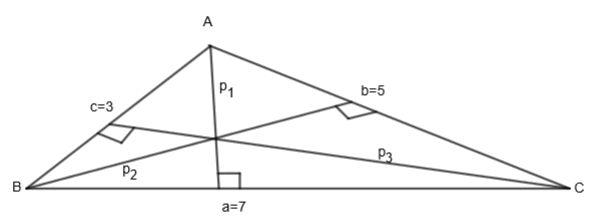
In the above triangle ABC, \[{{p}_{1}},{{p}_{2}},{{p}_{3}}\] are the altitudes from A, B, and C respectively. We know that by Heron’s formula, we get,
\[\text{Area of }\Delta =\sqrt{s\left( s-a \right)\left( s-b \right)\left( s-c \right)}\]
where a, b and c are the sides of the triangle and \[s=\dfrac{a+b+c}{2}\].
So, by substituting a = 7, b = 5, c = 3, we get,
\[s=\dfrac{7+5+3}{2}=\dfrac{15}{2}\]
So, we get the area of \[\Delta ABC\] as,
\[\text{Area of }\Delta ABC=\sqrt{\left( \dfrac{15}{2} \right)\left( \dfrac{15}{2}-7 \right)\left( \dfrac{15}{2}-5 \right)\left( \dfrac{15}{2}-3 \right)}\]
\[\text{Area of }\Delta ABC=\sqrt{\left( \dfrac{15}{2} \right)\left( \dfrac{1}{2} \right)\left( \dfrac{5}{2} \right)\left( \dfrac{9}{2} \right)}\]
\[\text{Area of }\Delta ABC=\sqrt{\dfrac{225\times 3}{16}}\]
\[\text{Area of }\Delta ABC=\dfrac{15\sqrt{3}}{4}sq.units.....\left( i \right)\]
Now, we also know that area of the triangle \[=\dfrac{1}{2}\times base\times height\].
So, from this, we get the area of the triangle \[=\dfrac{1}{2}{{p}_{1}}.BC=\dfrac{1}{2}{{p}_{2}}.AC=\dfrac{1}{2}{{p}_{3}}.AB\]
Area of \[\Delta ABC=\dfrac{1}{2}{{p}_{1}}a=\dfrac{1}{2}{{p}_{2}}b=\dfrac{1}{2}{{p}_{3}}c....\left( ii \right)\]
So, by equating the area of the triangle ABC from equation (i) and (ii), we get,
\[\dfrac{1}{2}a{{p}_{1}}=\dfrac{1}{2}b{{p}_{2}}=\dfrac{1}{2}c{{p}_{3}}=\dfrac{15\sqrt{3}}{4}\]
By multiplying 2 on both the sides of the above equation, we get,
\[a{{p}_{1}}=b{{p}_{2}}=c{{p}_{3}}=\dfrac{15\sqrt{3}}{4}.2\]
\[a{{p}_{1}}=b{{p}_{2}}=c{{p}_{3}}=\dfrac{15\sqrt{3}}{2}\]
So, we get,
\[a{{p}_{1}}+b{{p}_{2}}+c{{p}_{3}}=\dfrac{15\sqrt{3}}{2}+\dfrac{15\sqrt{3}}{2}+\dfrac{15\sqrt{3}}{2}\]
\[a{{p}_{1}}+b{{p}_{2}}+c{{p}_{3}}=3\times \dfrac{15\sqrt{3}}{2}\]
\[a{{p}_{1}}+b{{p}_{2}}+c{{p}_{3}}=\dfrac{45\sqrt{3}}{2}\]
By squaring both the sides of the above equation, we get,
\[{{\left( a{{p}_{1}}+b{{p}_{2}}+c{{p}_{3}} \right)}^{2}}={{\left( \dfrac{45\sqrt{3}}{2} \right)}^{2}}\]
\[{{\left( a{{p}_{1}}+b{{p}_{2}}+c{{p}_{3}} \right)}^{2}}={{\left( 45 \right)}^{2}}.\dfrac{3}{4}\]
By multiplying 4 on both the sides of the above equation, we get,
\[4{{\left( a{{p}_{1}}+b{{p}_{2}}+c{{p}_{3}} \right)}^{2}}=6075\]
So, we get the last digit of expression \[4{{\left( a{{p}_{1}}+b{{p}_{2}}+c{{p}_{3}} \right)}^{2}}\] as 5.
Note: In these types of questions, students must draw the diagram to visualize the question. Students must note that in a triangle, any sides can be taken as the base of the triangle but only the corresponding height should be taken to calculate the area of the triangle. Also, students must remember the various formulas for finding the area of the triangle as they are very useful in geometry while solving the questions related to the triangle.
Complete step-by-step answer:
Here, we are given a triangle ABC in which a = 7, b = 5, c = 3 and \[{{p}_{1}},{{p}_{2}},{{p}_{3}}\] are the altitudes from A, B, and C. We have to find the last digit of \[4{{\left( a{{p}_{1}}+b{{p}_{2}}+c{{p}_{3}} \right)}^{2}}\]. Let us draw a triangle ABC with a = 7, b = 5 and c = 3.
In the above triangle ABC, \[{{p}_{1}},{{p}_{2}},{{p}_{3}}\] are the altitudes from A, B, and C respectively. We know that by Heron’s formula, we get,
\[\text{Area of }\Delta =\sqrt{s\left( s-a \right)\left( s-b \right)\left( s-c \right)}\]
where a, b and c are the sides of the triangle and \[s=\dfrac{a+b+c}{2}\].
So, by substituting a = 7, b = 5, c = 3, we get,
\[s=\dfrac{7+5+3}{2}=\dfrac{15}{2}\]
So, we get the area of \[\Delta ABC\] as,
\[\text{Area of }\Delta ABC=\sqrt{\left( \dfrac{15}{2} \right)\left( \dfrac{15}{2}-7 \right)\left( \dfrac{15}{2}-5 \right)\left( \dfrac{15}{2}-3 \right)}\]
\[\text{Area of }\Delta ABC=\sqrt{\left( \dfrac{15}{2} \right)\left( \dfrac{1}{2} \right)\left( \dfrac{5}{2} \right)\left( \dfrac{9}{2} \right)}\]
\[\text{Area of }\Delta ABC=\sqrt{\dfrac{225\times 3}{16}}\]
\[\text{Area of }\Delta ABC=\dfrac{15\sqrt{3}}{4}sq.units.....\left( i \right)\]
Now, we also know that area of the triangle \[=\dfrac{1}{2}\times base\times height\].
So, from this, we get the area of the triangle \[=\dfrac{1}{2}{{p}_{1}}.BC=\dfrac{1}{2}{{p}_{2}}.AC=\dfrac{1}{2}{{p}_{3}}.AB\]
Area of \[\Delta ABC=\dfrac{1}{2}{{p}_{1}}a=\dfrac{1}{2}{{p}_{2}}b=\dfrac{1}{2}{{p}_{3}}c....\left( ii \right)\]
So, by equating the area of the triangle ABC from equation (i) and (ii), we get,
\[\dfrac{1}{2}a{{p}_{1}}=\dfrac{1}{2}b{{p}_{2}}=\dfrac{1}{2}c{{p}_{3}}=\dfrac{15\sqrt{3}}{4}\]
By multiplying 2 on both the sides of the above equation, we get,
\[a{{p}_{1}}=b{{p}_{2}}=c{{p}_{3}}=\dfrac{15\sqrt{3}}{4}.2\]
\[a{{p}_{1}}=b{{p}_{2}}=c{{p}_{3}}=\dfrac{15\sqrt{3}}{2}\]
So, we get,
\[a{{p}_{1}}+b{{p}_{2}}+c{{p}_{3}}=\dfrac{15\sqrt{3}}{2}+\dfrac{15\sqrt{3}}{2}+\dfrac{15\sqrt{3}}{2}\]
\[a{{p}_{1}}+b{{p}_{2}}+c{{p}_{3}}=3\times \dfrac{15\sqrt{3}}{2}\]
\[a{{p}_{1}}+b{{p}_{2}}+c{{p}_{3}}=\dfrac{45\sqrt{3}}{2}\]
By squaring both the sides of the above equation, we get,
\[{{\left( a{{p}_{1}}+b{{p}_{2}}+c{{p}_{3}} \right)}^{2}}={{\left( \dfrac{45\sqrt{3}}{2} \right)}^{2}}\]
\[{{\left( a{{p}_{1}}+b{{p}_{2}}+c{{p}_{3}} \right)}^{2}}={{\left( 45 \right)}^{2}}.\dfrac{3}{4}\]
By multiplying 4 on both the sides of the above equation, we get,
\[4{{\left( a{{p}_{1}}+b{{p}_{2}}+c{{p}_{3}} \right)}^{2}}=6075\]
So, we get the last digit of expression \[4{{\left( a{{p}_{1}}+b{{p}_{2}}+c{{p}_{3}} \right)}^{2}}\] as 5.
Note: In these types of questions, students must draw the diagram to visualize the question. Students must note that in a triangle, any sides can be taken as the base of the triangle but only the corresponding height should be taken to calculate the area of the triangle. Also, students must remember the various formulas for finding the area of the triangle as they are very useful in geometry while solving the questions related to the triangle.
Recently Updated Pages
Master Class 9 General Knowledge: Engaging Questions & Answers for Success

Master Class 9 Social Science: Engaging Questions & Answers for Success
Master Class 9 English: Engaging Questions & Answers for Success
Master Class 9 Maths: Engaging Questions & Answers for Success
Master Class 9 Science: Engaging Questions & Answers for Success
Class 9 Question and Answer - Your Ultimate Solutions Guide
Trending doubts
Find the mode and median of the data 13 16 12 14 1-class-9-maths-CBSE
What were the main changes brought about by the Bolsheviks class 9 social science CBSE
What is the theme or message of the poem The road not class 9 english CBSE
What are the major achievements of the UNO class 9 social science CBSE
Explain the importance of pH in everyday life class 9 chemistry CBSE
Differentiate between parenchyma collenchyma and sclerenchyma class 9 biology CBSE