




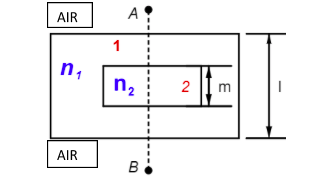
In a thick glass slab of thickness $I$, and refractive index ${n_1}$, a cuboidal cavity of thickness $m$ as curved as shown in Fig and is filled with a liquid of refractive index \[{n_2}\left( {{n_1} > {n_2}} \right)\]. The ratio $\dfrac{l}{m}$, so that shift produced by this slab is zero when an observer A observes B with paraxial rays is:
A) \[\dfrac{{{n_1} - {n_2}}}{{{n_2} - {n_1}}}\]
B) \[\dfrac{{{n_1} - {n_2}}}{{{n_2}({n_1} - 1)}}\]
C) \[\dfrac{{{n_1} - {n_2}}}{{({n_1} - 1)}}\]
D) \[\dfrac{{{n_1} - {n_2}}}{{{n_1}({n_2} - 1)}}\]
Answer
 Verified
628.5k+ views
Hint:For this problem, we have to calculate shifts differently for the liquid in the cavity and the glass slab the refractive index(R.I) and the thickness are different.The total shift is given zero.
Formula used:
Shift due to cavity, \[{x_1} = m(1 - \dfrac{1}{{{n_2}}})\]where $m$= depth of cavity and ${n_2}$= R.I of the liquid inside the cavity.
Shift due to the glass slab, \[{x_2} = (l - m)(1 - \dfrac{1}{{{n_1}}})\]where = the thickness of the glass slab and ${n_1}$= R.I of the liquid inside the glass slab.
Total shift, \[{x_1} + {x_2} = 0\]
Complete step by step answer:
The refractive index of an object =$\dfrac{{{\text{original depth of the object from the separation plane}}}}{{{\text{relative depth of the object}}}}$
Therefore refractive index, \[n = \dfrac{d}{{d'}}\]
Where $d$= original depth of the object from separation plane
$d'$= relative depth of the object from the separation plane
Now, as there is a concept of original depth and relative depth then there must be a virtual shift happening according to the observer.
This shift is defined by, \[shift = depth(1 - \dfrac{1}{{R.I}})\].
Therefore, Shift due to cavity, \[{x_1} = m(1 - \dfrac{1}{{{n_2}}})\]
where $m$= thickness of cavity and ${n_2}$= R.I of the liquid inside the cavity.
Shift due to the glass slab, \[{x_2} = (l - m)(1 - \dfrac{1}{{{n_1}}})\]
where $I$ = the thickness of the glass slab and ${n_1}$= R.I of the liquid inside the glass slab.
Given that total shift is zero i.e. \[{x_1} + {x_2} = 0\]
So,
\[m(1 - \dfrac{1}{{{n_2}}}) + (l - m)(1 - \dfrac{1}{{{n_1}}}) = 0\]
\[ \Rightarrow m - \dfrac{m}{{{n_2}}} + (l - m) - \dfrac{{(l - m)}}{{{n_1}}} = 0\]
\[ \Rightarrow m - \dfrac{m}{{{n_2}}} + l - m - \dfrac{l}{{{n_1}}} + \dfrac{m}{{{n_1}}} = 0\]
\[ \Rightarrow l(1 - \dfrac{1}{{{n_1}}}) - m(\dfrac{1}{{{n_2}}} - \dfrac{1}{{{n_1}}}) = 0\]
\[ \Rightarrow l(1 - \dfrac{1}{{{n_1}}}) = m(\dfrac{1}{{{n_2}}} - \dfrac{1}{{{n_1}}})\]
\[ \Rightarrow l(\dfrac{{{n_1} - 1}}{{{n_1}}}) = m(\dfrac{{{n_1} - {n_2}}}{{{n_1}{n_2}}})\]
\[ \Rightarrow l({n_1} - 1) = m(\dfrac{{{n_1} - {n_2}}}{{{n_2}}})\]
The ratio, \[\dfrac{l}{m} = [\dfrac{{{n_1} - {n_2}}}{{{n_2}({n_1} - 1)}}]\].
\[ \Rightarrow \dfrac{l}{m} = [\dfrac{{{n_1} - {n_2}}}{{{n_2}({n_1} - 1)}}]\]
Hence, option (B) is the correct one.
Notes:When the object is in a denser medium and the observer is in a rarer medium, the refracted ray diverges from the normal of the plane. In this condition, the object seems raised from the separation plane.
When the object is in a rarer medium and the observer is in a denser medium, the refracted ray comes close to the normal of the plane. In this condition, the object seems to have gone far from the separation plane.
Formula used:
Shift due to cavity, \[{x_1} = m(1 - \dfrac{1}{{{n_2}}})\]where $m$= depth of cavity and ${n_2}$= R.I of the liquid inside the cavity.
Shift due to the glass slab, \[{x_2} = (l - m)(1 - \dfrac{1}{{{n_1}}})\]where = the thickness of the glass slab and ${n_1}$= R.I of the liquid inside the glass slab.
Total shift, \[{x_1} + {x_2} = 0\]
Complete step by step answer:
The refractive index of an object =$\dfrac{{{\text{original depth of the object from the separation plane}}}}{{{\text{relative depth of the object}}}}$
Therefore refractive index, \[n = \dfrac{d}{{d'}}\]
Where $d$= original depth of the object from separation plane
$d'$= relative depth of the object from the separation plane
Now, as there is a concept of original depth and relative depth then there must be a virtual shift happening according to the observer.
This shift is defined by, \[shift = depth(1 - \dfrac{1}{{R.I}})\].
Therefore, Shift due to cavity, \[{x_1} = m(1 - \dfrac{1}{{{n_2}}})\]
where $m$= thickness of cavity and ${n_2}$= R.I of the liquid inside the cavity.
Shift due to the glass slab, \[{x_2} = (l - m)(1 - \dfrac{1}{{{n_1}}})\]
where $I$ = the thickness of the glass slab and ${n_1}$= R.I of the liquid inside the glass slab.
Given that total shift is zero i.e. \[{x_1} + {x_2} = 0\]
So,
\[m(1 - \dfrac{1}{{{n_2}}}) + (l - m)(1 - \dfrac{1}{{{n_1}}}) = 0\]
\[ \Rightarrow m - \dfrac{m}{{{n_2}}} + (l - m) - \dfrac{{(l - m)}}{{{n_1}}} = 0\]
\[ \Rightarrow m - \dfrac{m}{{{n_2}}} + l - m - \dfrac{l}{{{n_1}}} + \dfrac{m}{{{n_1}}} = 0\]
\[ \Rightarrow l(1 - \dfrac{1}{{{n_1}}}) - m(\dfrac{1}{{{n_2}}} - \dfrac{1}{{{n_1}}}) = 0\]
\[ \Rightarrow l(1 - \dfrac{1}{{{n_1}}}) = m(\dfrac{1}{{{n_2}}} - \dfrac{1}{{{n_1}}})\]
\[ \Rightarrow l(\dfrac{{{n_1} - 1}}{{{n_1}}}) = m(\dfrac{{{n_1} - {n_2}}}{{{n_1}{n_2}}})\]
\[ \Rightarrow l({n_1} - 1) = m(\dfrac{{{n_1} - {n_2}}}{{{n_2}}})\]
The ratio, \[\dfrac{l}{m} = [\dfrac{{{n_1} - {n_2}}}{{{n_2}({n_1} - 1)}}]\].
\[ \Rightarrow \dfrac{l}{m} = [\dfrac{{{n_1} - {n_2}}}{{{n_2}({n_1} - 1)}}]\]
Hence, option (B) is the correct one.
Notes:When the object is in a denser medium and the observer is in a rarer medium, the refracted ray diverges from the normal of the plane. In this condition, the object seems raised from the separation plane.
When the object is in a rarer medium and the observer is in a denser medium, the refracted ray comes close to the normal of the plane. In this condition, the object seems to have gone far from the separation plane.
Recently Updated Pages
Master Class 11 English: Engaging Questions & Answers for Success

Master Class 11 Social Science: Engaging Questions & Answers for Success
Master Class 11 Maths: Engaging Questions & Answers for Success
Master Class 11 Biology: Engaging Questions & Answers for Success
Master Class 11 Physics: Engaging Questions & Answers for Success
Master Class 11 Chemistry: Engaging Questions & Answers for Success
Trending doubts
What is cell theory Who formulated it class 11 biology CBSE
Phyllotaxy is the arrangement of ALeaflets BLeaves class 11 biology CBSE
The symbiotic association of fungi and algae is called class 11 biology CBSE
Cell theory was formulated by A Schleiden and Schwann class 11 biology CBSE
Find the value of the expression given below sin 30circ class 11 maths CBSE
Are pea seeds an example of non albuminous seeds class 11 biology CBSE