




In a survey of brand preference for toothpaste, 82 of the population (number of people covered for the survey is 100) liked at least one of the brands: I, II, and III. 40 of those liked brand I, 25 liked brand II and 35 liked brand III. If 8 of those asked showed a liking for all the three brands, then what percentage of those liked more than one of the three brands?
A. 13
B. 10
C. 8
D. 5
Answer
 Verified
608.4k+ views
Hint: We solve this problem simply by using the set theory and its properties. Assume the variables representing the number of people who like different kinds of brands. Solve them to get the exact count of people who like more than one of the three brands. To count the number of people who like at least two of the three brands, one should count the total number of people like one, two, or three brands and all of the three brands. Then subtract the number of people who like all of the three brands twice as the intersection of two brands includes it.
Complete step by step answer:
Let us assume the number of populations like any two brands is $x$.
We will solve this by creating a Venn diagram and using variables to represent the number of people who like different brands.
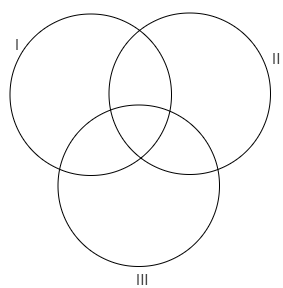
We are given 82 like at least one of the three brands, so we can write
$ \Rightarrow n\left( {I \cup II \cup III} \right) = 82$
We are given 40 like the brand I, so we can write
$ \Rightarrow n\left( I \right) = 40$
We are given 25 like brand II, so we can write
$ \Rightarrow n\left( {II} \right) = 25$
We are given 35 like brand III, so we can write
$ \Rightarrow n\left( {III} \right) = 35$
We are given 8 like all of three brands, so we can write
$ \Rightarrow n\left( {I \cap II \cap III} \right) = 8$
The general formula of the union of 3 sets is,
$n\left( {A \cup B \cup C} \right) = n\left( A \right) + n\left( B \right) + n\left( C \right) - n\left( {A \cap B} \right) - n\left( {B \cap C} \right) - n\left( {C \cap A} \right) + n\left( {A \cap B \cap C} \right)$
Substitute the values in the above equation,
$ \Rightarrow 82 = 40 + 25 + 35 - x + 8$
Simplify the terms,
$ \Rightarrow 82 = 108 - x$
Move constant terms on one side,
$ \Rightarrow x = 108 - 82$
Subtract the values on the right side,
$ \Rightarrow x = 26$
As it contains 3 times the population who like all of the three brands. So subtract 2 times to get the exact value,
$ \Rightarrow n\left( {A \cap B} \right) + n\left( {B \cap C} \right) + n\left( {C \cap A} \right) - 2n\left( {A \cap B \cap C} \right) = 26 - 2 \times 8$
Simplify the terms,
$\therefore n\left( {A \cap B} \right) + n\left( {B \cap C} \right) + n\left( {C \cap A} \right) - 2n\left( {A \cap B \cap C} \right) = 10$
Thus, 10% of the population like more than one brand.
Hence, option (B) is the correct answer.
Note: It’s necessary to draw Venn diagrams to write equations to solve this question. Otherwise, we won’t be able to get the correct answer. One needs to understand how the number of people liked different brands of toothpaste.
Complete step by step answer:
Let us assume the number of populations like any two brands is $x$.
We will solve this by creating a Venn diagram and using variables to represent the number of people who like different brands.
We are given 82 like at least one of the three brands, so we can write
$ \Rightarrow n\left( {I \cup II \cup III} \right) = 82$
We are given 40 like the brand I, so we can write
$ \Rightarrow n\left( I \right) = 40$
We are given 25 like brand II, so we can write
$ \Rightarrow n\left( {II} \right) = 25$
We are given 35 like brand III, so we can write
$ \Rightarrow n\left( {III} \right) = 35$
We are given 8 like all of three brands, so we can write
$ \Rightarrow n\left( {I \cap II \cap III} \right) = 8$
The general formula of the union of 3 sets is,
$n\left( {A \cup B \cup C} \right) = n\left( A \right) + n\left( B \right) + n\left( C \right) - n\left( {A \cap B} \right) - n\left( {B \cap C} \right) - n\left( {C \cap A} \right) + n\left( {A \cap B \cap C} \right)$
Substitute the values in the above equation,
$ \Rightarrow 82 = 40 + 25 + 35 - x + 8$
Simplify the terms,
$ \Rightarrow 82 = 108 - x$
Move constant terms on one side,
$ \Rightarrow x = 108 - 82$
Subtract the values on the right side,
$ \Rightarrow x = 26$
As it contains 3 times the population who like all of the three brands. So subtract 2 times to get the exact value,
$ \Rightarrow n\left( {A \cap B} \right) + n\left( {B \cap C} \right) + n\left( {C \cap A} \right) - 2n\left( {A \cap B \cap C} \right) = 26 - 2 \times 8$
Simplify the terms,
$\therefore n\left( {A \cap B} \right) + n\left( {B \cap C} \right) + n\left( {C \cap A} \right) - 2n\left( {A \cap B \cap C} \right) = 10$
Thus, 10% of the population like more than one brand.
Hence, option (B) is the correct answer.
Note: It’s necessary to draw Venn diagrams to write equations to solve this question. Otherwise, we won’t be able to get the correct answer. One needs to understand how the number of people liked different brands of toothpaste.
Recently Updated Pages
Master Class 11 English: Engaging Questions & Answers for Success

Master Class 11 Social Science: Engaging Questions & Answers for Success
Master Class 11 Maths: Engaging Questions & Answers for Success
Master Class 11 Biology: Engaging Questions & Answers for Success
Master Class 11 Physics: Engaging Questions & Answers for Success
Master Class 11 Chemistry: Engaging Questions & Answers for Success
Trending doubts
One Metric ton is equal to kg A 10000 B 1000 C 100 class 11 physics CBSE
Difference Between Prokaryotic Cells and Eukaryotic Cells
Find the value of the expression given below sin 30circ class 11 maths CBSE
Difference between physical and chemical change class 11 chemistry CBSE
Two of the body parts which do not appear in MRI are class 11 biology CBSE
Draw a diagram of a plant cell and label at least eight class 11 biology CBSE