




In a survey, 50 people like product A, 30 people like product B, and 20 people like product C and 35 people like exactly two products, if 5 people like all the three products then the number of people who do not like any product ? As there are 100 people in the survey.
A. 10
B. 45
C. 70
D. 20
Answer
 Verified
584.7k+ views
Hint: We will find the number of people in the group and make a rough figure to understand what is given and then find the values accordingly.
Complete answer:
In a survey, 50 people like the product A, 30 people like the product B, and 20 people like product C and 35 people like exactly two products and 5 people like all the three products.
We will draw a venn diagram here,
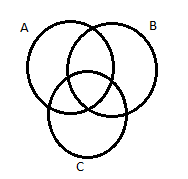
To find the number of people who do not like any product we have to find the number of people who like at least one product and then subtract the obtained value from the total number of people in survey that is 100.
The number of people who like at least one product are $n\left( {A \cup B \cup C} \right)$ .
Now, we will apply the formula of $n\left( {A \cup B \cup C} \right)$ which is,
$n\left( {A \cup B \cup C} \right) = n\left( A \right) + n\left( B \right) + n\left( C \right) - \left[ {n\left( {A \cap B} \right) + n\left( {B \cap C} \right) + n\left( {A \cap C} \right)} \right] + n\left( {A \cap B \cap C} \right)$
As we have given ,
$n\left( A \right) = 50$, $n\left( B \right) = 30$, $n\left( C \right) = 20$, $n\left( {A \cap B \cap C} \right) = 5$.
Now, we substitute the values of all these in the formula of $n\left( {A \cup B \cup C} \right)$.
$
n\left( {A \cup B \cup C} \right) = 50 + 30 + 20 - \left[ {n\left( {A \cap B} \right) + n\left( {B \cap C} \right) + n\left( {A \cap C} \right)} \right] + 5 \\
n\left( {A \cup B \cup C} \right) = 105 - \left[ {n\left( {A \cap B} \right) + n\left( {B \cap C} \right) + n\left( {A \cap C} \right)} \right]{\text{ }} \to \left( 1 \right) \\
$
As we have also given that 35 people like exactly two products
Then, people who like exactly two products \[ = n\left( {A \cap B} \right) + n\left( {B \cap C} \right) + n\left( {A \cap C} \right) - 3\left[ {n\left( {A \cap B \cap C} \right)} \right]\]
We have subtracted \[3\left[ {n\left( {A \cap B \cap C} \right)} \right]\]from \[n\left( {A \cap B} \right) + n\left( {B \cap C} \right) + n\left( {A \cap C} \right)\]because \[n\left( {A \cap B \cap C} \right)\]are the people who like all the three products and we have to find here the people who like exactly two products.
$
35 = n\left( {A \cap B} \right) + n\left( {B \cap C} \right) + n\left( {A \cap C} \right) - 3\left( 5 \right) \\
50 = n\left( {A \cap B} \right) + n\left( {B \cap C} \right) + n\left( {A \cap C} \right){\text{ }} \to \left( 2 \right) \\
$
Now, we will put the value of equation (2) in equation (1), then we will get,
\[
n\left( {A \cap B \cap C} \right) = 105 - 50 \\
n\left( {A \cap B \cap C} \right) = 55 \\
\]
So, the number of people who like at least one product are 55.
Now, we will subtract the value of the people who like at least one product from the total people to get the required value.
Required value$ = 100 - 55 = 45$.
So, there are 45 people who do not like any product.
So, option B is the correct answer.
Note: Here $P\left( {A \cup B} \right)$ does not represent total number of students but represents the total number of students who take at least one subject out of two subjects. So we found $P\left( {A \cup B} \right)$ first and then subtract it from 30 to get the required value.
Complete answer:
In a survey, 50 people like the product A, 30 people like the product B, and 20 people like product C and 35 people like exactly two products and 5 people like all the three products.
We will draw a venn diagram here,
To find the number of people who do not like any product we have to find the number of people who like at least one product and then subtract the obtained value from the total number of people in survey that is 100.
The number of people who like at least one product are $n\left( {A \cup B \cup C} \right)$ .
Now, we will apply the formula of $n\left( {A \cup B \cup C} \right)$ which is,
$n\left( {A \cup B \cup C} \right) = n\left( A \right) + n\left( B \right) + n\left( C \right) - \left[ {n\left( {A \cap B} \right) + n\left( {B \cap C} \right) + n\left( {A \cap C} \right)} \right] + n\left( {A \cap B \cap C} \right)$
As we have given ,
$n\left( A \right) = 50$, $n\left( B \right) = 30$, $n\left( C \right) = 20$, $n\left( {A \cap B \cap C} \right) = 5$.
Now, we substitute the values of all these in the formula of $n\left( {A \cup B \cup C} \right)$.
$
n\left( {A \cup B \cup C} \right) = 50 + 30 + 20 - \left[ {n\left( {A \cap B} \right) + n\left( {B \cap C} \right) + n\left( {A \cap C} \right)} \right] + 5 \\
n\left( {A \cup B \cup C} \right) = 105 - \left[ {n\left( {A \cap B} \right) + n\left( {B \cap C} \right) + n\left( {A \cap C} \right)} \right]{\text{ }} \to \left( 1 \right) \\
$
As we have also given that 35 people like exactly two products
Then, people who like exactly two products \[ = n\left( {A \cap B} \right) + n\left( {B \cap C} \right) + n\left( {A \cap C} \right) - 3\left[ {n\left( {A \cap B \cap C} \right)} \right]\]
We have subtracted \[3\left[ {n\left( {A \cap B \cap C} \right)} \right]\]from \[n\left( {A \cap B} \right) + n\left( {B \cap C} \right) + n\left( {A \cap C} \right)\]because \[n\left( {A \cap B \cap C} \right)\]are the people who like all the three products and we have to find here the people who like exactly two products.
$
35 = n\left( {A \cap B} \right) + n\left( {B \cap C} \right) + n\left( {A \cap C} \right) - 3\left( 5 \right) \\
50 = n\left( {A \cap B} \right) + n\left( {B \cap C} \right) + n\left( {A \cap C} \right){\text{ }} \to \left( 2 \right) \\
$
Now, we will put the value of equation (2) in equation (1), then we will get,
\[
n\left( {A \cap B \cap C} \right) = 105 - 50 \\
n\left( {A \cap B \cap C} \right) = 55 \\
\]
So, the number of people who like at least one product are 55.
Now, we will subtract the value of the people who like at least one product from the total people to get the required value.
Required value$ = 100 - 55 = 45$.
So, there are 45 people who do not like any product.
So, option B is the correct answer.
Note: Here $P\left( {A \cup B} \right)$ does not represent total number of students but represents the total number of students who take at least one subject out of two subjects. So we found $P\left( {A \cup B} \right)$ first and then subtract it from 30 to get the required value.
Recently Updated Pages
Master Class 11 Computer Science: Engaging Questions & Answers for Success

Master Class 11 Business Studies: Engaging Questions & Answers for Success
Master Class 11 Economics: Engaging Questions & Answers for Success
Master Class 11 English: Engaging Questions & Answers for Success
Master Class 11 Maths: Engaging Questions & Answers for Success
Master Class 11 Biology: Engaging Questions & Answers for Success
Trending doubts
One Metric ton is equal to kg A 10000 B 1000 C 100 class 11 physics CBSE
There are 720 permutations of the digits 1 2 3 4 5 class 11 maths CBSE
Discuss the various forms of bacteria class 11 biology CBSE
Draw a diagram of a plant cell and label at least eight class 11 biology CBSE
State the laws of reflection of light
Explain zero factorial class 11 maths CBSE