




In a silicon diode, the reverse current increases from 10$\mu $A to 20$\mu $A when the reverse voltage changes from 2V to 4V. The reverse AC resistance of the diode is
A) $1 \times {10^5}\Omega $
B) $3 \times {10^5}\Omega $
C) $2 \times {10^5}\Omega $
D) $4 \times {10^5}\Omega $
Answer
 Verified
647.4k+ views
Hint: Diode, an electrical component that allows the flow of current in only one direction. In the circuit diagrams, a diode is represented by a triangle with a line across one vertex. A diode works on a function of holes and electrons and hence with the reverse biasing the depletion layer will increase. By finding a change in voltage and current we can easily find resistance as $V=IR$.
Complete step by step answer:
The following diagram shows a PN junction diode with a depletion layer connected in reverse bias.
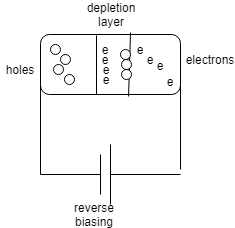
Reverse bias usually refers to how a diode is used in a circuit. If a diode is reverse biased, the voltage at the cathode is higher than that at the anode. Therefore, no current will flow until the electric field is so high that the diode breaks down.
The current here is known as drift current.
The voltage is changed from 4V to 2V
Change in voltage is $\Delta $V=4V-2V
We are also given the reverse current increases from 10$\mu $ A to 20$\mu $ A.
So change in current is $\Delta I$=20$\mu $ A.− 10$\mu $ A which is equal to 10$\mu $ A.
We know that $V=IR$
Putting values of $V$ and $I$, we will get
$R= 2 \times {10^5}\Omega $
Hence option C is correct.
Note:
A reverse-biased diode is said to be an open circuit. But when the diode is on, it acts as a short circuit. Ideally, the diode operates as an open nonlinear circuit with a fixed, constant voltage drop. This model is favored in the engineering field due to its simplicity. It is based on the concept that “forward conducting” has a minor fluctuating voltage drop from about 0.6-0.8 volts, with the assumption that the amount of voltage is constant at 0.7V.
Complete step by step answer:
The following diagram shows a PN junction diode with a depletion layer connected in reverse bias.
Reverse bias usually refers to how a diode is used in a circuit. If a diode is reverse biased, the voltage at the cathode is higher than that at the anode. Therefore, no current will flow until the electric field is so high that the diode breaks down.
The current here is known as drift current.
The voltage is changed from 4V to 2V
Change in voltage is $\Delta $V=4V-2V
We are also given the reverse current increases from 10$\mu $ A to 20$\mu $ A.
So change in current is $\Delta I$=20$\mu $ A.− 10$\mu $ A which is equal to 10$\mu $ A.
We know that $V=IR$
Putting values of $V$ and $I$, we will get
$R= 2 \times {10^5}\Omega $
Hence option C is correct.
Note:
A reverse-biased diode is said to be an open circuit. But when the diode is on, it acts as a short circuit. Ideally, the diode operates as an open nonlinear circuit with a fixed, constant voltage drop. This model is favored in the engineering field due to its simplicity. It is based on the concept that “forward conducting” has a minor fluctuating voltage drop from about 0.6-0.8 volts, with the assumption that the amount of voltage is constant at 0.7V.
Recently Updated Pages
Explain the structure of megasporangium class 12 biology CBSE

Why is chloroform kept in dark coloured bottles class 12 chemistry CBSE
Derive the balancing condition of a Wheatstone bri class 12 physics CBSE
Draw VI characteristics of a pn junction diode Explain class 12 physics CBSE
Is it possible to carry pride in ones language too class 12 english CBSE
In a population at Hardy Weinberg equilibrium the allele class 12 biology CBSE
Trending doubts
Draw a labelled sketch of the human eye class 12 physics CBSE
Which are the Top 10 Largest Countries of the World?
Draw ray diagrams each showing i myopic eye and ii class 12 physics CBSE
Which is the correct genotypic ratio of mendel dihybrid class 12 biology CBSE
Differentiate between homogeneous and heterogeneous class 12 chemistry CBSE
Which animal never drinks water in its entire life class 12 biology CBSE