




In a semiconductor, the forbidden energy gap between the valence band and the conduction band is of the order of
A. $1MeV$
B. $0.1MeV$
C. $1eV$
D. $5eV$
Answer
 Verified
585.9k+ views
Hint: A semiconductor is a material that has resistivity in between the resistivity of conductors and insulators. The resistivity of a semiconductor can be increased by an increase in temperature. It is known that the electrons are arranged in a circular pattern around the nucleus.
Complete step by step answer:
Step I:
Since the atoms are in a circular pattern, therefore they revolve in orbitals around the nucleus.These orbitals overlap with each other when the atoms are together. Since the orbitals inter mix, therefore there will be different energy levels called energy bands The band with the highest energy is called the valence band.
Step II:
The electrons always move from a higher energy state to a lower energy state. The electrons need some energy to jump from one energy band to another. But some electrons gain that energy even at room temperature and they leave the valence band.
Step III:
The electrons that leave the energy band at room temperature are called free electrons. Due to the movement of these free electrons, current flows in the conductor. So they are also called conduction electrons and the band is called conduction band.
Step IV:
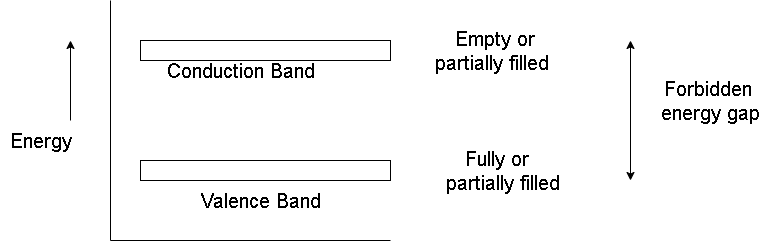
But not all the electrons gain enough energy to jump from conduction band to the valence band. Therefore some external energy is to be supplied so that they can move. This energy should be equal to the difference between the conduction band and valence band. For semiconductors, the energy supplied should be of the order of $1eV$.
Step V:
Therefore option C is the right answer.
Note: It is to be noted that the valence band will never be empty. It will either be completely filled or partially filled. On the other hand, the conduction band can be empty or it can be partially filled. The difference between the conduction band and valence band is known as the forbidden energy gap.
Complete step by step answer:
Step I:
Since the atoms are in a circular pattern, therefore they revolve in orbitals around the nucleus.These orbitals overlap with each other when the atoms are together. Since the orbitals inter mix, therefore there will be different energy levels called energy bands The band with the highest energy is called the valence band.
Step II:
The electrons always move from a higher energy state to a lower energy state. The electrons need some energy to jump from one energy band to another. But some electrons gain that energy even at room temperature and they leave the valence band.
Step III:
The electrons that leave the energy band at room temperature are called free electrons. Due to the movement of these free electrons, current flows in the conductor. So they are also called conduction electrons and the band is called conduction band.
Step IV:
But not all the electrons gain enough energy to jump from conduction band to the valence band. Therefore some external energy is to be supplied so that they can move. This energy should be equal to the difference between the conduction band and valence band. For semiconductors, the energy supplied should be of the order of $1eV$.
Step V:
Therefore option C is the right answer.
Note: It is to be noted that the valence band will never be empty. It will either be completely filled or partially filled. On the other hand, the conduction band can be empty or it can be partially filled. The difference between the conduction band and valence band is known as the forbidden energy gap.
Recently Updated Pages
Master Class 11 Computer Science: Engaging Questions & Answers for Success

Master Class 11 Business Studies: Engaging Questions & Answers for Success
Master Class 11 Economics: Engaging Questions & Answers for Success
Master Class 11 English: Engaging Questions & Answers for Success
Master Class 11 Maths: Engaging Questions & Answers for Success
Master Class 11 Biology: Engaging Questions & Answers for Success
Trending doubts
One Metric ton is equal to kg A 10000 B 1000 C 100 class 11 physics CBSE
There are 720 permutations of the digits 1 2 3 4 5 class 11 maths CBSE
Discuss the various forms of bacteria class 11 biology CBSE
Draw a diagram of a plant cell and label at least eight class 11 biology CBSE
State the laws of reflection of light
Explain zero factorial class 11 maths CBSE