




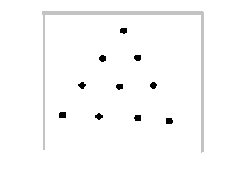
In a school, a plantation programme was arranged on the occasion of ‘world environment day’, on a ground of triangular shape. The trees are to be planted as shown in the figure.
One plant in the first row, two in the second row, three in the third row and so on. If there are 25 rows then find the total number of plants.
A.320
B.322
C.325
D.330
Answer
 Verified
643.2k+ views
Hint – In this type of question, the first thing that you should do is to write down the formula for finding the sum of total plants. This type of question comes under in arithmetic progression, and sum of progression is ${s_n} = \dfrac{n}{2}\left[ {2a + \left( {n - 1} \right)d} \right]$; ${s_n}$ is sum of n terms, n is number of terms, a is first term and d is common difference between two successive term. Finally put the value in the formula to get the answer.
Complete step-by-step answer:
In this question, it is given that;
First term (a) =1
Number of terms (n) =25
Common difference (d) =1
Plants are to be planted in each row are as $123.....$
We know that,
${s_n} = \dfrac{n}{2}\left[ {2a + \left( {n - 1} \right)d} \right]$
Putting the value in above equation, we get;
\[{s_n} = \dfrac{{25}}{2}\left[ {2 \times 1\left( {25 - 1} \right)1} \right]\]
${s_{25}} = \dfrac{{25}}{2}\left[ {2 + 24 \times 1} \right]$
$
= \dfrac{{25}}{2}\left[ {2 + 24} \right] \\
= \dfrac{{25}}{2} \times 26 \\
= 25 \times 13 \\
$
${s_{25}} = 325$
Here, sum all plants in 25 rows is 325. So option C is correct.
Note – An arithmetic progression (AP) is a sequence of numbers in order in which the difference between two consecutive terms is a constant value, examples of AP in our regular life are roll numbers of students in a class etc. Another formula is ${T_n} = a + \left( {n - 1} \right)d$ , where ${T_n}$ is ${n^{th}}$ term, a= first term, d= common difference between two successive term. If we know the last term (L) then${s_n} = \dfrac{n}{2}\left[ {a + L} \right]$.
Complete step-by-step answer:
In this question, it is given that;
First term (a) =1
Number of terms (n) =25
Common difference (d) =1
Plants are to be planted in each row are as $123.....$
We know that,
${s_n} = \dfrac{n}{2}\left[ {2a + \left( {n - 1} \right)d} \right]$
Putting the value in above equation, we get;
\[{s_n} = \dfrac{{25}}{2}\left[ {2 \times 1\left( {25 - 1} \right)1} \right]\]
${s_{25}} = \dfrac{{25}}{2}\left[ {2 + 24 \times 1} \right]$
$
= \dfrac{{25}}{2}\left[ {2 + 24} \right] \\
= \dfrac{{25}}{2} \times 26 \\
= 25 \times 13 \\
$
${s_{25}} = 325$
Here, sum all plants in 25 rows is 325. So option C is correct.
Note – An arithmetic progression (AP) is a sequence of numbers in order in which the difference between two consecutive terms is a constant value, examples of AP in our regular life are roll numbers of students in a class etc. Another formula is ${T_n} = a + \left( {n - 1} \right)d$ , where ${T_n}$ is ${n^{th}}$ term, a= first term, d= common difference between two successive term. If we know the last term (L) then${s_n} = \dfrac{n}{2}\left[ {a + L} \right]$.
Recently Updated Pages
Master Class 11 English: Engaging Questions & Answers for Success

Master Class 11 Social Science: Engaging Questions & Answers for Success
Master Class 11 Maths: Engaging Questions & Answers for Success
Master Class 11 Biology: Engaging Questions & Answers for Success
Master Class 11 Physics: Engaging Questions & Answers for Success
Master Class 11 Chemistry: Engaging Questions & Answers for Success
Trending doubts
One Metric ton is equal to kg A 10000 B 1000 C 100 class 11 physics CBSE
Difference Between Prokaryotic Cells and Eukaryotic Cells
Find the value of the expression given below sin 30circ class 11 maths CBSE
Difference between physical and chemical change class 11 chemistry CBSE
Two of the body parts which do not appear in MRI are class 11 biology CBSE
Draw a diagram of a plant cell and label at least eight class 11 biology CBSE