




In a school, 50% of the students play cricket and 40% play football, if 10% of students play both the games, then what percent of students play neither cricket nor football?
A. 10%
B. 15%
C. 20%
D. 25%
Answer
 Verified
602.1k+ views
Hint: Consider n(C) as percent of students who play cricket, n(F) as percent of students who play football and \[n\left( C\cap F \right)\] represent both cricket and football players. Then, find the percent of students who plays both of them using formula \[n\left( C\cup F \right)=n\left( \text{C} \right)+n\left( F \right)-n\left( C\cap F \right)\] and then subtract it from 100%.
Complete step-by-step answer:
In the question, we are given a situation of a school, where 50% of the students play cricket and 40% play football while 10% play both the games. So, from the given data, we have to say that, what percent of students play neither cricket nor football.
So, let's take cricket as C and football as F. So, according to that, we suppose n(C) represent percent of students who plays cricket while n(F) represent percent of students who plays football and \[n\left( C\cap F \right)\] represents both cricket and football players.
So, we can write it as,
\[\begin{align}
& n\left( C \right)=50\% \\
& n\left( F \right)=40\% \\
& n\left( C\cap F \right)=10\% \\
\end{align}\]
So, we will find total number of students who plays at least one of the sports, let it be represented as \[n\left( C\cup F \right)\] which we will find using formula,
\[n\left( C\cup F \right)=n\left( \text{C} \right)+n\left( F \right)-n\left( C\cap F \right)\]
Hence, on substitution of the values of \[n\left( \text{C} \right),n\left( F \right)\text{ and }n\left( C\cap F \right)\] we get,
\[\begin{align}
& n\left( C\cup F \right)=50\%+40\%-10\% \\
& \Rightarrow n\left( C\cup F \right)=80\% \\
\end{align}\]
So, total 80% of the students play either in any of the two games.
Now, as we know that, there are a total 100% students, so, we can say remaining \[\left( 100\%-80\% \right)\Rightarrow 20\%\] students neither play any of the game.So, the correct option is C.
Note: Instead of using the formula, we can use a Venn diagram. Let's represent the cricket as C and football as F. So, one can represent it as,
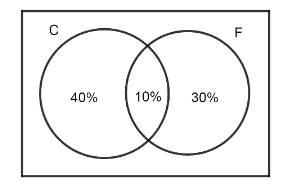
As the total box adds up to 100%, one can find the percent of students who neither play any of the sports by subtracting the total from 100%.
Complete step-by-step answer:
In the question, we are given a situation of a school, where 50% of the students play cricket and 40% play football while 10% play both the games. So, from the given data, we have to say that, what percent of students play neither cricket nor football.
So, let's take cricket as C and football as F. So, according to that, we suppose n(C) represent percent of students who plays cricket while n(F) represent percent of students who plays football and \[n\left( C\cap F \right)\] represents both cricket and football players.
So, we can write it as,
\[\begin{align}
& n\left( C \right)=50\% \\
& n\left( F \right)=40\% \\
& n\left( C\cap F \right)=10\% \\
\end{align}\]
So, we will find total number of students who plays at least one of the sports, let it be represented as \[n\left( C\cup F \right)\] which we will find using formula,
\[n\left( C\cup F \right)=n\left( \text{C} \right)+n\left( F \right)-n\left( C\cap F \right)\]
Hence, on substitution of the values of \[n\left( \text{C} \right),n\left( F \right)\text{ and }n\left( C\cap F \right)\] we get,
\[\begin{align}
& n\left( C\cup F \right)=50\%+40\%-10\% \\
& \Rightarrow n\left( C\cup F \right)=80\% \\
\end{align}\]
So, total 80% of the students play either in any of the two games.
Now, as we know that, there are a total 100% students, so, we can say remaining \[\left( 100\%-80\% \right)\Rightarrow 20\%\] students neither play any of the game.So, the correct option is C.
Note: Instead of using the formula, we can use a Venn diagram. Let's represent the cricket as C and football as F. So, one can represent it as,
As the total box adds up to 100%, one can find the percent of students who neither play any of the sports by subtracting the total from 100%.
Recently Updated Pages
Master Class 11 Social Science: Engaging Questions & Answers for Success

Master Class 11 Physics: Engaging Questions & Answers for Success
Master Class 11 Maths: Engaging Questions & Answers for Success
Master Class 11 Economics: Engaging Questions & Answers for Success
Master Class 11 Computer Science: Engaging Questions & Answers for Success
Master Class 11 Chemistry: Engaging Questions & Answers for Success
Trending doubts
One Metric ton is equal to kg A 10000 B 1000 C 100 class 11 physics CBSE
There are 720 permutations of the digits 1 2 3 4 5 class 11 maths CBSE
1 Quintal is equal to a 110 kg b 10 kg c 100kg d 1000 class 11 physics CBSE
State and prove Bernoullis theorem class 11 physics CBSE
Difference Between Prokaryotic Cells and Eukaryotic Cells
Which among the following are examples of coming together class 11 social science CBSE